
Chime Financial’s Next Chapter: Scaling Digital Banking, Product Expansion, and the Regulatory Integration Test
Chime Financial’s platform-first approach and payments-driven revenue model have delivered strong member growth and operational profitability, but a pending bank acquisition and the resulting regulatory shift introduce new complexity. The company’s ability to deepen primary relationships, extend into new financial products, and execute on integration will determine whether it can sustain its momentum against intensifying competition and regulatory scrutiny.
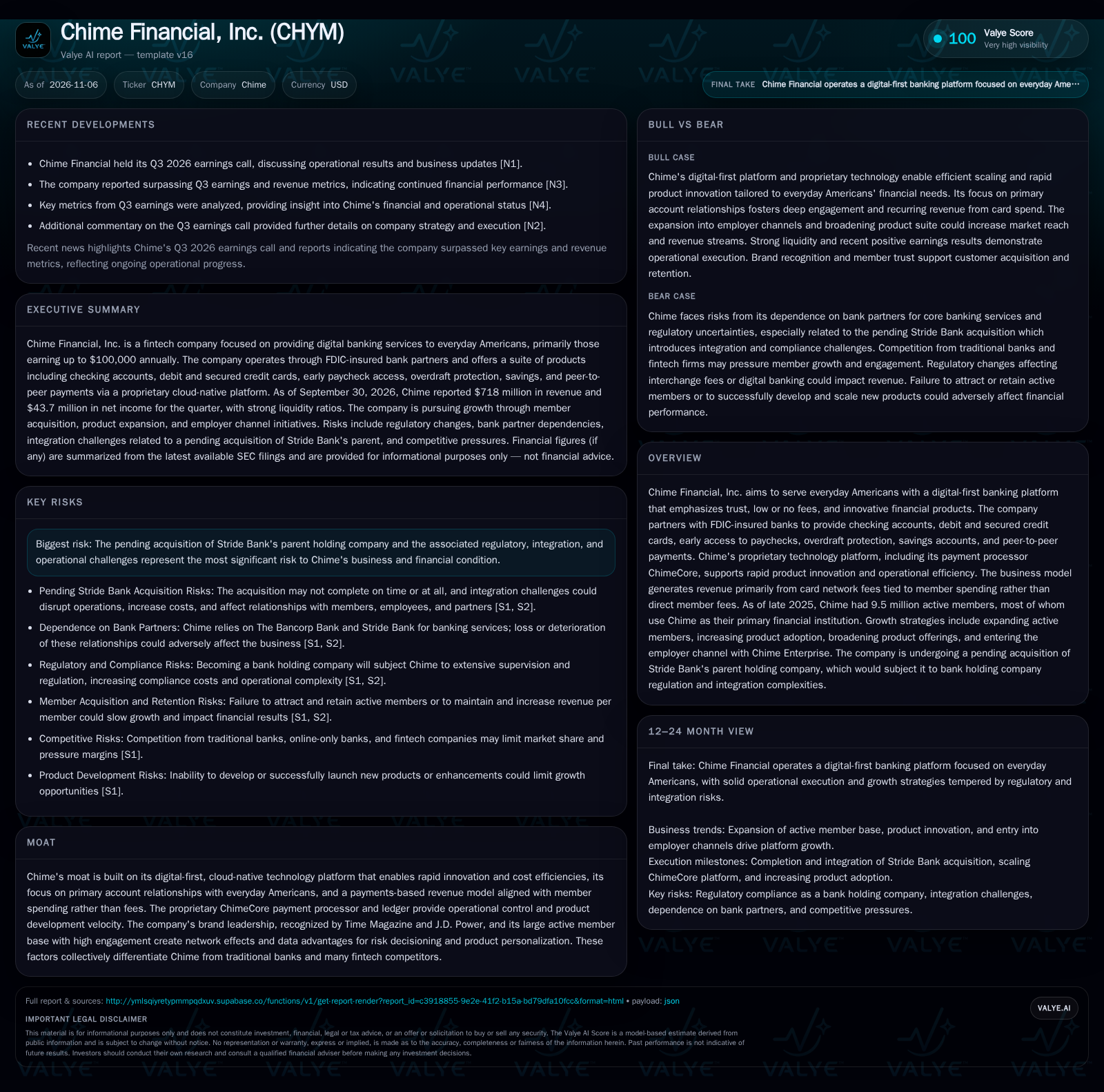
Chime Financial, Inc. reported Q3 2026 revenue of $718 million and net income of $43.7 million, with a liquidity position highlighted by $636.7 million in cash and a 4.8 current ratio. The company’s 9.5 million active members primarily use Chime as their main financial account, driving recurring card-spend-based fee revenue. Chime is pursuing new growth vectors—including unsecured credit, investing, insurance, and employer-channel expansion—while preparing to acquire Stride Bank’s parent company, a move that would transform its regulatory profile and risk landscape. The key question: Can Chime maintain growth and profitability as it transitions from fintech disruptor to regulated bank holding company? [S1] [S2]
Chime Financial, Inc. has carved out a prominent place among digital-first banking platforms targeting everyday Americans, leveraging a fee-avoidant, member-centric model and proprietary technology to scale rapidly. Its latest financials reveal both robust revenue and net income, underpinned by a large, engaged user base that primarily relies on Chime as their main bank. As Chime prepares to execute its most transformative move yet—the acquisition of Stride Bank’s parent holding company—its ability to navigate regulatory complexity, sustain member engagement, and successfully broaden its product suite will be pivotal in determining whether it can extend its growth trajectory or face the growing pains of a maturing fintech entering the regulated banking arena.
Recent Performance and Strategic Moves Shape Chime’s Risk-Reward Profile
Chime Financial reported Q3 2026 revenue of $718 million and net income of $43.7 million, while maintaining a substantial liquidity position with $636.7 million in cash, $2.005 billion in current assets, and a current ratio of 4.8 [S2]. This operational strength is buttressed by a sizable member base—9.5 million active users as of December 2025—with most members considering Chime their primary financial institution [S1]. The business is now at an inflection point, as it pursues the acquisition of Stride Bank’s parent holding company, a move that would transition Chime into a regulated bank holding company and introduce new compliance and integration risks [S1] [S2]. The combination of platform-driven growth, product expansion ambitions, and looming regulatory transformation defines the current strategic context for Chime.
How Chime’s Payments-Centric Model Drives Revenue and Margin Potential
Chime’s core economic engine is its ability to generate revenue from card network fees based on member spending, rather than charging members punitive fees or account charges [S1]. This structure aligns Chime’s interests with member engagement and transaction volume, creating recurring revenue streams as long as members use Chime as their primary spending account. The cost structure benefits from a cloud-native, proprietary platform (ChimeCore) that enables operational efficiency and rapid product innovation, likely lowering variable costs per account and supporting scalable fixed-cost leverage as the user base grows.
Chime’s economics are sensitive to card spend and member engagement; as long as members use their Chime cards for everyday transactions, interchange revenue is stable and growing. However, the company’s expansion into new products—such as unsecured credit cards, investing, and insurance—could introduce new revenue streams with different margin profiles. For example, unsecured lending typically carries higher risk and regulatory capital needs, but also offers the potential for higher yields. The move to become a bank holding company may require higher compliance and operational costs, partially offsetting technology-driven efficiencies. Chime’s capital needs may rise, especially if it expands into balance-sheet-based products or must hold regulatory capital post-acquisition.
Assessing Chime’s Defensibility Amid Fintech and Traditional Banking Rivals
Chime’s competitive edge has historically stemmed from its digital-only, low-fee model, fast product iteration, and a strong focus on building primary account relationships with mass-market consumers. Proprietary technology, notably the ChimeCore platform, provides a foundation for cost efficiency and rapid feature rollouts. The ability to capture recurring card spend from high-engagement users creates a data advantage for personalization and risk management.
However, the competitive landscape is intensifying. Large incumbent banks are investing heavily in digital experiences, while neobanks and fintechs continue to target similar customer segments with innovative features or niche verticals. Barriers to switching remain relatively low in digital banking, and regulatory changes could erode Chime’s interchange revenue advantage. The planned Stride acquisition may provide more control over banking infrastructure but will also expose Chime to the same regulatory scrutiny and cost base as traditional banks, potentially narrowing its cost and agility advantages. Ultimately, Chime’s long-term defensibility will hinge on its ability to deepen customer relationships, deliver differentiated products, and absorb the operational and regulatory burdens of becoming a bank holding company.
What Success Looks Like: Deeper Member Engagement and Product Breadth Fuel Profitable Scale
In a favorable scenario, Chime leverages its acquisition of Stride Bank’s parent to gain direct control over banking operations, accelerating product innovation and reducing partner dependency. The transition to a bank holding company is executed smoothly, with regulatory compliance integrated into the technology stack, limiting operational drag. Chime’s user base continues to expand, driven by effective marketing, word-of-mouth referrals, and new employer partnerships through Chime Enterprise.
The introduction of higher-margin products—such as unsecured credit cards, investing, and insurance—succeeds in increasing average revenue per member without materially increasing credit risk or operational costs. Chime maintains high engagement, with members using the platform for primary spending and savings, and cross-sells new offerings effectively. Confirmation of this scenario would include sustained double-digit growth in active members, rising revenue per user, successful product launches, and evidence of stable or improving profitability post-acquisition. Falsification would come from regulatory stumbles, slowing member growth, or margin compression from cost overruns or credit losses.
Sustaining Growth While Managing Regulatory and Integration Complexity
The most plausible trajectory is that Chime’s core payments-driven business continues to grow moderately, supported by steady member acquisition and engagement, but with some deceleration as competition increases and member acquisition costs rise. The Stride Bank parent acquisition closes, but integration is gradual and introduces higher compliance and operational expenses, offsetting some technology-driven efficiencies.
Chime’s new product rollouts (such as unsecured credit) generate incremental revenue but face typical adoption and risk-management challenges. The company maintains profitability, but net margin expansion is limited by increased regulatory costs and the need to invest in compliance, risk systems, and product development. Evidence for this scenario would be continued revenue and member growth in the single- to low-double-digit range, stable or slightly compressed margins, and successful but measured product launches. Falsifying evidence would include failure to close the Stride acquisition, a sharp drop in active member growth, or significant regulatory setbacks.
Where Things Could Go Wrong: Integration Drag, Regulatory Surprise, and Member Churn
In the adverse case, the Stride Bank parent acquisition is delayed, fails, or proves far more complex and costly than anticipated, leading to operational disruption and loss of strategic focus. Chime faces unexpected regulatory requirements—such as tighter restrictions on interchange fees, capital requirements, or consumer lending rules—that erode unit economics and require costly system overhauls.
Simultaneously, traditional banks and aggressive fintechs accelerate digital product innovation, eroding Chime’s customer acquisition and retention advantages. Member churn rises, engagement falls, and recurring card spend declines, causing revenue growth to stall or reverse. New product launches underperform, either due to regulatory delays, credit losses, or insufficient member adoption. Confirmation would come from missed revenue or profitability targets, a spike in operational or regulatory expenses, or evidence of member attrition and declining transaction volumes.
Milestones and Metrics That Will Reveal Whether Chime Extends Its Fintech Lead or Hits Regulatory Headwinds
Active member growth: Quarterly disclosure of active member count and new member acquisition rates, especially after the Stride Bank parent acquisition closes, would help test the sustainability of Chime’s growth engine.
Primary account status: If disclosed, the percentage of members using Chime as their primary bank account would indicate engagement depth and predict recurring revenue resilience.
Card spend per active member: Trends in average card spend per user are crucial for gauging underlying revenue drivers and engagement.
Revenue per active member: This metric, if provided, would clarify the impact of cross-selling new products and shifting product mix on unit economics.
Acquisition and integration progress: Updates on the timeline, regulatory approvals, and operational milestones related to the Stride Bank parent acquisition will be critical for assessing execution risk.
Regulatory capital and compliance costs: If disclosed, changes in compliance and capital requirements post-acquisition will signal the scale of regulatory drag on margins.
Product adoption rates: Uptake of new offerings—such as unsecured credit, investing, or insurance—will reveal whether Chime can successfully expand its wallet share.
Member retention and churn: Quarterly cohort retention or churn data, if disclosed, would provide early warning of engagement or competitive pressures.
Disclaimer: This is research-only, informational analysis and not investment advice. It may include AI-generated interpretation and general industry context. Always verify important details using primary sources.

Comments