
Simpson Manufacturing: Structural Product Leader Navigates Margin Pressures and Expansion Ambitions
Simpson Manufacturing, a dominant force in wood and concrete structural solutions, grows sales and operating income despite cost inflation and tariff headwinds. The company’s investments in automation, footprint expansion, and digital tools point to a strategic effort to reinforce its market position and product innovation, but margin compression and construction-cycle sensitivity remain central challenges.
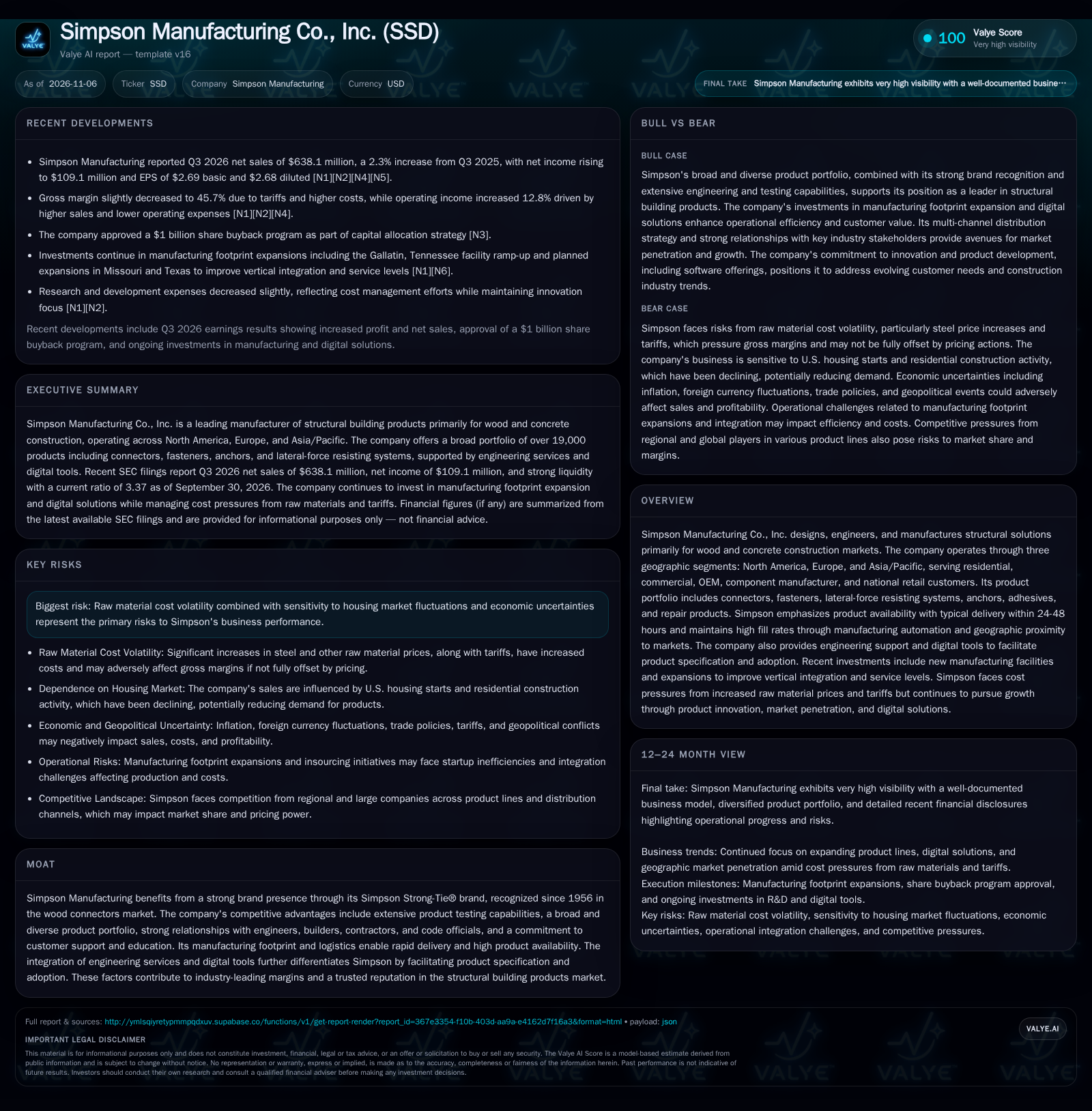
Simpson Manufacturing posted higher Q3 2026 sales and operating income, but margins slipped due to steel cost inflation and tariffs. The company is ramping new U.S. manufacturing facilities and expanding in Missouri and Texas to bolster vertical integration and service. With a strong brand, broad product portfolio, and deep engineering ties, Simpson aims to defend its leadership in structural connectors and fasteners. However, cost volatility and cyclicality of construction markets could test its ability to sustain profit growth.
Simpson Manufacturing stands at a pivotal juncture as it juggles persistent margin pressure with ambitions for operational scale and market reach. In Q3 2026, the company grew both sales and operating income, even as gross margins slipped under the weight of a 50% surge in steel prices and tariff headwinds. By investing in U.S.-based manufacturing and expanding its digital and engineering support, Simpson is doubling down on product availability, rapid delivery, and specification-driven demand. The question is whether these moves will be enough to offset cost volatility and the cyclical drag of construction markets, or if competitive and macroeconomic forces will erode its historical margin leadership.
Recent Performance: Margin Compression Amid Growth and Expansion
Simpson Manufacturing reported Q3 2026 net sales of $638.1 million, up 2.3% year-over-year, with wood construction products accounting for approximately 84% of sales and concrete products 16% [S2]. Operating income for the first nine months of 2026 rose 12.8% to $413.3 million, driven by higher sales and lower operating expenses, including personnel and travel costs [S2]. However, gross margin narrowed to 45.7% from 46.1% in the prior year quarter, reflecting a sharp increase in raw material costs—notably steel, which rose over 50%—and the impact of tariffs in the North America segment [S2]. Simpson has continued to invest in manufacturing capacity, commissioning a major new facility in Gallatin, Tennessee and planning further expansions in Missouri and Texas to improve vertical integration and service levels [S2]. As of September 30, 2026, the company held $491.3 million in cash and a current ratio of 3.37 [S2].
How Simpson’s Business Model Generates Value—and Where It’s Vulnerable
Simpson’s revenue model is anchored in high-volume, specification-driven sales of structural connectors, fasteners, anchors, and lateral-force resisting systems primarily to the North American market, with additional contributions from Europe and Asia/Pacific [S1]. A large portion of sales flow through multi-channel distribution—including dealers, home centers, direct contractor sales, and OEM relationships—providing both broad reach and some insulation from channel concentration risk [S1]. Pricing power is supported by the company’s brand equity, deep relationships with engineers and code officials, and a reputation for product reliability and rapid availability. However, the ability to push through cost increases is tested when raw material inflation (notably steel) and tariffs squeeze gross margins, as seen in Q3 2026 [S2].
The cost structure combines significant fixed manufacturing overhead—amortized across high volumes—with variable raw material expenses that can spike rapidly. Ongoing investments in automation, onshoring, and facility expansion are intended to increase operating leverage and reduce supply chain risk, but they also raise capital intensity and expose the company to integration and efficiency ramp-up risks. Simpson’s substantial R&D (45–70 new products annually) and digital tool investments aim to sustain product differentiation and lock-in, but the payback period is sensitive to construction cycle swings and customer adoption rates [S1].
Defending Leadership in a Crowded, Cyclical Market
Simpson’s most defensible advantages stem from its Simpson Strong-Tie® brand, extensive product testing, and trusted relationships with engineers, builders, and code officials [S1]. These factors increase the likelihood that Simpson’s products are specified in building plans, creating a form of demand pull that is less price-sensitive and more resilient to short-term economic shocks. The company’s breadth of product—over 19,000 SKUs—enables cross-selling and deep penetration within both residential and commercial projects.
However, the structural building products market is highly competitive, with regional and global players offering alternative connectors, anchors, and fasteners. Substitution risk is present, especially in commoditized SKUs or when cost pressures force customers to trade down. Digital tools and engineering support may create switching frictions, but these are not absolute moats—especially if rivals invest in similar capabilities or if digital solutions become commoditized. The rise of offsite construction, modular building, or alternative materials could also alter traditional demand patterns and erode Simpson’s historical advantages. Ultimately, the company’s ability to maintain premium pricing and specification influence will be tested in the next construction downturn or if competitors close the gap on service and innovation.
Margin Recovery and Share Gains Through Onshoring and Innovation
A favorable scenario sees Simpson successfully ramping its new U.S.-based manufacturing facilities, leading to greater vertical integration, reduced logistics costs, and improved supply chain resilience. If steel prices stabilize or decline, and the company is able to pass on prior cost increases through disciplined pricing, gross margins could recover toward historical highs. Further, continued investment in digital design tools and engineering support may increase product specification rates, deepen customer loyalty, and enable Simpson to capture additional share in both the residential and commercial segments.
Confirmation of this scenario would require evidence of sustained gross margin improvement (e.g., a return to or above 46%), announced customer wins or specification mandates tied to new product lines, and higher adoption rates of Simpson’s digital solutions (if disclosed). Signs of successful facility ramp-up—such as improved fill rates, reduced lead times, and lower per-unit logistics costs—would also validate the strategic expansion thesis.
Managing Through Construction Cyclicality and Cost Volatility
The most plausible outlook is that Simpson continues to grow modestly in line with broader construction activity, offsetting some cost inflation through selective price increases and ongoing operational improvements. Gross margins may remain below peak levels as steel prices and tariffs persist, but operating leverage from higher volumes and automation investments helps cushion the impact. The company’s strong brand, entrenched channel relationships, and engineering support maintain its leadership in wood connectors and fasteners, while the concrete product segment grows incrementally.
This scenario would be confirmed by continued mid-single-digit sales growth, stable or slightly pressured margins (remaining in the 45–46% range), and no major share losses to competitors. Evidence of stable operating income despite cost headwinds, as seen in the first nine months of 2026, would reinforce this steady-state thesis [S2].
Sustained Margin Erosion and Share Loss in a Construction Downturn
A more adverse scenario unfolds if raw material inflation and tariffs persist or worsen, and Simpson is unable to fully pass through costs, leading to sustained margin erosion. Should U.S. housing starts and construction activity decline further, demand for Simpson’s core products could fall, amplifying the impact of negative operating leverage. If manufacturing expansions encounter significant integration hurdles, inefficiencies or cost overruns could further compress profitability. In this scenario, customers seeking lower-cost substitutes or rivals matching Simpson’s engineering and digital capabilities could erode its historical market share.
Evidence supporting this scenario would include a further decline in gross margin (e.g., below 44%), negative sales growth, reported operational issues at new manufacturing sites, or customer defections to alternative suppliers.
Testing Simpson’s Resilience: What Could Shift the Margin and Growth Narrative
Track quarterly gross margin trends for signs of stabilization or further compression, especially relative to steel price and tariff movements.
Monitor progress and cost efficiency at newly ramped and expanding U.S. manufacturing facilities—fill rates, lead times, and reported integration challenges would help test the economics of onshoring.
Watch for disclosed price realization: Are price increases sticking, and to what extent are they offsetting raw material inflation?
Assess the rate of new product introductions and their adoption—evidence of successful innovation would support premium positioning.
If disclosed, follow digital tool usage metrics: Uptake of Simpson’s design and planning software could indicate growing customer lock-in.
Observe trends in U.S. housing starts and commercial construction activity, as these are leading indicators for Simpson’s core end-market demand.
Monitor competitive actions—such as new product launches, pricing moves, or digital tool rollouts by peers—that could threaten Simpson’s share or compress industry margins.
Disclaimer: This is research-only, informational analysis and not investment advice. It may include AI-generated interpretation and general industry context. Always verify important details using primary sources.

Comments