
Aspen Aerogels: Charting Profitability in Advanced Thermal Solutions
Aspen Aerogels maintains reported liquidity position and operational transparency, but persistent net losses and sector competition highlight a critical test: can its proprietary aerogel technology translate revenue growth into sustainable profits and durable customer relationships?
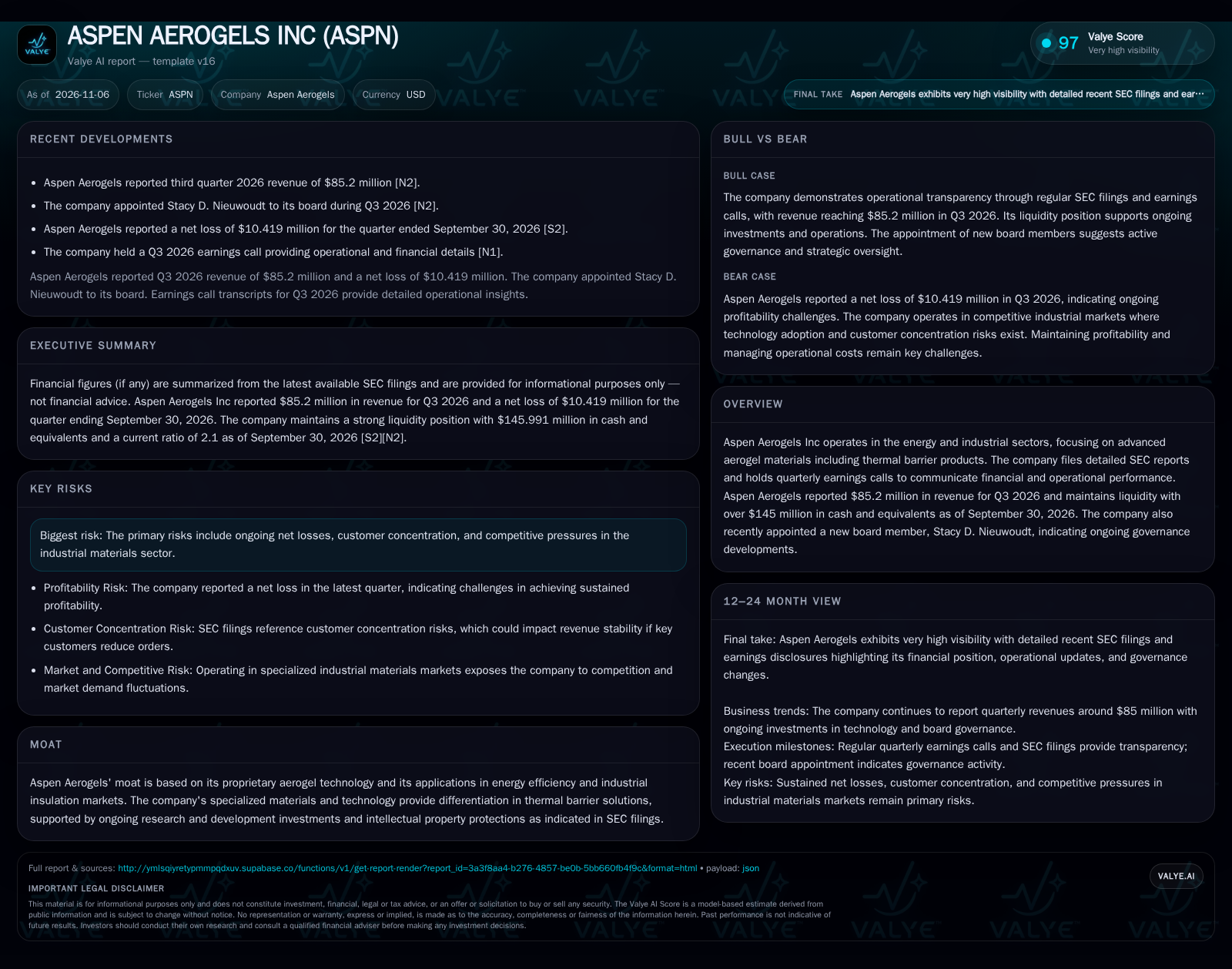
Aspen Aerogels reported $85.2 million in Q3 2026 revenue and ended the quarter with $145.991 million in cash, but posted a net loss of $10.419 million. The company’s core challenge is converting its differentiated aerogel technology and industrial market reach into consistent profitability amid customer concentration and competitive risks. Ongoing governance changes and detailed disclosures underscore a commitment to transparency, but execution on margin expansion and customer diversification will be pivotal. [S2] [N2]
Aspen Aerogels sits at a strategic crossroads: its advanced aerogel technologies have gained traction in energy and industrial sectors, and operational transparency remains high, underpinned by a sizable reported cash balance and regular disclosures. Yet, the company continues to report net losses despite healthy revenue growth, raising the stakes for its next phase of execution. The real test ahead is whether Aspen can leverage its technology differentiation and liquidity to achieve sustainable profitability, broaden its customer base, and solidify its competitive position in a market defined by both innovation and margin pressure.
Recent Financial Results Highlight Growth Potential and Challenges
Aspen Aerogels reported third quarter 2026 revenue of $85.2 million, reflecting ongoing commercial traction in its energy and industrial end markets [N2]. Despite this revenue base, the company posted a net loss of $10.419 million for the same period, highlighting continued challenges in achieving cost discipline or margin expansion [S2]. As of September 30, 2026, Aspen held $145.991 million in cash and equivalents, with a current ratio of 2.1 and a cash ratio of 1.22, indicating a reported liquidity position [S2]. The appointment of Stacy D. Nieuwoudt to the board in Q3 2026 signals active governance and potential for strategic recalibration [N2]. Together, these facts illustrate a company with the resources and transparency to pursue growth, but still searching for a sustainable profit formula.
Aspen’s Aerogel Technology as a Driver for Sustainable Profit Growth
Aspen Aerogels’ business model centers on the development and commercialization of proprietary aerogel materials—highly efficient thermal barriers used in energy infrastructure, industrial insulation, and potentially in automotive and battery applications. Revenue is likely generated through direct sales to large industrial customers, with pricing power dependent on material performance, integration in customer systems, and the ability to justify a premium over legacy insulation solutions.
The economics of advanced materials are typically characterized by high fixed costs (R&D, specialized manufacturing, intellectual property protection) and variable costs tied to production volume and raw inputs. If Aspen can scale production efficiently, it may achieve operating leverage as incremental sales absorb fixed overhead. However, gross margin expansion will depend on the mix of higher-value applications, success in passing through cost inflation, and reduction in manufacturing unit costs through process improvements or capacity utilization.
The company reported cash and liquidity metrics for the period; these figures do not by themselves establish operating runway, investment capacity, financial flexibility, or financing capacity. [S1] [S2] To shift from net losses to profitability, Aspen must either grow revenue faster than expenses, improve gross margins via cost structure optimization, or both. Customer concentration—if present—may influence pricing dynamics and negotiating power, impacting the sustainability of any margin gains.
Standing Out in the Competitive Industrial Materials Landscape
Aspen Aerogels’ competitive positioning is rooted in its proprietary aerogel technology, which offers superior thermal insulation compared to conventional materials. This technological edge may enable the company to win contracts in sectors where energy efficiency, space savings, or fire safety are critical, such as oil and gas infrastructure, industrial processing, and potentially electric vehicle battery protection.
However, the industrial insulation market is mature and competitive, with numerous established players offering a range of alternative solutions—including fiberglass, mineral wool, and emerging advanced materials. The threat of substitution is real if customers perceive insufficient differentiation or if competing products narrow the performance gap at a lower price point. Switching costs for large industrial customers can be significant due to qualification requirements and integration complexity, but these can also slow adoption rates for new technologies.
Aspen’s international operations may open additional growth avenues but also expose the company to global competition, regulatory hurdles, and currency volatility. The durability of Aspen’s moat will depend on continued R&D investment, effective IP enforcement, and the ability to embed its products deeply into customer supply chains.
Technology Leadership as a Catalyst for Margin Improvement
A favorable scenario for Aspen Aerogels would see its proprietary aerogel solutions gain wider adoption across energy, industrial, and new verticals such as electric vehicles or battery storage. This expansion could drive both higher sales volume and improved product mix, as more applications justify premium pricing for advanced materials. If Aspen can leverage its manufacturing base to achieve economies of scale, fixed costs would be spread over a larger revenue base, leading to higher gross margins and positive operating leverage.
Confirmation of this scenario would come from sequential gross margin improvement, a narrowing or reversal of net losses, and evidence of customer diversification—such as new contracts in growth segments or geographies. Additional signals would include increased R&D efficiency (new patents, improved formulations), and commentary in earnings calls about strong order pipelines or backlog. A useful metric would be recurring revenue or multi-year contract wins, if disclosed, to test the stickiness and visibility of revenue streams.
Projected Revenue Growth Coupled with Incremental Margin Gains
The most plausible near-term path for Aspen Aerogels is continued revenue growth in its core energy and industrial markets, supported by periodic wins in new applications or geographies. Margin improvement may occur gradually as production processes are optimized and higher-value product lines expand, but persistent cost pressures and customer concentration could delay a return to profitability.
This scenario would be confirmed by stable or modestly rising quarterly revenues, incremental gross margin gains, and steady R&D or SG&A discipline. Ongoing disclosures in quarterly filings and earnings calls should reveal progress on cost structure and any updates on customer diversification. However, breakthrough profitability would likely require a step-change either in demand or manufacturing efficiency.
Risks from Customer Concentration and Margin Pressure Extending Loss Periods
The adverse scenario for Aspen Aerogels involves stagnating or declining revenues due to customer concentration risk—where one or a few key customers reduce orders, delay projects, or shift to alternative materials. In this context, Aspen’s fixed-cost base would become a liability, with underutilization leading to negative operating leverage and further net losses.
Competitive pricing pressure from established or emerging insulation providers could force Aspen to cut prices, eroding gross margins and making it difficult to cover ongoing R&D and capital expenditures. Confirmation of this scenario would be a drop in quarterly revenues, deteriorating gross margins, or disclosures of lost major customers. A spike in short-term borrowings or the announcement of restructuring measures would further support the downside case.
Indicators of Aspen’s Progress Toward Monetizing Innovation
Quarterly gross margin trends: Sequential improvement would suggest progress on cost structure and pricing discipline; erosion would signal competitive or operational pressures.
Customer diversification: Disclosure of new large customers or a reduced reliance on top accounts would help test the revenue stability thesis.
Product mix evolution: Evidence of growth in higher-margin or next-generation applications (such as EV battery insulation) would support the case for margin expansion.
Operating expense discipline: Trends in R&D and SG&A as a percentage of revenue will indicate whether scaling is occurring efficiently.
Cash flow from operations: Positive or improving cash flow would signal business model maturation and lower capital risk.
Contract duration and backlog (if disclosed): Multi-year contracts or a growing order book would enhance revenue visibility and support valuation.
Board and management changes: Further governance developments could indicate strategic shifts or responses to performance challenges.
Utilization of credit facilities: Drawdowns or changes in debt levels may reveal underlying liquidity needs or capital expenditure plans.
Disclaimer: This is research-only, informational analysis and not investment advice. It may include AI-generated interpretation and general industry context. Always verify important details using primary sources.

Comments