
Nexstar Media Group: Navigating Broadcast Scale, Streaming Disruption, and Regulatory Roadblocks
Nexstar Media Group’s record revenue and renewed network deals highlight the strength of its local TV platform, yet the company faces intensifying headwinds as cord-cutting erodes its traditional revenue base and regulatory scrutiny clouds its acquisition-driven growth ambitions.
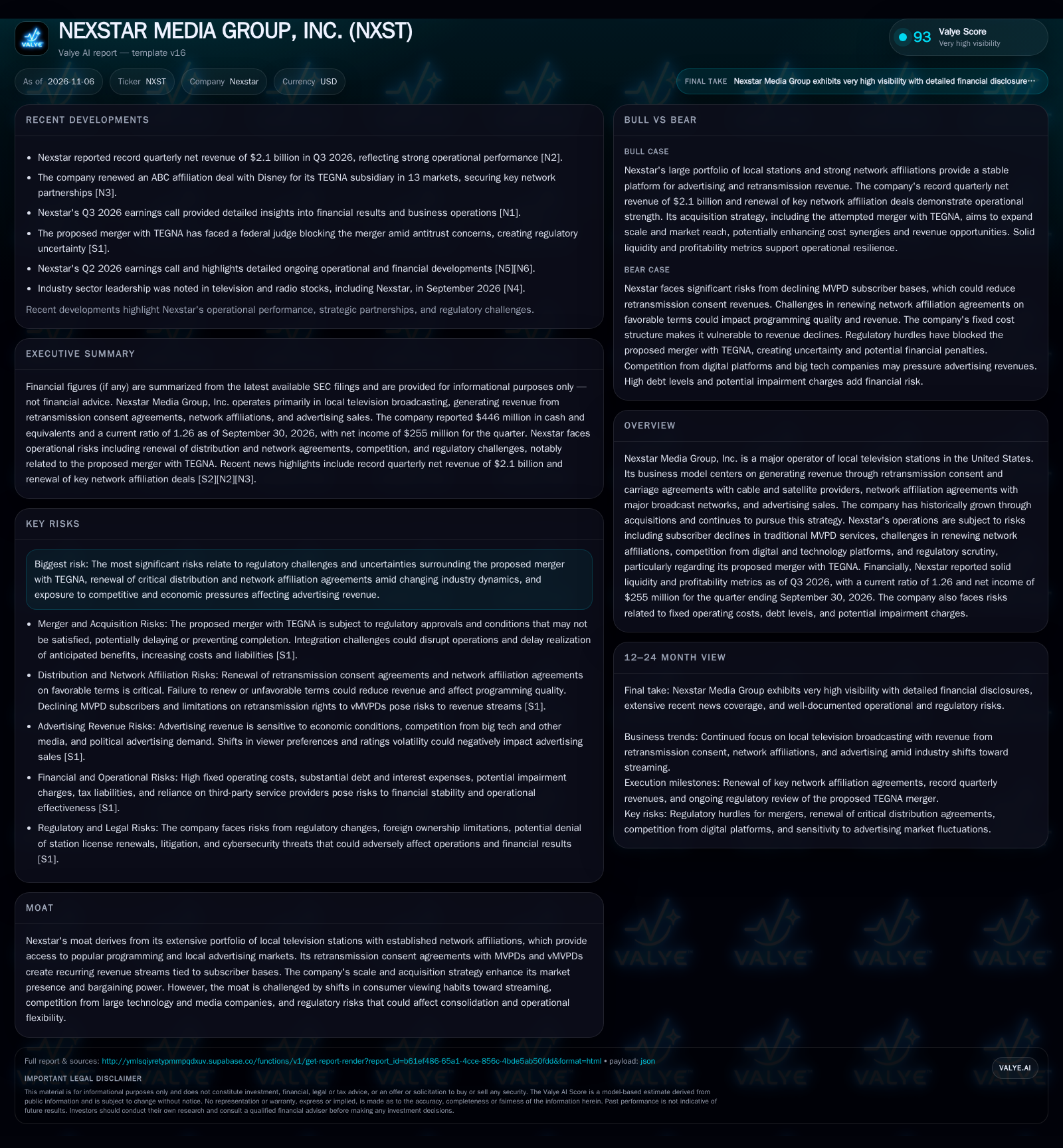
Nexstar Media Group reported record Q3 2026 revenue of $2.1 billion, secured key ABC affiliation renewals for its TEGNA subsidiary, and posted strong quarterly earnings. However, the company’s core retransmission and advertising revenues remain under pressure from subscriber declines and digital competition, while its proposed TEGNA merger faces major regulatory hurdles. The fixed cost structure amplifies both the upside from scale and the downside from any revenue shocks, making contract renewals and regulatory outcomes critical to the investment thesis. [S2] [N2] [N3] [S1]
Nexstar Media Group stands as the largest owner of local TV stations in the U.S., recently reporting record quarterly revenue and renewing key network affiliations. These milestones affirm the value of Nexstar’s broadcast footprint, but the company’s reliance on retransmission and advertising revenues exposes it to secular declines in pay TV subscribers and intensifying competition from digital platforms. With its proposed TEGNA merger stalled by regulatory action and fixed costs amplifying both gains and losses, Nexstar’s future will hinge on its ability to secure favorable contract renewals, adapt to streaming-driven disruption, and resolve regulatory hurdles.
Recent Performance and Strategic Developments Shape the Near-Term Outlook
Nexstar reported record net revenue of $2.1 billion for Q3 2026, reflecting both the scale of its broadcast operations and effective execution amid a shifting media landscape [N2]. Net income reached $255 million for the quarter, translating to basic EPS of $7.97 [S2]. The company’s TEGNA subsidiary renewed an ABC affiliation deal with Disney in 13 markets, a critical step in securing continued access to premium content and maintaining audience ratings [N3]. However, the proposed merger with TEGNA faces a preliminary injunction from a federal judge over antitrust concerns, effectively halting further integration and introducing significant regulatory uncertainty [S1] [N8]. Nexstar ended the period with $446 million in cash and a current ratio of 1.26, providing operational liquidity but not, by itself, resolving long-term strategic questions [S2].
Revenue Streams, Margin Structure, and the Leverage of Scale
Nexstar’s business model is anchored by three primary revenue streams: retransmission consent and carriage fees from MVPDs and vMVPDs, network affiliation agreements (primarily with the Big 4 broadcasters), and advertising sales. Retransmission revenue is closely tied to the number of pay TV subscribers—an industry metric in steady decline due to cord-cutting and the rise of streaming platforms. Advertising revenue, particularly at the local level, remains cyclical and highly sensitive to both economic conditions and the competitive threat from digital platforms and big tech.
The company operates a highly fixed cost structure, typical of broadcast media, where station operating costs, network fees, and content acquisition are relatively inelastic in the short term. This structure creates substantial operating leverage: incremental revenue flows disproportionately to the bottom line, but revenue declines can rapidly erode profitability. The risk is compounded by the need to periodically renegotiate network affiliation and retransmission deals, which can involve higher payments to networks or less favorable terms.
Nexstar’s historical growth through acquisitions, such as the recent TEGNA deal (now in regulatory limbo), is designed to increase bargaining power with both networks and distributors, leverage centralized operations, and extract cost synergies. However, acquisition integration introduces its own execution and capital allocation risks. The company reported cash and liquidity metrics for the period; these figures do not by themselves establish operating runway, investment capacity, financial flexibility, or financing capacity. [S2]
Assessing Moat Strength in a Fragmenting Media Ecosystem
Nexstar’s competitive advantage historically stems from its extensive local station footprint—reaching approximately 80% of U.S. television households as of September 2026—and its network affiliations, which provide access to high-value programming and large local advertising markets [S2]. The scale of its portfolio enhances bargaining power with both content providers and distributors, and enables cost efficiencies across sales, programming, and technology platforms.
Yet this moat is under pressure from several directions. The secular decline in MVPD subscribers reduces retransmission revenue, while the proliferation of direct-to-consumer streaming options siphons both audience and advertising dollars. Digital advertising platforms offer more granular targeting and measurable outcomes, making them increasingly attractive to local and national advertisers alike. Nexstar’s partial ownership of assets like The CW Network, NewsNation, and digital properties represents an attempt to diversify, but the majority of revenue and profit remains tied to traditional broadcasting economics.
Regulatory scrutiny further complicates Nexstar’s position, as evidenced by the judicial block on the TEGNA merger. The threat of more stringent antitrust enforcement could limit future consolidation, a key historical driver of the company’s scale and bargaining power.
What Could Unlock Outperformance: Successful Integration, Contract Renewals, and Digital Pivot
A favorable scenario for Nexstar would see the company successfully resolving regulatory issues and completing the TEGNA integration, extracting anticipated cost and revenue synergies from its expanded footprint. Renewal of key network affiliation and retransmission agreements—on terms that preserve or enhance margin—would stabilize core revenue streams. If the company leverages its scale to negotiate better rates with networks and distributors, while gradually shifting more of its advertising business to digital and connected TV platforms, operating leverage could drive outsized earnings growth.
Evidence that would confirm this scenario includes: regulatory clearance for the TEGNA merger, disclosed synergy realization in future financial reports, multi-year renewals of network affiliations on favorable terms, and measurable growth in digital and connected TV advertising revenue (if disclosed). Rising margins and improving revenue diversification away from MVPD-dependent streams would further validate the upside thesis.
Steady-State Broadcasting Amid Industry Headwinds and Regulatory Delays
The most plausible near-term path is one in which Nexstar continues operating its large station portfolio with modest organic growth or mild revenue declines, driven by ongoing MVPD subscriber losses offset by periodic political advertising cycles and incremental digital gains. The TEGNA merger remains stalled or delayed, limiting the realization of anticipated synergies and scale benefits. Network affiliation and retransmission renewals proceed, but with some incremental cost pressure as networks extract higher fees.
In this scenario, Nexstar remains profitable but faces margin compression and slower top-line growth. Evidence confirming this path would include stable but unremarkable revenue and profit trends, incremental increases in network payments, and limited progress on digital revenue diversification. Regulatory headlines that prolong merger uncertainty would further anchor the base case.
Pressure from Cord-Cutting, Unfavorable Renewals, and Regulatory Setbacks
A more adverse scenario unfolds if MVPD subscriber attrition accelerates, causing retransmission revenue to decline faster than anticipated. If Nexstar fails to renew key network affiliation agreements on economically viable terms—or if networks demand sharply higher reverse compensation—programming quality and audience ratings could suffer, further weakening advertising revenue.
Should the TEGNA merger be permanently blocked, Nexstar would lose a major avenue for scale and synergy realization, while incurring integration and legal costs. The company’s fixed cost structure would amplify the impact of any revenue shortfall, increasing the risk of profit and cash flow deterioration. Evidence that would support this scenario includes: disclosure of material MVPD subscriber losses, unfavorable contract renewal outcomes, persistent regulatory opposition to consolidation, and signs of advertising market share loss to digital competitors.
Milestones That Will Determine Nexstar’s Strategic Trajectory
Renewal outcomes and economics of major network affiliation agreements, especially with the Big 4 broadcasters—disclosed terms or management commentary would clarify margin impact.
Trends in MVPD and vMVPD subscriber counts tied to retransmission agreements—a useful metric would be reported subscriber declines in earnings calls or filings.
Progress (or lack thereof) on regulatory approval and integration of the TEGNA merger, including any updates on legal proceedings or negotiated settlements.
Disclosure of digital and connected TV advertising revenue as a share of total advertising—would help test the company’s ability to pivot revenue streams.
Any changes in the economics or duration of retransmission consent agreements with major distributors, as these directly affect revenue visibility.
Reported changes in local or national advertising demand, particularly in the context of economic slowdowns or shifts to digital channels.
Updates on debt levels, interest expense, and refinancing activity—these will affect free cash flow and potential financial flexibility, especially if revenue growth stalls.
Impairment charges or asset write-downs, especially if tied to underperforming markets or failed integrations, as early warnings of economic stress.
Disclaimer: This is research-only, informational analysis and not investment advice. It may include AI-generated interpretation and general industry context. Always verify important details using primary sources.

Comments