
Nkarta’s CAR NK Platform: Advancing Clinical Wins, Scaling Manufacturing, and Targeting Autoimmune Innovation
Nkarta, Inc. is advancing engineered, allogeneic CAR NK cell therapies for B-cell mediated autoimmune diseases, leveraging a scalable manufacturing platform and recent clinical evidence of deep B-cell depletion. As the company pivots away from oncology and invests in dual cGMP facilities, the central question is whether its off-the-shelf approach can overcome clinical, regulatory, and competitive hurdles to establish a new standard in autoimmune therapy.
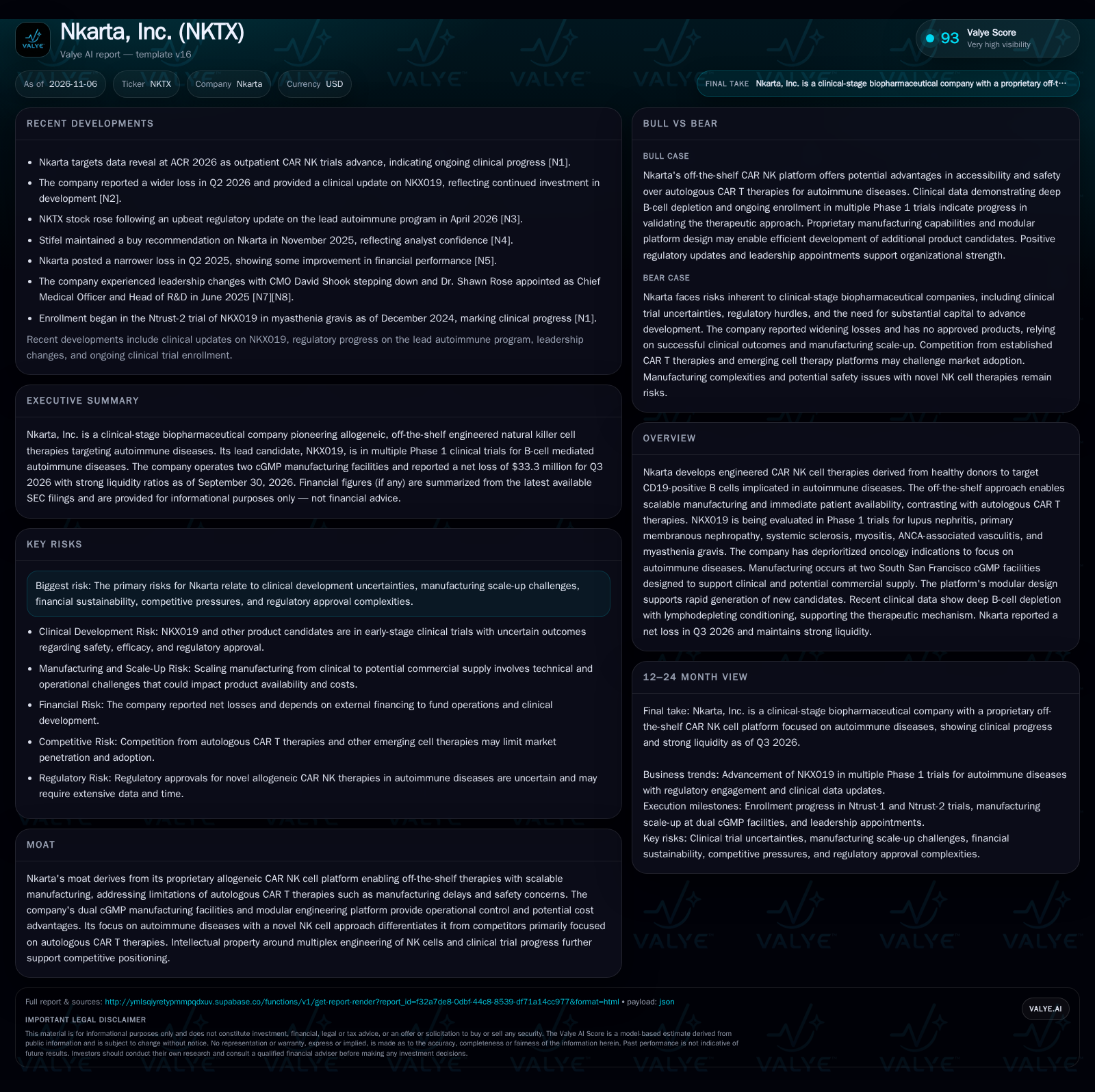
Nkarta’s lead candidate, NKX019, is progressing through Phase 1 trials for several autoimmune indications, with recent clinical updates showing mechanistic proof of deep B-cell depletion. The company’s dual cGMP manufacturing facilities support its off-the-shelf model, aiming to address the limitations of autologous CAR T therapies.
Nkarta, Inc. is at a pivotal juncture in the evolution of cell therapy for autoimmune disease. By focusing on engineered, allogeneic CAR NK cell therapies—particularly the lead candidate NKX019—the company is seeking to leapfrog the logistical and safety barriers that have limited the wider adoption of autologous CAR T therapies. With Phase 1 trials underway across several B-cell mediated autoimmune indications and a concerted shift away from oncology, Nkarta is betting on the scalability and immediacy of its off-the-shelf approach. The question is whether this combination of clinical progress, proprietary manufacturing, and strategic focus will be enough to carve out a durable position in a fiercely competitive and capital-intensive field.
Nkarta’s Latest Clinical and Operational Advances Refocus Strategy
Nkarta’s current landscape is defined by three pivotal developments: first, the advancement of NKX019 in Phase 1 trials for several autoimmune diseases, where the company has reported deep B-cell depletion—a mechanistic signal critical for efficacy in B-cell mediated conditions [S1]. Second, the company has formally deprioritized its oncology programs, reallocating resources to autoimmune disease, which reflects both a strategic pivot and a response to emerging clinical and commercial opportunities in this space [S1]. Third, Nkarta’s operational backbone is now supported by two cGMP manufacturing facilities in South San Francisco, with one already supplying clinical drug product and the second positioned for additional clinical and potential commercial supply [S1]. These moves are underpinned by a liquidity position of $48.4 million in cash and $108.3 million in short-term investments as of September 30, 2026 [S2]. This combination of clinical progress, strategic realignment, and manufacturing investment sets the stage for Nkarta’s next phase but also raises the stakes for execution.
Manufacturing Expansion and Clinical Proof Are Central to Nkarta’s Economics
Nkarta’s business model is predicated on the economics of allogeneic, off-the-shelf cell therapy. Unlike autologous CAR T therapies, which require individualized manufacturing for each patient, Nkarta’s platform uses healthy donor NK cells to produce standardized batches of engineered CAR NK cells. This approach theoretically enables lower per-unit costs, faster delivery, and greater scalability—if manufacturing costs can be kept in check and clinical outcomes are robust. The company’s dual cGMP facilities suggest a commitment to vertical integration and operational control, which could translate to improved gross margins as volumes scale.
Revenue realization for Nkarta, if approved, would likely depend on a combination of pricing power (driven by clinical differentiation and health-economic value) and volume (determined by the breadth of autoimmune indications and the ability to serve both acute and chronic patient populations). Fixed costs are significant at this stage, with R&D and manufacturing infrastructure leading to net losses—$33.3 million in Q3 2026 alone [S2]. However, the allogeneic model could enable higher operating leverage as production increases, provided demand materializes and regulatory hurdles are cleared. Capital needs remain high, as with most clinical-stage biotechs, with ongoing investment required for late-stage trials, regulatory submissions, and commercial readiness.
Platform Flexibility and Off-the-Shelf Access Set Nkarta Apart Amid Rising Competition
Nkarta’s competitive narrative is built around the promise of off-the-shelf, allogeneic CAR NK therapies offering logistical and safety advantages over autologous CAR T therapies. The modular engineering platform and dual cGMP facilities are designed to enable rapid iteration and scalable supply. However, the competitive landscape is evolving quickly: established CAR T therapies (especially for oncology) are expanding their footprint into autoimmune diseases, while other cell therapy modalities—including allogeneic T cells and regulatory T-cell approaches—are vying for clinical and commercial validation.
A key differentiator for Nkarta is the use of NK cells, which may have a more favorable safety profile and reduced risk of graft-versus-host disease compared to T-cell therapies. If efficacy is comparable, this could be a meaningful advantage. However, the bar for clinical benefit is rising, as recent academic studies and competitor disclosures highlight strong outcomes for CD19-directed CAR T therapies in autoimmune disease [S1]. Intellectual property around NK cell engineering and the ability to generate new candidates via a modular platform may provide some moat, but sustained competitive advantage will depend on clinical outcomes, payer willingness to reimburse, and the operational ability to deliver consistently at scale.
Strong Clinical Outcomes Could Elevate Nkarta’s Platform Value Significantly
The upside scenario for Nkarta hinges on two reinforcing outcomes: first, that NKX019 demonstrates compelling efficacy and a differentiated safety profile in autoimmune indications, and second, that the company’s manufacturing platform proves robust and scalable. If Phase 1 and subsequent trials yield durable B-cell depletion with manageable safety, Nkarta could position itself as the preferred option for both patients and providers, particularly in outpatient settings where autologous CAR T logistics are prohibitive.
Confirmation of this scenario would require positive readouts from ongoing and upcoming trials—such as those targeting lupus nephritis, systemic sclerosis, and myasthenia gravis—along with regulatory milestones and early signals of payer acceptance. Evidence such as rapid enrollment, expansion to pivotal trials, and academic or commercial partnerships would further validate platform value. Successful execution could open pathways to additional autoimmune or even non-autoimmune indications, leveraging the modularity of the engineering platform.
Regulatory and Adoption Challenges May Temper Nkarta’s Growth Momentum
The most plausible trajectory is incremental progress: Nkarta continues to generate supportive safety and mechanistic data in early-phase trials, but must navigate the lengthy and often unpredictable regulatory pathway for novel cell therapies. Clinical efficacy may prove sufficient for a subset of autoimmune diseases, but questions around long-term durability, optimal patient selection, and safety management could limit initial adoption.
Commercialization, if achieved, would likely begin in highly refractory or severe cases where treatment alternatives are limited. Manufacturing scale-up proceeds, but real-world operational challenges—such as batch consistency, logistics, and payer negotiations—create a measured ramp rather than a rapid inflection. Signs supporting this scenario would include steady but not explosive trial enrollment, cautious regulatory feedback, and the need for additional capital raises before reaching breakeven. Falsification would come from either clear clinical setbacks or unexpectedly rapid regulatory and commercial traction.
Operational or Clinical Hurdles Could Stall Nkarta’s Platform Development
In the adverse scenario, clinical trials of NKX019 fail to demonstrate sufficient efficacy or reveal unanticipated safety issues—such as off-target effects or inadequate persistence—leading to regulatory delays or program discontinuation. Alternatively, manufacturing scale-up could encounter technical or quality-control failures, resulting in supply interruptions or inability to meet clinical/commercial demand.
Financial stress would intensify under these conditions, as the company’s net losses and capital requirements outpace available liquidity. Competitive threats could also erode any first-mover advantage if other allogeneic or even next-generation autologous therapies reach the market with superior data or operational models. Confirmation of this scenario would include halted or suspended trials, negative regulatory decisions, major manufacturing setbacks, or forced restructuring to preserve cash.
Key Milestones Shaping Nkarta’s Progress and Market Position
Phase 1 trial readouts for NKX019 in autoimmune indications—especially lupus nephritis and myasthenia gravis—will be crucial for assessing both efficacy and safety.
Updates on regulatory feedback and engagement, particularly any movement toward pivotal trials or expedited review pathways.
Manufacturing output and batch consistency data from the dual cGMP facilities, if disclosed, would help test the ability to scale production reliably.
Clinical trial enrollment rates and dropout statistics, as indicators of patient and investigator enthusiasm and operational execution.
Cash burn rate and any additional financing events, which will inform the sustainability of development timelines and expansion plans.
Evidence of payer and provider interest—such as early access programs, reimbursement dialogue, or commercial partnerships—as a proxy for future adoption.
Competitive data releases from other cell therapy developers in autoimmune diseases, which could alter the perceived bar for clinical and commercial success.
Disclaimer: This is research-only, informational analysis and not investment advice. It may include AI-generated interpretation and general industry context. Always verify important details using primary sources.

Comments