
Horizon Technology Finance: Navigating Sector Concentration and Profitability Pressures in Life Sciences Lending
Horizon Technology Finance’s sharp Q3 net loss and expanded share buybacks highlight both the risks and the strategic levers in its specialized venture debt model. As sector headwinds and geopolitical uncertainties mount, the company’s ability to manage credit quality, portfolio mix, and operational resilience will determine whether it can translate its life sciences focus into sustainable returns.
Horizon Technology Finance reported a significant Q3 2026 net loss amid a challenging environment for specialty lenders focused on life sciences and medical devices. The company expanded its share repurchase program and continues to distribute dividends, but sector concentration, profitability volatility, and geopolitical risks remain central to the investment thesis. The core question is whether Horizon’s specialized approach and risk management can deliver durable value as sector and macro headwinds persist.
Horizon Technology Finance Corp’s Q3 2026 net loss and negative EPS reflect intensifying challenges for specialty finance companies with concentrated exposure to volatile sectors like life sciences and medical devices. The next phase will test whether active risk management and sector expertise can counterbalance these pressures—or if persistent losses become structural.
Recent Losses and Capital Actions Reshape Horizon’s Near-Term Profile
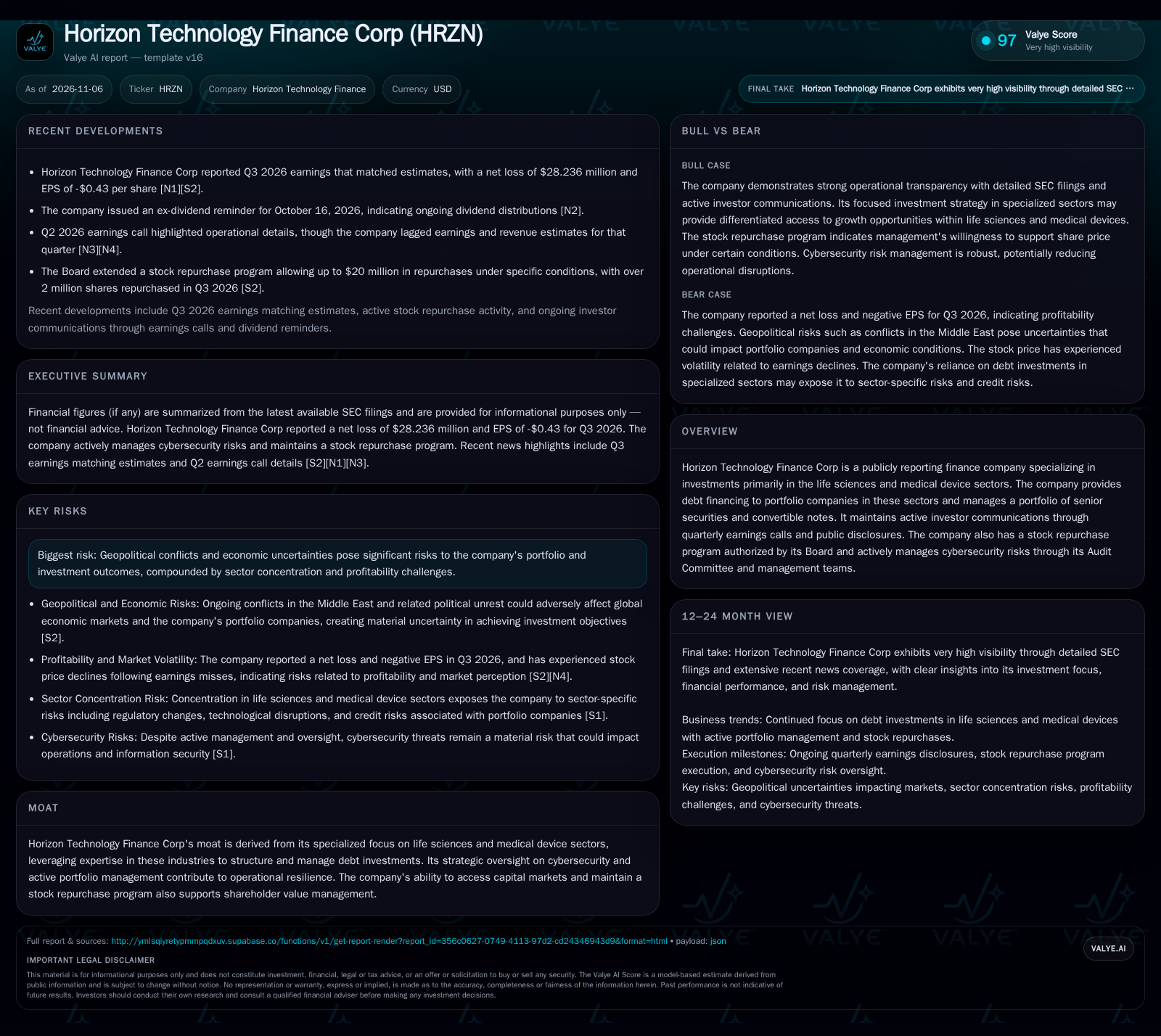
Horizon Technology Finance reported a net loss of $28.236 million for Q3 2026, translating to a basic and diluted EPS of -$0.43 per share [S2]. This marks a notable setback in profitability, especially given the company’s focus on income-generating debt investments. In response, the Board extended a share repurchase program authorizing up to $20 million in buybacks, with over 2 million shares repurchased during the quarter [S2]. Meanwhile, the company maintained its dividend distribution, as indicated by the October ex-dividend event [N2]. Horizon’s portfolio remains heavily tilted toward life sciences and medical device companies, and recent SEC filings highlight both senior securities and convertible notes as key investment vehicles [S1]. These facts collectively underscore a business under pressure but deploying shareholder-return levers to mitigate market reaction and reinforce confidence.
The interplay between sector concentration and capital actions like share repurchases merits further scrutiny. While buybacks can signal management's commitment to shareholder value, they also reduce available capital that might otherwise be deployed to support or diversify the portfolio. The company reported cash and liquidity metrics for the period; these figures do not by themselves establish operating runway, investment capacity, financial flexibility, or financing capacity. The company's decision to continue dividends amid losses adds another layer of capital allocation complexity, potentially constraining flexibility in responding to emerging credit challenges or seizing new lending opportunities.
Venture Debt Model: Revenue Streams, Sensitivities, and Operating Leverage
Horizon Technology Finance generates revenue primarily from interest income on debt investments—typically senior secured loans and convertible notes—extended to growth-stage companies in the life sciences and medical device sectors. The economics of this model are highly sensitive to credit quality, borrower performance, and sector-specific volatility. Interest income is generally predictable for performing loans, but elevated credit losses or non-accruals can quickly erode margins, as recent losses suggest.
Fixed costs are relatively stable, driven by internal investment management, compliance, and risk oversight. However, the business exhibits limited operating leverage relative to traditional lenders due to the specialized, hands-on nature of portfolio management and the need for deep sector diligence. The cited source reports dividend-related activity; that disclosure alone does not establish dividend-policy continuity, management confidence, or a material constraint on capital flexibility.
Share repurchases, while supportive of per-share metrics, divert capital that could otherwise be deployed into new loans or portfolio support. This creates a trade-off between immediate shareholder returns and future earning potential, especially when underlying portfolio performance is under stress.
The venture debt model’s reliance on growth-stage companies inherently exposes Horizon to higher credit risk compared to traditional lending. Revenue streams, while predictable under stable conditions, are vulnerable to abrupt shifts in borrower creditworthiness, especially given the long development cycles and regulatory hurdles typical in life sciences. Operating leverage is further constrained by the need for specialized underwriting and ongoing monitoring, which limits scalability without proportional increases in overhead. This dynamic underscores the importance of disciplined capital deployment and risk-adjusted pricing to sustain profitability amid cyclical pressures.
Specialization as Differentiator—But Also a Source of Concentration Risk
Horizon’s competitive edge lies in its specialization within life sciences and medical device lending. Deep sector knowledge, network effects among venture-backed borrowers, and the ability to structure bespoke loans are all elements that can enable the company to command better pricing or access higher-quality deal flow than generalist lenders.
However, this specialization also amplifies concentration risk. Regulatory changes, clinical trial setbacks, or sector funding pullbacks can simultaneously impact multiple portfolio companies, increasing correlated loss potential. Competing business development companies (BDCs), venture debt funds, and even non-bank lenders are active in these sectors, sometimes driving down yields or loosening terms. Technology advances—such as alternative financing platforms—could erode traditional venture debt’s value proposition if they gain adoption among growth-stage companies.
A further competitive factor is Horizon’s demonstrated focus on cybersecurity oversight, which, while not directly revenue-generating, may reduce operational risk and bolster trust with investors and borrowers.
In addition to sector concentration risk, competitive dynamics may influence Horizon’s pricing power and deal flow quality. The presence of multiple specialized lenders can compress yields, particularly if competitors adopt looser underwriting standards to win market share. Conversely, Horizon’s deep sector expertise and established relationships could enable selective origination of higher-quality loans that justify premium pricing. However, the rise of alternative financing mechanisms, such as venture capital extensions or revenue-based financing, could erode traditional venture debt demand, necessitating continuous innovation in product structuring and borrower engagement to maintain differentiation.
If Credit Quality Stabilizes, Shareholder Returns Could Rebound
A favorable scenario would see Horizon’s portfolio companies weathering current sector and macro headwinds, leading to a stabilization or improvement in credit quality. This would reduce non-accruals and credit losses, enabling a rebound in net investment income and possibly restoring positive EPS. If the company can continue to originate high-yield loans with disciplined underwriting, while opportunistically repurchasing shares below intrinsic value, per-share returns could be enhanced.
Evidence confirming this scenario would include a marked decline in net losses or a return to positive quarterly EPS, reduced realized and unrealized losses on the investment portfolio, and a resumption of portfolio growth without a deterioration in credit metrics. Additional supporting signals would be positive commentary on sector fundamentals during earnings calls and the maintenance or increase of the dividend.
Portfolio Volatility and Sector Headwinds Drive Mixed Outcomes
The most plausible near-term outcome is continued earnings volatility as Horizon’s portfolio navigates both sector-specific and macroeconomic uncertainties. Modest recoveries in certain portfolio names could offset ongoing stress in others, leading to lumpy, inconsistent profitability. The company may continue to rely on share repurchases and dividends to support shareholder value, but underlying earnings power remains constrained by heightened credit risk and sector concentration.
Confirmation of this scenario would be quarterly results that fluctuate between modest losses and break-even or slightly positive EPS, ongoing but measured share repurchases, and stable (not growing) portfolio size. If credit metrics do not deteriorate further but also do not markedly improve, investor sentiment is likely to remain cautious.
Worsening Credit Losses and Sector Shocks Threaten Sustainability
A negative scenario would involve a further deterioration in the credit performance of Horizon’s portfolio companies, potentially triggered by sector-wide funding shortfalls, regulatory setbacks, or macro/geopolitical shocks—such as those linked to Middle East conflicts. Elevated defaults or non-accruals would drive further net losses, erode book value, and could force a reduction or suspension of the dividend.
Signs that this scenario is unfolding would include a sharp increase in realized and unrealized portfolio losses, additional quarters of negative EPS, a reduction or halt in share repurchases to preserve capital, and explicit management commentary about portfolio stress or loss reserves. A contraction in portfolio size or distressed asset sales would further confirm downside pressure.
Testing the Resilience of Horizon’s Life Sciences Lending Model
Quarterly net investment income and EPS trends: A return to positive earnings, or at least a narrowing of losses, would be a key sign of stabilization.
Portfolio company concentration and sector exposure: If disclosed, changes in top-10 holdings or sector mix could indicate efforts to diversify risk.
Share repurchase activity: Sustained buybacks at significant scale may signal management confidence, while a pause could reflect capital preservation.
Portfolio growth or contraction: Net new investments, if disclosed, would help test whether Horizon sees attractive risk-adjusted returns in its core sectors.
Management commentary on sector conditions: Insights from earnings calls and filings regarding the health of life sciences and medical device markets would help gauge forward risk.
Macroeconomic and geopolitical developments: External shocks, particularly those referenced in SEC filings, could materially affect portfolio performance.
Disclaimer: This is research-only, informational analysis and not investment advice. It may include AI-generated interpretation and general industry context. Always verify important details using primary sources.

Comments