
NGL Energy Partners: Capital Strategy and Water Segment Dynamics in Midstream Evolution
NGL Energy Partners LP is pivoting toward higher-margin water services and operational efficiency, as signaled by raised 2027 EBITDA guidance and a $100 million repurchase program.
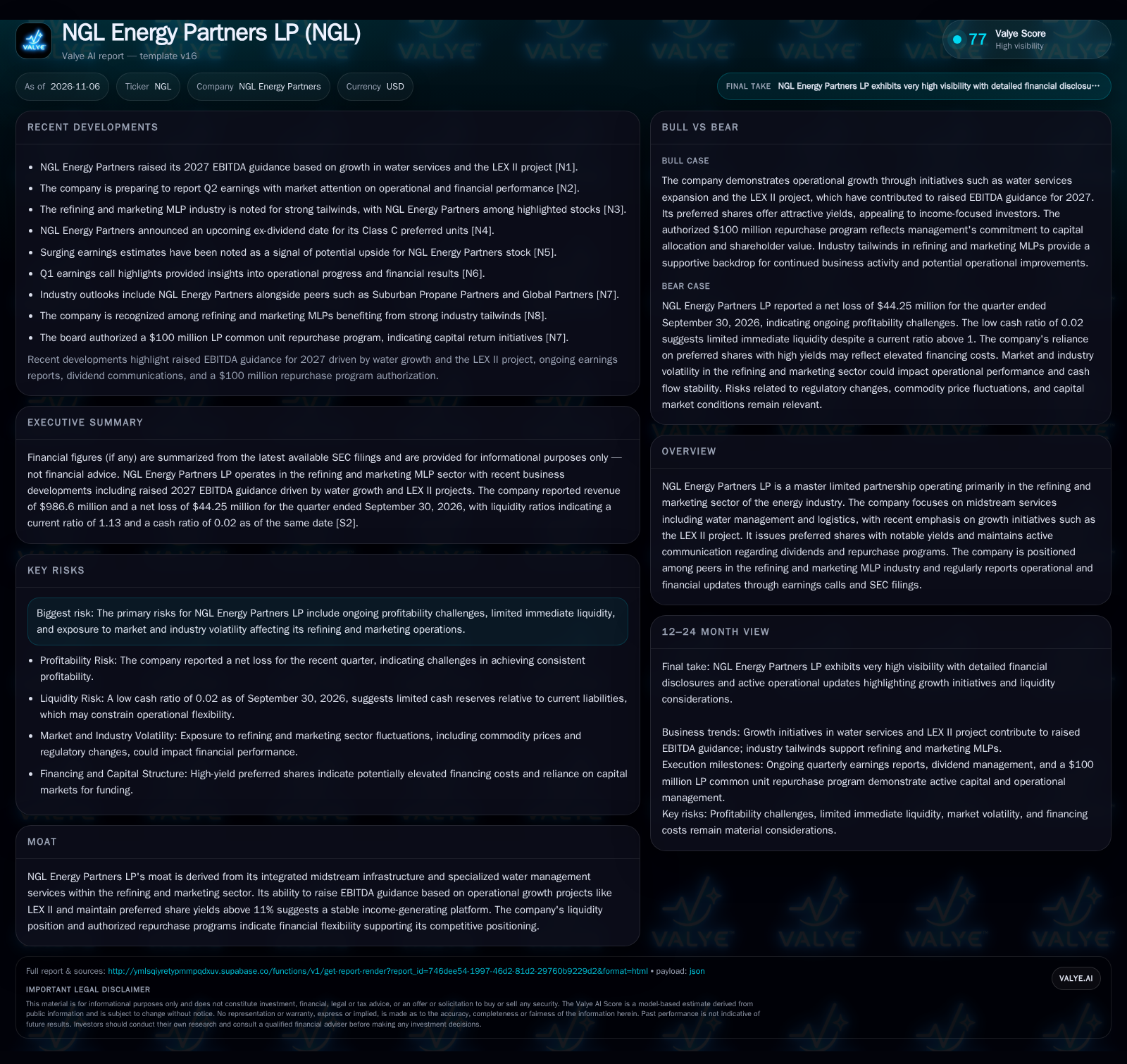
NGL Energy Partners is leveraging water management expansion and the LEX II project to support higher future EBITDA, while deploying capital through a sizable repurchase program. [S2] [N1] [N7]
NGL Energy Partners LP is at a strategic crossroads: the company is doubling down on its water services platform and the LEX II project to drive future earnings, as reflected in its increased 2027 EBITDA guidance. Meanwhile, management is signaling confidence through a $100 million common unit repurchase program. Yet, beneath the surface, persistent net losses and razor-reported cash balance pose material questions about the durability of its business model.
Evolving Growth Plans Confront Current Financial Constraints
NGL Energy Partners has raised its 2027 EBITDA guidance, attributing this to momentum in water services and the LEX II project—two areas management flags as key growth engines [N1]. This forward-looking optimism is set against a backdrop of ongoing net losses: for the quarter ended September 30, 2026, the company posted a net loss of $44.25 million on revenue of $986.6 million [S2]. Liquidity remains a concern, with only $7.56 million in cash and a cash ratio of 0.02, despite a current ratio of 1.13 [S2]. Meanwhile, the board’s authorization of a $100 million LP unit repurchase program signals a commitment to capital returns even as the company faces profitability and liquidity constraints [N7]. These developments collectively highlight a business model in transition—one that is betting on operational expansion but must navigate tight near-term financial headroom.
Water Services and Capital Structure: Core Drivers of Profitability Challenges
NGL Energy Partners’ revenue model is anchored in fee-based midstream services, with a growing emphasis on water management—a segment generally offering more stable, higher-margin contracts than legacy commodity-linked operations. The LEX II project is positioned as a catalyst for volume and earnings growth, likely by expanding capacity and enhancing service integration. However, the company’s persistent net losses raise questions about cost structure, pricing power, and the true incremental margin of recent investments.
The reliance on high-yield preferred shares (with yields above 11%) reflects a capital structure tailored to income-seeking investors but also signals elevated financing costs that can erode operating leverage. In this context, the $100 million repurchase program may be intended to support unit prices and reduce equity cost of capital, but also represents a cash outlay at a time of constrained liquidity. The fixed cost base associated with midstream assets offers potential for operating leverage if volumes ramp, yet it also amplifies downside risk if utilization falls short or if water service contracts prove less resilient than anticipated.
The company reported cash and liquidity metrics for the period; these figures do not by themselves establish operating runway, investment capacity, financial flexibility, or financing capacity. The interplay between stable, contracted revenues and episodic exposure to market cycles and refinancing risk will dictate the company’s ability to translate topline growth into durable distributable cash flow.
Standing Out and Staying Resilient in a Competitive Midstream Landscape
NGL Energy Partners operates in a competitive landscape that includes other midstream MLPs such as Suburban Propane Partners and Global Partners [N7]. Its strategic focus on water management and integrated logistics is a potential differentiator, as water handling is increasingly critical in unconventional oil and gas development. This specialization can create switching frictions for upstream customers, especially if NGL offers bundled services or proprietary infrastructure.
However, the broader midstream sector is characterized by capital intensity, regulatory scrutiny, and price competition. Many peers also pursue water and logistics solutions, eroding the first-mover advantage and compressing margins if supply outpaces demand. The ability to secure long-term, fee-based contracts with creditworthy counterparties is key to revenue visibility, but commercial terms, contract renewal rates, and customer concentration risks are not disclosed. Substitution risk remains if E&P customers vertically integrate water management or if new entrants deploy more efficient technology.
NGL’s reliance on high-yield preferred equity may limit its flexibility relative to competitors with stronger balance sheets or lower cost of capital. Ultimately, the company’s competitive durability will depend on its ability to execute growth projects, maintain service differentiation, and weather cyclical downturns without resorting to dilutive or expensive capital raises.
Operational Improvements as a Path to Enhanced Cash Flow
If NGL Energy Partners achieves its raised 2027 EBITDA targets through successful expansion of water services and LEX II project ramp-up, the business could experience meaningful operating leverage. Higher volumes and improved pricing in water management may allow fixed costs to be spread over a larger revenue base, driving margin expansion and potentially restoring net profitability. This, in turn, could support higher distributions or further unit repurchases, enhancing total returns for common and preferred equity holders.
Securing new long-term customer contracts, announcing incremental project milestones, or demonstrating a trend toward positive net income would further validate the thesis. Conversely, a failure to translate operational growth into improved margins or distributable cash flow would undermine the upside narrative.
Anticipating Margin Pressures and Funding Limitations in 2027
The most plausible outlook for NGL Energy Partners is one of incremental EBITDA growth from water services and LEX II, but with persistent pressure on net margins due to elevated financing costs and the capital-intensive nature of operations.
Supporting evidence would include steady or slightly improved EBITDA and distributable cash flow, ongoing communication of new project wins or contract extensions, and maintenance of current distribution levels. However, if financing costs rise further or if water segment growth stalls, the company could remain trapped in a cycle of thin liquidity and periodic net losses.
Risks from Liquidity Challenges and Market Fluctuations
Adverse outcomes could be triggered if revenue growth from water services and LEX II underperforms expectations, resulting in continued net losses and eroding cash reserves. In this scenario, the company might be forced to curtail distributions, suspend the repurchase program, or seek additional high-cost financing, potentially diluting existing unitholders.
A rise in interest rates or deterioration in capital markets could further increase refinancing costs, while commodity price volatility might depress volumes in the core midstream business. Confirmation of this scenario would include declining EBITDA, negative trends in distributable cash flow, or announcements of covenant breaches, capital raises, or distribution cuts. Persistent liquidity stress could also increase the risk of asset sales or restructuring.
Factors Influencing the Balance Between Growth and Structural Challenges
Quarterly trends in water services revenue and segment EBITDA—if disclosed—would help test the durability of the company’s growth thesis.
Updates on LEX II project milestones, capacity utilization, and customer contracts will be crucial for validating expansion assumptions.
Sustained improvement in net income or a clear path to positive earnings would indicate successful operating leverage.
Announcements regarding new long-term contracts, renewals, or customer wins in water management would support revenue visibility claims.
Details on the pace and scale of the $100 million unit repurchase program—actual repurchases versus authorization—would clarify capital allocation discipline.
Disclosures of covenant compliance, refinancing activity, or asset sales would provide early warnings of balance sheet stress.
Disclaimer: This is research-only, informational analysis and not investment advice. It may include AI-generated interpretation and general industry context. Always verify important details using primary sources.

Comments