
Sphere Entertainment: Immersive Venues, Media Networks, and the Challenge of Scaling Experiential Economics
Sphere Entertainment’s blend of next-generation immersive venues and traditional media networks offers revenue diversity but exposes the company to heavy fixed costs, operational complexity, and sectoral headwinds. Recent results show robust top-line performance but persistent losses, raising questions about the path to sustainable profitability and the scalability of its flagship Sphere model.
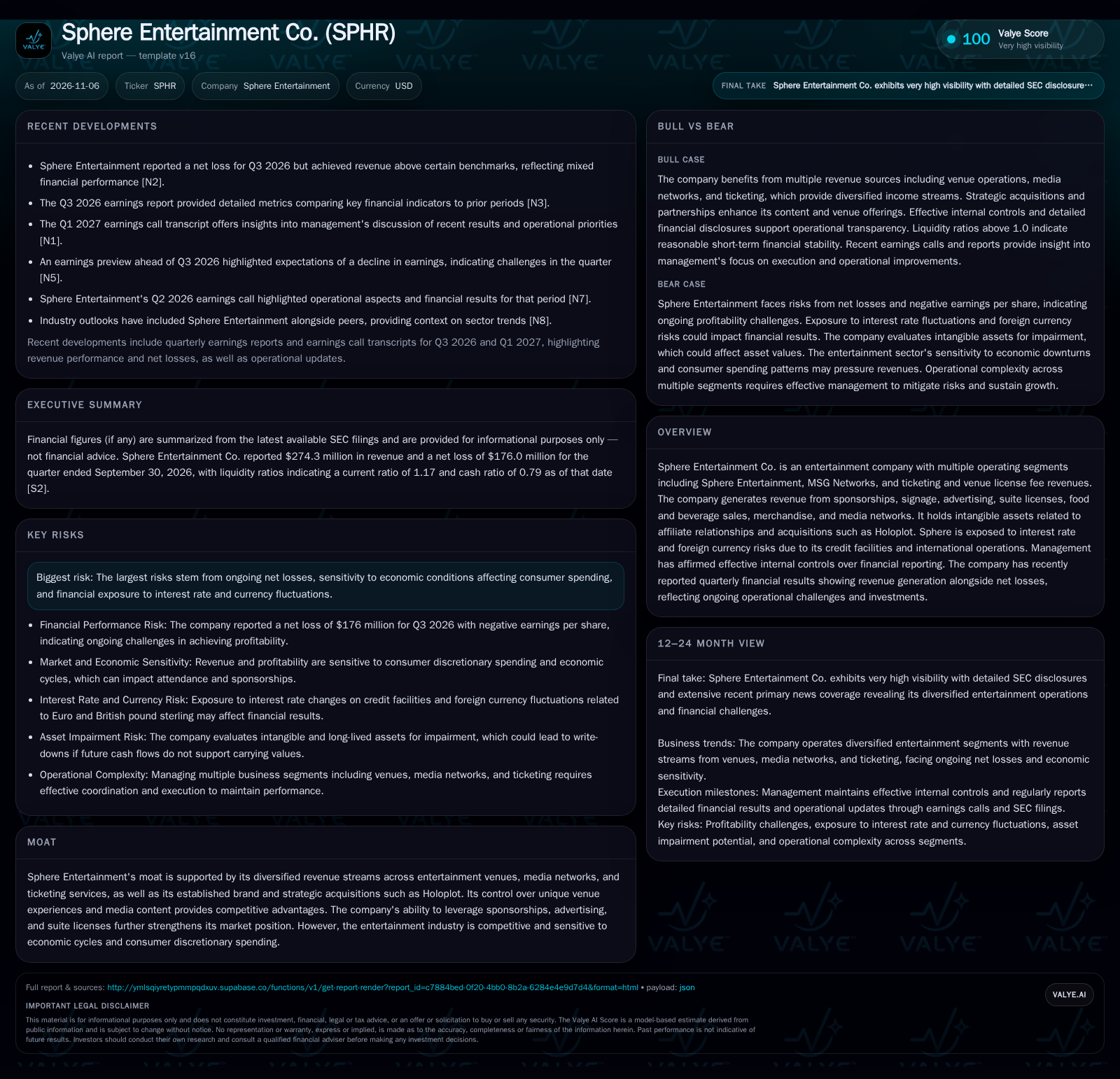
Sphere Entertainment reported $274.3 million in quarterly revenue and a net loss of $176 million as of September 30, 2026, reflecting the high fixed costs and ongoing investments in its immersive venue and media network businesses. While the company’s diversified revenue model and advanced venue technologies offer potential for differentiation, persistent losses, economic sensitivity, and operational complexity remain key risks. The ability to scale the Sphere concept globally and adapt MSG Networks to shifting media consumption patterns will likely determine future value creation. [S2] [N2]
Sphere Entertainment Co. has positioned itself at the intersection of immersive venue innovation and traditional media, with ambitions to redefine live experiences through its flagship Las Vegas Sphere and to capture value from its MSG Networks segment. The company’s most recent quarter illustrates both the promise and peril of this approach: strong revenue achievement, yet deep net losses, underscore the tension between high fixed-cost innovation and the realities of consumer demand, economic cycles, and evolving media habits. As Sphere seeks to scale its experiential model and adapt to new distribution paradigms, the question is whether its differentiated assets and diversified revenue streams can overcome the heavy drag of capital intensity and sectoral disruption. [S2] [N2]
Recent Financial Results Spotlight Revenue Growth—and Persistent Losses
For the quarter ending September 30, 2026, Sphere Entertainment reported $274.3 million in revenue and a net loss of $176 million, translating to basic and diluted EPS of -$4.84. Cash and cash equivalents stood at $527.2 million, with a current ratio of 1.17 and a cash ratio of 0.79, reflecting a liquidity position above bare minimum thresholds. These figures underscore both the company’s ability to generate substantial top-line from its diversified segments and the ongoing challenge of achieving operational profitability amid heavy fixed costs and ongoing investments. The company’s multi-segment approach—combining immersive venues with media networks and ticketing—offers revenue diversity but also adds operational complexity and exposure to sector-specific risks, such as economic sensitivity and media consumption shifts. [S2] [N2]
How the Sphere Model Translates Innovation into Revenue—And Where the Economics Pinch
Sphere Entertainment’s economics hinge on two distinct but interconnected engines: the high fixed-cost, high-capacity Sphere venue in Las Vegas and the recurring but margin-pressured MSG Networks business. The Sphere segment monetizes through ticket sales for immersive experiences and live events, venue licensing, sponsorships, advertising (via the Exosphere’s massive LED display), suite licenses, food and beverage, and merchandise. This creates a multi-pronged revenue mix, but the venue’s vast scale and advanced technology mean significant fixed operating costs—utilities, maintenance, content creation, and staffing—plus substantial upfront and ongoing capital expenditures.
MSG Networks, meanwhile, generates revenue from affiliate fees paid by distributors (cable/satellite/streaming platforms) and advertising tied to regional sports programming. However, this segment faces secular headwinds as cord-cutting accelerates and content costs (sports rights) remain high. The company’s attempt to pivot to direct-to-consumer (DTC) streaming via MSG+ introduces new revenue potential but may involve lower margins and higher customer-acquisition costs compared to legacy affiliate models.
Overall, Sphere’s business model depends on achieving high venue utilization, premium pricing for immersive events, strong sponsorship demand, and the ability to offset declining legacy media margins with DTC growth. The capital intensity and operating leverage mean that small changes in utilization or pricing can have outsized effects on profitability, for better or worse.
Differentiation Through Immersive Experience—But Facing Intense Venue and Media Competition
Sphere’s core competitive advantage lies in the uniqueness of its immersive venue technology—the world’s largest programmable LED screen, proprietary audio, and haptic/4D effects—which enables experiences unavailable elsewhere. This could support premium pricing, attract high-profile artist residencies, and secure brand partnerships for both live events and artistic/advertising displays.
However, the company faces competition on several fronts. Other major event venues in Las Vegas and globally compete for the same artists, residencies, and corporate events. The capital intensity of building new Spheres elsewhere creates barriers to rapid network expansion, and each new location requires significant local demand and operational ramp-up. In media, MSG Networks competes with other regional sports networks and faces direct competition from national streaming platforms and changing sports media rights landscapes.
The risk is that while the Sphere venue is differentiated, its moat may be narrower than it appears if competing venues invest in their own immersive upgrades, if sponsorship/ad budgets shift elsewhere, or if media rights and distribution economics continue to erode in the DTC era.
If Sphere Achieves High Venue Utilization and DTC Success, Operating Leverage Could Drive Turnaround
A favorable scenario sees Sphere Entertainment achieving consistently high utilization rates at its Las Vegas venue, with immersive experiences and artist residencies drawing repeat audiences and premium sponsorships. If the company can maintain pricing power and fill the calendar with marquee events, fixed costs get spread over more revenue, unlocking operating leverage. Simultaneously, if MSG Networks successfully transitions to a profitable DTC model without excessive churn or margin erosion, it could offset declines in legacy affiliate revenue.
Evidence that would support this scenario includes: rising attendance and ticket yields at Sphere Las Vegas, multi-year sponsorship/advertising deals, positive EBITDA inflection in the Sphere segment, and strong subscriber growth (with low churn) for MSG+ DTC streaming. Confirmation would also come from announcements of successful new Sphere locations (such as Abu Dhabi) with favorable financing and early demand indicators.
Balancing Modest Venue Growth with Media Margin Pressure as the Most Likely Trajectory
The most plausible mid-term path is one in which Sphere Entertainment achieves steady but unspectacular growth in venue attendance and sponsorship, with the Las Vegas Sphere operating near breakeven or modest profitability, but not at full capacity. MSG Networks likely continues to see pressure on affiliate revenue, partially offset by gradual DTC subscriber gains, but overall margin compression persists as content costs remain high and the audience fragments.
Supporting evidence would include stable (but not sharply rising) Sphere attendance and event counts, incremental improvements in segment profitability, and DTC subscriber growth that is positive but not enough to fully offset legacy declines. Falsification would come from either sharp declines in venue utilization or an inability to slow the loss of high-margin affiliate revenues.
Adverse Shocks: Underutilized Venues and Media Disruption Amplify Losses and Capital Burn
In a negative scenario, Sphere Las Vegas struggles to maintain high utilization, with fewer blockbuster events, softening demand, or competition from other venues eroding pricing and sponsorships. The high fixed-cost base means that even moderate declines in revenue can quickly widen losses. If economic conditions deteriorate or travel to Las Vegas is disrupted, discretionary spending could fall, further reducing attendance.
On the media side, if MSG Networks experiences accelerated affiliate churn and the DTC pivot fails to achieve scale or pricing power, revenue and margins could decline rapidly. Asset impairment risks could surface if future cash flows fall short of carrying values, especially for recent venue and technology investments. Confirmation would come from declining venue attendance, missed revenue guidance, increased cash burn, or signs of asset write-downs.
Milestones That Will Define Sphere Entertainment’s Ability to Scale and Sustain Its Model
Quarterly venue attendance and capacity utilization rates for the Las Vegas Sphere, as well as event calendar density and average ticket yields, if disclosed, would help test the scalability of the immersive venue model.
Evidence of multi-year sponsorship, advertising, or residency agreements at premium rates would indicate demand durability and pricing power for the Sphere platform.
Segment-level EBITDA or operating margin trends—especially for the Sphere and MSG Networks units—would clarify whether operating leverage is being achieved or losses are deepening.
DTC subscriber growth rates, churn, and average revenue per user (ARPU) for MSG+ would provide early signals of the viability and margin potential of the streaming transition.
Announcements or disclosures regarding new Sphere venue locations, including financing terms, projected economics, and pre-opening demand indicators, would reveal the scalability and risk of the global expansion strategy.
Quarterly cash burn rate and capital expenditure levels, if disclosed, would help assessreported liquidity position and capital allocation discipline in light of persistent net losses.
Any impairments or write-downs of intangible or long-lived assets, particularly related to venue investments or affiliate relationships, would highlight the risk of overestimating future cash flows.
Disclaimer: This is research-only, informational analysis and not investment advice. It may include AI-generated interpretation and general industry context. Always verify important details using primary sources.

Comments