
Rezolute’s Late-Stage Pivot: Ersodetug’s Regulatory Pathway, Clinical Uncertainties, and the Economics of Rare Disease Drug Development
Rezolute, Inc. is at a pivotal juncture as it advances ersodetug—a monoclonal antibody for hypoglycemia due to hyperinsulinism—through late-stage trials.
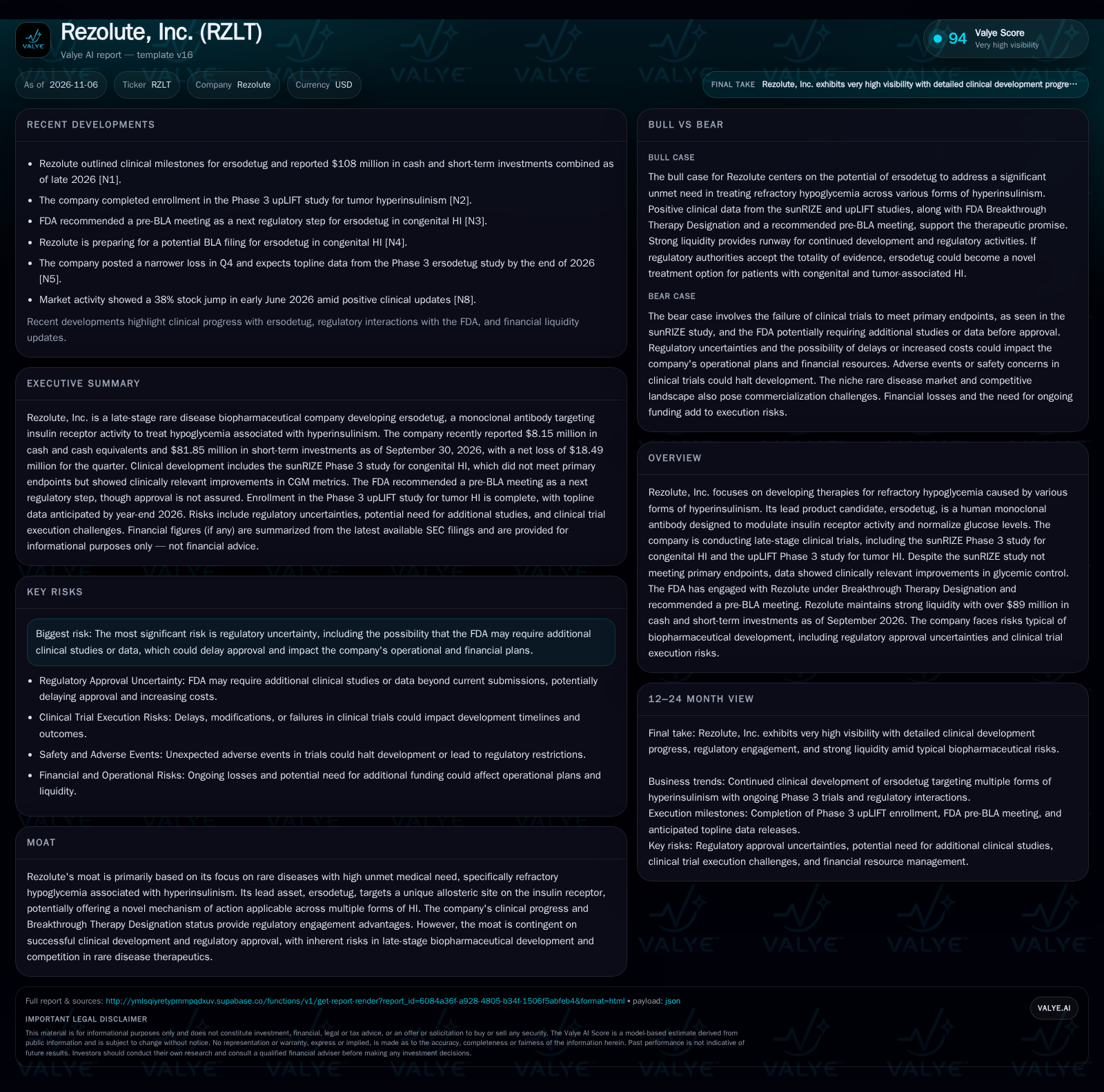
Rezolute, Inc. is progressing ersodetug for hyperinsulinism-related hypoglycemia, with a completed Phase 3 trial in congenital HI that showed clinically meaningful but not statistically definitive results, and a second Phase 3 trial for tumor HI with imminent topline data. The FDA has recommended a pre-BLA meeting, but approval is not assured. Commercial success hinges on regulatory acceptance and market adoption in a rare disease context. [S2] [N1] [N2] [N3]
Rezolute, Inc. is navigating the high-stakes landscape of rare disease therapeutics with its late-stage candidate ersodetug, aimed at treating severe hypoglycemia caused by various forms of hyperinsulinism. The company has reported both the completion of key Phase 3 clinical trial enrollment and substantial liquidity, positioning it to pursue regulatory submissions. However, the path forward is complicated by mixed clinical trial outcomes and the inherent unpredictability of FDA requirements, which could lead to further studies or delays. As Rezolute prepares for a potential Biologics License Application, the interplay between clinical data interpretation, regulatory expectations, and resource allocation will be central to its prospects. [S2] [N1] [N2] [N3]
Ersodetug’s Clinical Milestones and Regulatory Inflection Points
Rezolute’s lead candidate, ersodetug, is positioned as a potential treatment for refractory hypoglycemia across both congenital and tumor-induced hyperinsulinism. The sunRIZE Phase 3 study in congenital HI failed to meet its primary and key secondary endpoints, yet demonstrated clinically meaningful improvements in multiple continuous glucose monitoring metrics—a nuance that could influence regulatory deliberations. The FDA, under Breakthrough Therapy Designation, has recommended a pre-BLA meeting, signaling a willingness to review the totality of data but withholding any judgment on approvability or data sufficiency. Meanwhile, enrollment is complete in the upLIFT Phase 3 trial for tumor HI, with topline data expected by the end of 2026. These developments collectively set the stage for a pivotal period, with regulatory decisions and new clinical data likely to determine Rezolute’s near-term trajectory. [S2] [N1] [N2] [N3] [N4] [N5]
Translating Rare Disease R&D into Commercial Value: Economics and Capital Demands
Biopharmaceutical development in rare diseases is characterized by high upfront R&D costs, lengthy timelines, and binary regulatory risk. Rezolute’s economics will ultimately depend on achieving FDA approval and then securing payer reimbursement and market uptake—each step representing its own hurdle. If approved, rare disease drugs like ersodetug may command premium pricing due to limited alternatives and high unmet need, but pricing is often tempered by negotiation with payers and the size of the addressable patient population. The company’s reported $8.15 million in cash and $81.85 million in short-term investments as of September 30, 2026, offers areported liquidity position for near-term regulatory activities and ongoing trials, but will need to be carefully managed in light of a net quarterly loss of $18.49 million. Should further studies be required, additional funding could become necessary, highlighting the sector’s perennial tension between clinical progress and capital sufficiency. [S2] [N1]
Operating leverage in this context is delayed: substantial fixed R&D costs precede any revenue, and only after regulatory approval and commercial launch can gross margins scale. Manufacturing monoclonal antibodies is capital-intensive but, in rare diseases, per-patient revenue can be high enough to support attractive margins—assuming sufficient uptake and payer acceptance. However, rare disease launches often require significant investment in medical affairs, patient identification, and market education, which can compress operating margins in the early years post-launch.
Assessing Rezolute’s Moat: Novel Mechanism, Market Gaps, and Competitive Pressures
Rezolute’s competitive position is defined by its focus on refractory hypoglycemia due to hyperinsulinism—a rare and underserved condition with limited approved therapies. Ersodetug’s mechanism, targeting an allosteric site on the insulin receptor, is differentiated from existing treatments that target upstream pathways or rely on surgical intervention. This could theoretically allow broader applicability across both genetic and acquired forms of HI. However, the company’s moat is contingent on regulatory approval and demonstration of clear clinical benefit. Should ersodetug be approved, barriers to entry include the complexity of biologic drug development, the need for specialized clinical trial infrastructure, and the challenges of addressing a small and dispersed patient base.
Potential counterforces include emerging competitors in the rare metabolic disease space, advances in gene therapy or small-molecule modulators, and the risk that new entrants or established pharma companies with broader commercial infrastructure could outcompete Rezolute if efficacy or safety profiles are similar. Moreover, payer scrutiny over rare disease drug costs and real-world effectiveness could limit pricing power or market share, especially if clinical endpoints do not translate into meaningful quality-of-life improvements.
How Regulatory Flexibility and Clinical Nuance Could Unlock Value
A favorable scenario for Rezolute centers on the FDA accepting the totality of clinical evidence for ersodetug—despite the sunRIZE trial’s failure to meet primary endpoints—by placing greater weight on clinically relevant improvements in continuous glucose monitoring and patient outcomes. This would require regulatory flexibility, often seen in rare diseases where small patient populations and heterogeneous phenotypes make strict statistical endpoints challenging. If the upLIFT Phase 3 trial in tumor HI delivers statistically robust and clinically meaningful results, it could further validate ersodetug’s mechanism and expand its addressable market.
Confirmation of this scenario would involve the FDA granting BLA approval following the pre-BLA meeting, positive payer feedback on reimbursement, and initial commercial uptake in both congenital and tumor HI populations. Early physician adoption, supported by compelling real-world efficacy or patient-reported outcomes, would further de-risk the launch trajectory. Conversely, an FDA requirement for additional studies or a negative regulatory decision would falsify this upside path.
Navigating Regulatory Ambiguity and Capital Constraints in Rare Disease Commercialization
The most plausible path for Rezolute involves a protracted regulatory review, with the FDA requesting additional analyses or possibly a confirmatory study, given the missed primary endpoints in sunRIZE. Approval could be conditional or delayed, increasing development costs and extending the time to market. Meanwhile, topline data from the upLIFT trial may be mixed or require further validation, slowing momentum. Rezolute’s existing liquidity would support operations through these regulatory steps, but the company could need to raise additional capital if timelines extend or if an additional trial is mandated.
In this scenario, commercialization—if achieved—would proceed cautiously, with payers and clinicians awaiting more robust evidence before widespread adoption. Revenue ramp would be gradual, and operating margins could remain suppressed as medical affairs and market access investments continue. Evidence confirming this scenario would include extended regulatory timelines, additional capital raises, or announcements of new or modified clinical trials. A rapid approval or outright rejection would falsify the base case.
When Clinical and Regulatory Risk Compound: The Adverse Path
The downside for Rezolute materializes if the FDA judges the sunRIZE data insufficient for approval, especially given the lack of statistically significant primary and key secondary endpoints, and if upLIFT topline data fail to demonstrate clear benefit or raise new safety concerns. In this scenario, the company could be required to conduct additional large-scale trials, significantly increasing costs and delaying any potential revenue. Market sentiment would likely deteriorate, further constraining capital-raising options.
Adverse events in ongoing or future trials, or changes in regulatory standards for rare disease therapies, could further erode the business case. Evidence for this scenario would include negative regulatory outcomes, halted or redesigned studies, material adverse safety findings, or disclosures of significant cash burn without offsetting progress. A positive regulatory or commercial inflection would falsify this outcome.
Milestones That Will Shape Rezolute’s Transition from R&D to Commercialization
FDA feedback following the pre-BLA meeting for ersodetug in congenital HI—specifically, whether the agency signals acceptance of current data or demands further studies.
Topline results from the upLIFT Phase 3 trial in tumor hyperinsulinism, including both efficacy and safety signals.
Updates on cash burn rate and any announced or completed financing events, which would clarify operational runway relative to regulatory timelines.
Disclosures regarding payer engagement and initial reimbursement strategy, if available, as these will determine real-world pricing power.
Physician and patient advocacy group feedback on ersodetug’s clinical utility, which could influence adoption and market penetration.
Incidence and nature of any adverse events reported in ongoing or future trials, as these can directly affect approvability.
Any changes in competitive landscape—such as new entrants or advances in alternative HI therapies—that could pressure Rezolute’s position.
Disclaimer: This is research-only, informational analysis and not investment advice. It may include AI-generated interpretation and general industry context. Always verify important details using primary sources.

Comments