
Valhi Inc.: Navigating Cyclical Segments with Diversification and Margin Sensitivity
Valhi Inc. Reported liquidity position, a Q2 2026 earnings surge in its chemicals segment, and ongoing profitability, but faces earnings volatility and an underperform analyst rating. The company’s diversified structure across chemicals, component products, and real estate provides resilience, yet exposes it to cyclical swings and market scrutiny.
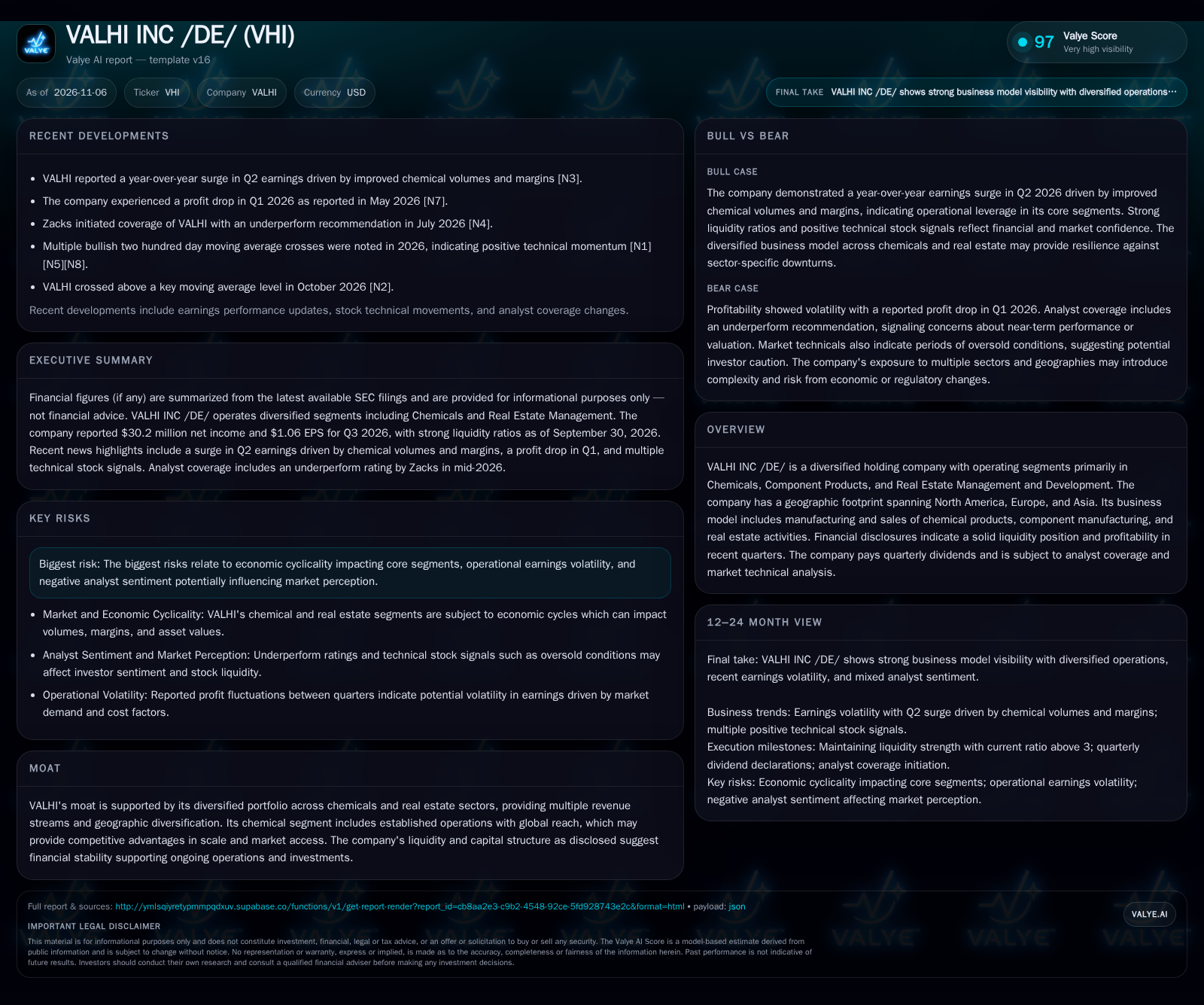
Valhi Inc. operates across chemicals, component products, and real estate, reporting reported liquidity position and a Q2 2026 earnings surge driven by chemical segment margins. However, earnings remain volatile, as seen in a Q1 profit drop, and analyst sentiment is cautious. The company’s diversification provides some resilience, but core exposure to cyclical chemical markets and commodity swings remains a central risk.
Valhi Inc. stands as a diversified holding company spanning chemicals, component manufacturing, and real estate management, with operations across North America, Europe, and Asia. [S2] [N3] [N4] [N7]
Recent Financial Momentum and Segment Volatility Shape the Near-Term Outlook
Valhi Inc. reported $30.2 million in net income and $1.06 basic and diluted EPS for Q3 2026, indicating continued profitability into the back half of the year. As of September 30, 2026, cash and cash equivalents stood at $216.9 million, supporting a robust current ratio of 3.29, which signals reported liquidity position. [S2]
The company’s Q2 2026 results showed a year-over-year earnings surge, specifically attributed to improved chemical volumes and margins, underscoring the segment’s leverage on group financials. However, this performance followed a profit drop in Q1 2026, reflecting the inherent volatility in Valhi’s operating environment. [N3] [N7]
Analyst sentiment remains mixed, with Zacks initiating coverage in July 2026 with an underperform recommendation, indicating external skepticism about sustainability or valuation. [N4]
Earnings Sensitivity Stems from Diverse Segment Dynamics and Cost Structures
Valhi’s revenue and profit streams are generated from three primary segments: Chemicals (notably titanium dioxide pigments), Component Products, and Real Estate Management and Development. The chemical segment is volume- and price-sensitive, with margins fluctuating alongside raw material costs, end-market demand, and global supply conditions. Periods of margin expansion, such as in Q2 2026, can quickly improve profitability thanks to operating leverage, while downturns, as seen in Q1, expose the downside risk inherent in commodity-linked businesses. [N3] [N7]
The Component Products and Real Estate segments provide diversification, but their contributions are generally less volatile and smaller in scale. Real estate operations may deliver steady returns but are subject to asset value swings and longer investment cycles.
Capital needs are moderate, with evidence of a substantial liquidity cushion and no immediate signs of financial constraint. However, the chemicals business periodically requires investment in working capital and plant maintenance, which could pressure cash flows during downturns if not tightly managed. Dividend payments, such as the $0.08/share declared in early 2025, reflect a commitment to capital return but could be reassessed if volatility persists. [S2]
The interplay between fixed and variable costs within Valhi’s chemical segment critically influences its earnings sensitivity. Given the capital-intensive nature of chemical manufacturing, a substantial portion of costs are fixed or semi-fixed, such as depreciation and maintenance of plant equipment. This cost structure means that during periods of higher volumes and favorable pricing, incremental revenues disproportionately enhance margins due to operating leverage. Conversely, during downturns, fixed costs persist, compressing margins and magnifying earnings declines. The company reported cash and liquidity metrics for the period; these figures do not by themselves establish operating runway, investment capacity, financial flexibility, or financing capacity.
Diversification and Global Reach Offer Some Insulation, but Commodity Exposure Remains Central
Valhi’s competitive position is anchored by its diversified portfolio, spanning chemicals, components, and real estate. The chemicals segment benefits from scale and global market access, which may support cost efficiencies and customer relationships. However, the segment remains exposed to intense competition from global chemical producers, cyclical demand patterns, and pricing pressure from lower-cost regions.
In Component Products, the company faces competition from both domestic and international manufacturers, with differentiation likely hinging on product quality, reliability, and integration with customer supply chains.
The real estate business, while more insulated from immediate commodity swings, is subject to macroeconomic cycles and local market dynamics. The breadth of Valhi’s operations across North America, Europe, and Asia may mitigate localized shocks but also introduces regulatory and operational complexity.
Overall, Valhi’s moat is based on diversification and scale, but its core chemicals business leaves it exposed to the same structural pressures that challenge other commodity-linked conglomerates.
Sustained Margin Expansion in Chemicals Could Unlock Further Earnings Growth
A favorable scenario would see continued strength in chemical volumes and sustained or rising margins, potentially driven by tight global supply, disciplined capacity management, or favorable input cost trends. If Valhi is able to leverage its scale to secure long-term supply contracts or pass through cost increases to customers, operating leverage could drive outsized gains in net income and cash flow.
Confirmation of this scenario would come from multiple consecutive quarters of rising chemical segment profits, stable or growing dividend payments, and upward revisions from analysts. Additional evidence might include disclosure of long-term supply agreements, margin guidance, or capital investment in higher-return segments.
Falsification would be signaled by renewed margin compression, sharp volume declines, or a need to cut dividends or increase leverage to sustain operations.
Segment Volatility Balanced by Diversification and Prudent Liquidity Management
The most plausible trajectory is one in which Valhi’s chemical segment continues to exhibit quarter-to-quarter volatility, with occasional margin-driven surges offset by periods of contraction. The component and real estate segments provide partial stabilization, but do not fully offset swings in the core chemicals operation.
Valhi’s reported liquidity position and moderate capital needs allow it to weather cyclical downturns without immediate financial distress. Dividend continuity is plausible unless a prolonged downturn emerges. Market sentiment may remain mixed, with technical stock signals and analyst ratings fluctuating in response to earnings volatility.
Should the company’s earnings stabilize or show reduced volatility, sentiment could gradually improve.
Commodity Downturn or Prolonged Margin Pressure Drives Financial Strain
A negative scenario would involve a sustained downturn in chemical pricing or demand—possibly triggered by oversupply, declining end-market consumption, or a spike in input costs. In this scenario, the chemical segment’s contribution would shrink, and the diversified portfolio might not be sufficient to offset the earnings drag.
Negative analyst revisions and further stock price weakness could follow, amplifying external scrutiny.
Evidence for this scenario would include consecutive quarters of declining segment margins, shrinking cash balances, or the announcement of cost-cutting measures and dividend reductions. A useful falsification would be stabilization or recovery in segment margins and cash flow.
Factors That Will Drive the Next Phase of Valhi’s Diversified Strategy
Quarterly chemical segment volume and margin trends—disclosure of these figures would clarify the sustainability of recent earnings surges and signal inflection points. [N3] [N7]
Cash flow from operations and changes in cash balances—if disclosed, these would help test the resilience of the business during periods of margin contraction. [S2]
Analyst rating changes or consensus estimate revisions—upgrades or downgrades may foreshadow shifts in market perception or signal emerging risks. [N4]
Announcements of new long-term supply contracts or capacity expansions in the chemicals segment would support the upside thesis.
Segment-level capital expenditure disclosures—if provided, these would offer clues about management’s confidence in demand and margin outlook.
Geographic revenue and profit breakdowns—would clarify the impact of regional economic conditions and help assess diversification benefits.
Real estate asset sales or acquisitions—if disclosed, these could materially affect cash flows and risk profile.
Disclaimer: This is research-only, informational analysis and not investment advice. It may include AI-generated interpretation and general industry context. Always verify important details using primary sources.

Comments