
Xerox at a Strategic Crossroads: Reinvention, Integration Hurdles, and the Economics of Moving Beyond Print
Xerox’s recent acquisitions and Reinvention strategy aim to reposition the business toward higher-growth IT solutions, but persistent losses, shareholder pressure, and competitive headwinds raise questions about execution, margin stability, and the company’s ability to escape legacy print economics.
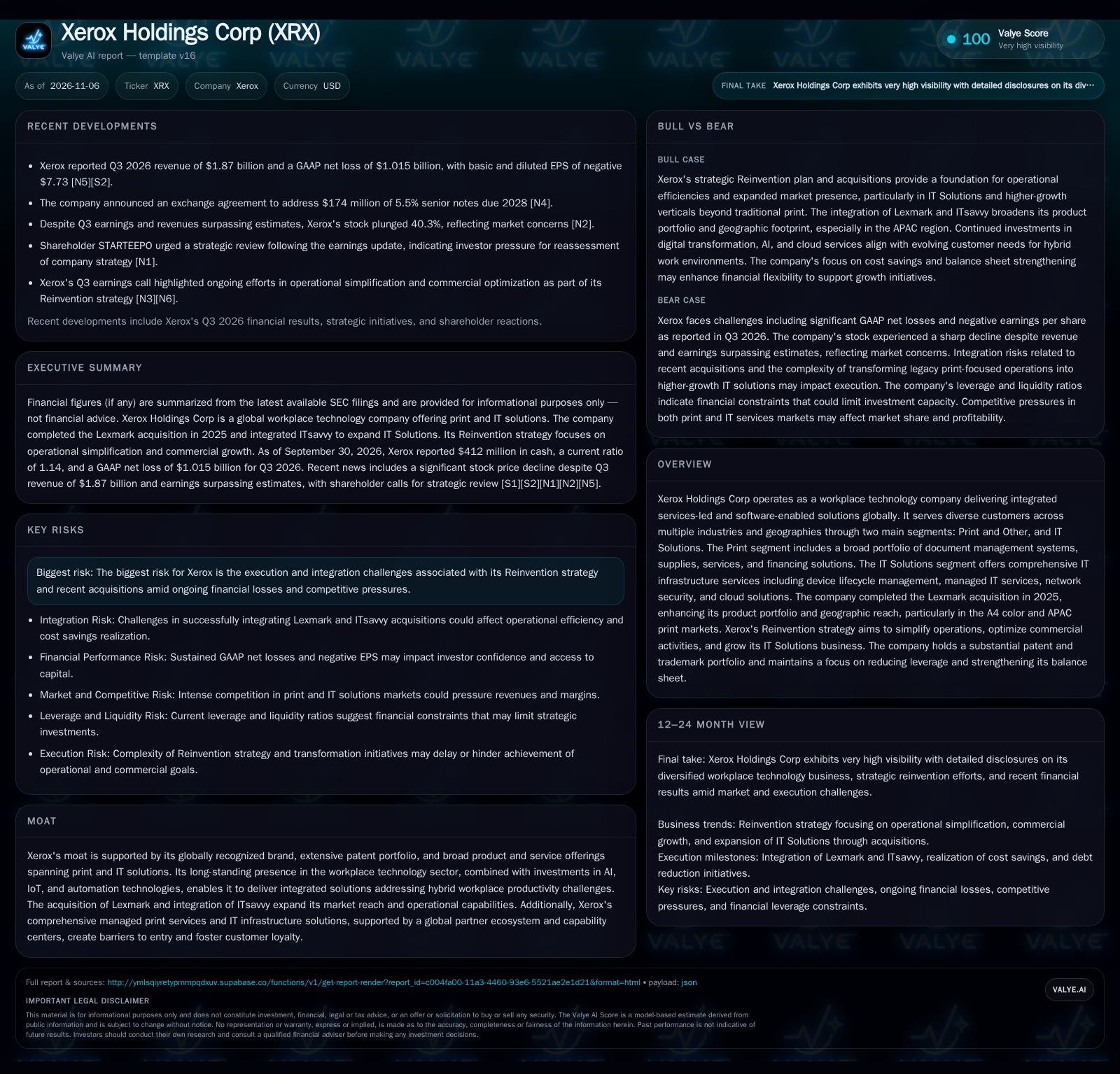
Xerox is attempting a major pivot from traditional print to integrated IT solutions, leveraging recent acquisitions and a broad patent portfolio. Despite operational simplification efforts and cost savings, the company posted a large Q3 2026 loss and faces investor demands for a strategic review. The success of its transformation will depend on integration execution, margin management, and its ability to build a differentiated IT platform in a crowded market. [S1] [S2] [N1] [N2] [N5]
Xerox Holdings Corp is at a pivotal juncture, grappling with the realities of transforming its legacy print-centric business into a diversified workplace technology platform. Despite headline-grabbing acquisitions of Lexmark and ITsavvy, and a declared Reinvention strategy promising operational streamlining and growth in IT solutions, Xerox’s Q3 2026 results revealed a sharp GAAP net loss and a dramatic stock price decline. With shareholders now pressing for a strategic review, the company’s future will likely hinge on its ability to deliver integration synergies, restore margin credibility, and demonstrate that it can compete—and win—in a rapidly evolving IT services landscape. [S1] [S2] [N1] [N2] [N5]
Recent Losses, Acquisitions, and Escalating Shareholder Pressure Define the Moment
Xerox reported Q3 2026 revenue of $1.87 billion alongside a GAAP net loss of $1.015 billion, with basic and diluted EPS at negative $7.73. [S2] [N5] This significant loss, despite revenue and earnings beating consensus estimates, triggered a 40.3% drop in the company’s share price and prompted activist shareholder STARTEEPO to call for a strategic review. [N1] [N2] The company’s balance sheet showed $412 million in cash, a current ratio of 1.14, and a cash ratio of 0.13 as of the end of Q3. [S2] Meanwhile, Xerox is actively addressing $174 million in senior notes maturing in 2028 through an exchange agreement. [N4] The combination of persistent financial losses, balance sheet constraints, and heightened investor scrutiny underscores the urgency—and risk—of its ongoing transformation and integration initiatives.
From Print Margins to IT Solutions: Shifting the Value Equation
Xerox’s traditional cash flow engine has been its Print and Other segment, which encompasses hardware sales (including A4 and A3 multifunction devices), consumables, document management, and managed print services. This model typically features a mix of upfront hardware revenue and recurring supplies/service streams, but faces secular volume declines and margin pressure as digital workflows replace paper-based processes. Service contracts and financing arrangements historically provided some revenue visibility, but the commoditization of print hardware and competition from lower-cost providers have eroded pricing power.
The company’s pivot into IT Solutions—accelerated by the acquisitions of Lexmark and ITsavvy—aims to capture higher-growth, potentially higher-margin opportunities in managed IT services, cloud, security, and device lifecycle management. If Xerox can successfully cross-sell IT services to its legacy customer base and leverage Lexmark’s global centers for operational efficiency, the business could achieve a more stable, service-driven margin profile. However, IT services typically involve lower capital intensity and more variable cost structures, but are also exposed to fierce competition, price transparency, and rapid technology cycles. Realizing operating leverage from existing infrastructure, and scaling recurring revenue versus transactional sales, will be vital for sustaining any margin improvement.
Brand Legacy, Patent Assets, and the Battle for Differentiation in IT Services
Xerox retains a globally recognized brand and an extensive portfolio of 4,153 U.S. utility and design patents, plus 159 trademarks as of year-end 2025. [S1] These assets support a broad suite of offerings across document management, workflow automation, and hybrid workplace solutions, and theoretically create barriers to entry for niche players. The integration of Lexmark strengthens Xerox’s position in the A4 color segment and expands its reach in the APAC print market—areas where scale and supply chain integration can matter.
However, the company faces entrenched competition both in print (from global print hardware manufacturers and contract service providers) and in IT services (from large managed service providers, cloud integrators, and security specialists). The shift to IT solutions brings Xerox into direct competition with established IT channel partners, regional VARs, and global systems integrators, many of whom already have deep customer relationships and specialized expertise. The question is whether Xerox can deliver enough differentiated value—through integrated print-IT offerings, workflow automation, or proprietary software—to justify premium pricing or sticky contracts in its targeted segments.
Reinvention Unlocks Synergies: Integration Yields Margin and Growth Inflection
If Xerox successfully executes its Reinvention strategy, realizing more than $500 million in cost savings and integrating Lexmark and ITsavvy with minimal disruption, the company could stabilize margins and reignite top-line growth. [S1] Leveraging Lexmark’s global capability centers for service delivery and operational support may reduce structural costs and improve responsiveness, particularly in international markets. Cross-selling IT solutions to an installed base of print customers, combined with expanded cloud and security offerings, could accelerate the transition to a recurring-revenue, service-centric business model.
Evidence that would confirm this scenario includes a return to positive operating cash flow, margin expansion in the IT Solutions segment, sequential growth in managed services contract value, and improved customer retention. Downward leverage (approaching the sub-3x target) and a reduction in net losses would further support the thesis that Xerox’s transformation is delivering tangible financial benefits.
Transformation Meets Friction: Incremental Progress Amid Execution Risk
The most plausible trajectory is one in which Xerox achieves partial integration and operational simplification, but faces ongoing friction from legacy print declines, competitive pricing in IT services, and the complexity of merging disparate business cultures. Cost savings from the Reinvention plan may be offset in part by restructuring charges, integration expenses, and the drag from underperforming segments.
Revenue growth could remain modest, with incremental gains in IT Solutions not fully compensating for print headwinds. Margins may stabilize but not materially expand, especially if Xerox is forced to discount aggressively to win IT contracts or invest heavily in customer acquisition and digital capabilities. Confirmation of this scenario would come from continued operating losses but narrowing deficits, flat or slightly improving gross margins, and slow but steady growth in services-related revenue. Falsification would require either a sharp return to profitability or a pronounced acceleration in service contract bookings.
Integration Stalls, Print Erosion Accelerates, and Shareholder Activism Forces Disruption
In a negative scenario, Xerox’s integration of Lexmark and ITsavvy fails to deliver targeted cost savings or operational synergies. Continued losses from the print segment, compounded by execution missteps and customer attrition, could lead to further margin erosion and cash burn.
Escalating shareholder activism, as seen in recent calls for a strategic review, could drive leadership changes, divestitures, or even a sale of the company. Confirmation of downside risk would include widening losses, negative operating cash flow, missed cost-reduction milestones, and persistent stock underperformance relative to peer IT service and hardware firms.
Milestones That Will Determine Whether Xerox’s Reinvention Succeeds or Falters
Progress against the $500 million cost savings target by the end of 2025—are savings realized and sustainable, or offset by integration costs? [S1]
Sequential revenue and margin trends in the IT Solutions segment, if disclosed, to gauge whether the pivot from print is generating profitable growth.
Updates on managed service contract wins, renewal rates, and customer retention in both print and IT services—a useful metric would be the percentage of revenue from recurring contracts.
Demonstrable reduction in leverage, specifically progress toward the stated target of less than 3.0x total debt to EBITDA. [S1]
Evidence of successful cross-selling or bundled deals leveraging the combined Xerox-Lexmark-ITsavvy portfolio.
Operating cash flow trends and any improvement in free cash flow generation—would help test whether the business model is self-funding.
Shareholder and board actions in response to ongoing losses—such as strategic reviews, leadership changes, or divestiture announcements.
Customer adoption rates for new workflow automation, cloud, and security solutions—if disclosed, would further validate the Reinvention strategy.
Disclaimer: This is research-only, informational analysis and not investment advice. It may include AI-generated interpretation and general industry context. Always verify important details using primary sources.

Comments