
BioAge Labs: Clinical Progress, Aging Biology Platform, and the Road to Proof-of-Concept
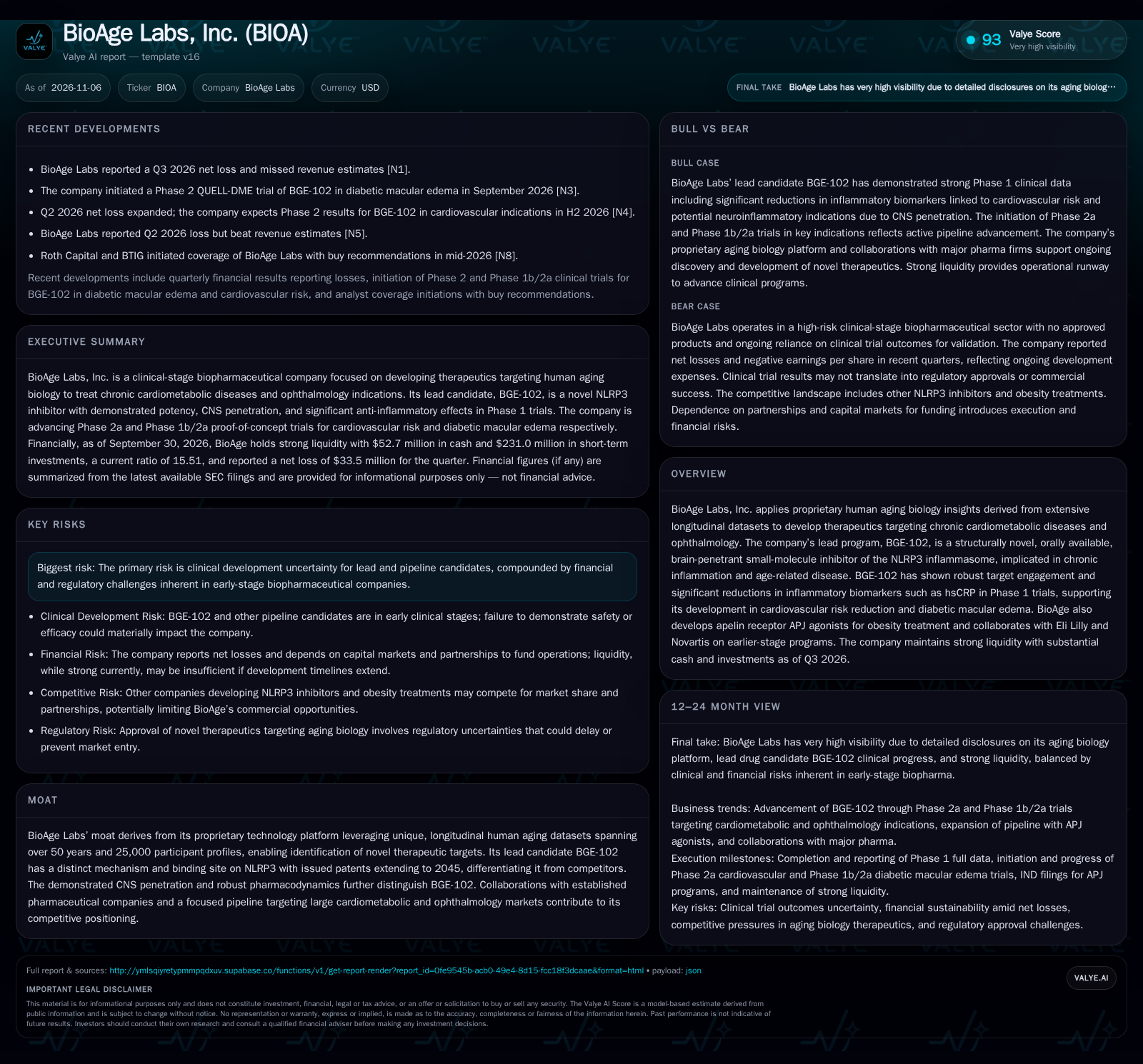
With reported liquidity position and a differentiated approach targeting the biology of aging, BioAge Labs is advancing its lead NLRP3 inhibitor BGE-102 into mid-stage trials for cardiometabolic and ophthalmic diseases. The company’s clinical milestones in 2026–2027 will test whether its unique platform and partnerships can translate into regulatory and commercial traction despite sectoral risks.
The next 12–18 months will see key Phase 2 readouts and IND progress, with the company’s unique aging-focused platform and pharma collaborations providing scientific and financial optionality. However, the model remains unproven commercially, and clinical failure or delays could erode its current advantage. [S1] [S2] [N3] [N4]
BioAge Labs is positioned at the intersection of aging biology and clinical drug development, with a proprietary platform and a lead asset, BGE-102, now advancing into mid-stage trials for cardiometabolic and ophthalmic indications. Yet, as with all early-stage biopharma, the core thesis will be tested not by platform promise or partnerships, but by whether its lead program delivers efficacy and safety in patients. The next phase of clinical results will clarify whether BioAge’s differentiated approach can create durable value or faces the same attrition risks as its sector peers. [S1] [S2] [N3] [N4]
Major Clinical Advancements and Financial Strength Define the Current State
BioAge Labs is advancing BGE-102, a novel NLRP3 inhibitor, through Phase 2a proof-of-concept trials for cardiovascular risk in obese patients with elevated hsCRP and Phase 1b/2a trials for diabetic macular edema, with results expected in 2026 and 2027. This clinical progress marks a shift from early safety validation to efficacy testing in patient populations, a key inflection for value creation and pipeline risk reduction. [S1] [N3] [N4]
While the reported net loss for Q3 was $33.5 million, this is typical for a clinical-stage biotech and underscores the capital-intensive nature of the business. [S2] [N1]
BioAge’s platform, built on proprietary longitudinal human aging datasets, and its collaborations with Eli Lilly and Novartis, position it as a credible innovator in the field of aging biology. However, no product has reached the market, and all pipeline value is contingent on future clinical and regulatory outcomes. [S1]
Commercial Model Hinges on Clinical Success and Market Differentiation
BioAge’s economics are currently defined by high R&D burn and lack of product revenue, a standard profile for clinical-stage biopharma. Its business model is predicated on advancing assets through proof-of-concept, with potential value realization via out-licensing, partnerships, or, less likely in the near term, self-commercialization.
If BGE-102 demonstrates efficacy and safety in Phase 2 trials, the company could pursue a licensing deal for late-stage development or retain rights to launch in select indications. The dual focus on cardiometabolic disease and ophthalmology (via diabetic macular edema) increases addressable market size but also requires differentiated clinical evidence to command premium pricing, especially with existing and emerging competitors in both spaces.
Operating leverage, if achieved, would stem from successful clinical translation—moving from negative cash flow to milestone payments, royalties, or product sales. The company’s fixed cost base (primarily R&D and G&A) is high, but variable costs would rise with commercial launch, including manufacturing, distribution, and sales infrastructure. The substantial cash and investments on hand reduce near-term financing risk but are not, by themselves, a guarantee of long-term sustainability.
Proprietary Platform and Patent Estate Provide Differentiation, but Competition Remains Intense
BioAge’s competitive position is anchored by its proprietary human aging datasets and platform, which support identification of novel targets and patient stratification. BGE-102’s issued patents—covering composition of matter and a unique binding site on NLRP3 through 2045—afford it a degree of intellectual property protection not always found in small-molecule programs. CNS penetration and robust pharmacodynamic effects, as demonstrated in Phase 1, further differentiate BGE-102 from some competitors. [S1]
However, the NLRP3 inhibitor field is crowded, with both small and large biopharma companies pursuing similar mechanisms for inflammation-driven diseases. In obesity and metabolic disease, GLP-1 analogs and other novel mechanisms have set a high efficacy and safety bar, while ophthalmology is dominated by established anti-VEGF therapies. BioAge’s collaborations with Eli Lilly and Novartis provide scientific and external validation, but do not preclude competitive headwinds or guarantee commercial uptake.
Switching costs for prescribers and payers in these indications are typically low unless BioAge’s candidates demonstrate clear clinical or economic advantages. The company’s platform could generate additional pipeline assets, but each will face similar hurdles of clinical, regulatory, and commercial proof.
Transformational Value if BGE-102 Delivers Clinical Proof and Platform Expands
A favorable outcome for BioAge would require BGE-102 to show statistically and clinically meaningful efficacy in both cardiovascular and ophthalmic indications, with a safety profile competitive with or superior to market standards. Strong Phase 2 data could enable lucrative licensing deals or partnerships with large pharma, accelerating late-stage development and potentially yielding milestone payments and future royalties.
The company’s unique aging-biology platform could then attract additional collaborations, expanding its R&D pipeline and validating its target-discovery approach. IND filings for APJ agonists in obesity would further broaden the addressable market and diversify risk. In this scenario, BioAge could transition from a high-burn, single-asset story to a platform company with sustainable economics.
Confirmation of this scenario would come from positive top-line results in upcoming Phase 2a and Phase 1b/2a trials, new or expanded licensing deals, and evidence of pipeline expansion or additional pharma partnerships.
Most Likely Trajectory: Incremental Progress, with Delayed or Mixed Readouts
The most plausible outcome is that BioAge achieves mixed or modest efficacy signals in its ongoing trials, sufficient to justify continued development but not enough to trigger outsized licensing deals or commercial commitments. The company may report some positive biomarker or subgroup findings but face challenges achieving statistical significance on primary endpoints.
In this scenario, the company continues to burn cash at current rates, relying on its liquidity reserve to fund additional trials or expanded cohorts. The platform may yield further pipeline candidates, but near-term value remains tied to BGE-102’s progress. Partnerships may continue at the discovery or preclinical stage, but without major upfront payments or clinical milestones, BioAge remains dependent on the capital markets for future funding.
Evidence supporting this trajectory would include trial extensions, modest efficacy data, or announcements of expanded but non-pivotal partnerships. Falsifying evidence would be either clear clinical failure or, conversely, a major licensing deal or acquisition offer.
Failure in Clinical Trials Would Undermine Platform and Funding Options
The most adverse outcome would be clinical failure for BGE-102—such as lack of efficacy or unacceptable safety signals in Phase 2 trials. Given the company’s high R&D burn and absence of commercial revenue, negative or inconclusive results would likely trigger cost-cutting, pipeline reprioritization, and a reassessment of the platform’s core thesis.
In this scenario, BioAge’s liquidity, while currently strong, would be consumed by ongoing expenses without the prospect of near-term partnering or product launches. The company could face challenges raising additional capital, especially if investor confidence in the aging-biology approach is shaken by failed proof-of-concept.
Confirmation would come from trial terminations, workforce reductions, and delays or cancellations of planned IND filings. Additional evidence would be an inability to secure new partnerships or a significant drop in analyst coverage or market interest.
Milestones That Will Determine Whether BioAge’s Platform Delivers on Its Potential
Top-line efficacy and safety results from Phase 2a (cardiovascular) and Phase 1b/2a (diabetic macular edema) trials for BGE-102, expected in 2026–2027.
Evidence of successful CNS penetration and sustained target engagement in patient populations, as measured by reduction in hsCRP and IL-1β (if disclosed).
Progress on IND filings and preclinical data for APJ agonist programs targeting obesity, especially by end of 2026.
Updates on the scope, terms, or expansion of collaborations with Eli Lilly and Novartis.
Disclosure of new pipeline assets or additional target discovery deals leveraging the aging biology platform.
Any changes in competitive landscape, such as new NLRP3 inhibitor approvals or major clinical readouts from peer companies.
Analyst coverage changes, including downgrades or dropped coverage, which may reflect shifting external confidence.
Disclaimer: This is research-only, informational analysis and not investment advice. It may include AI-generated interpretation and general industry context. Always verify important details using primary sources.

Comments