
Consolidated Edison: Managing Receivables and Regulatory Constraints in a Shifting Utility Landscape
Consolidated Edison’s regulated utility model in New York and New Jersey delivers stable revenues, but rising aged receivables and limits on cost recovery challenge financial resilience. The company’s strategic review of transmission assets and post-pandemic collection efforts will shape its risk profile and long-term value.
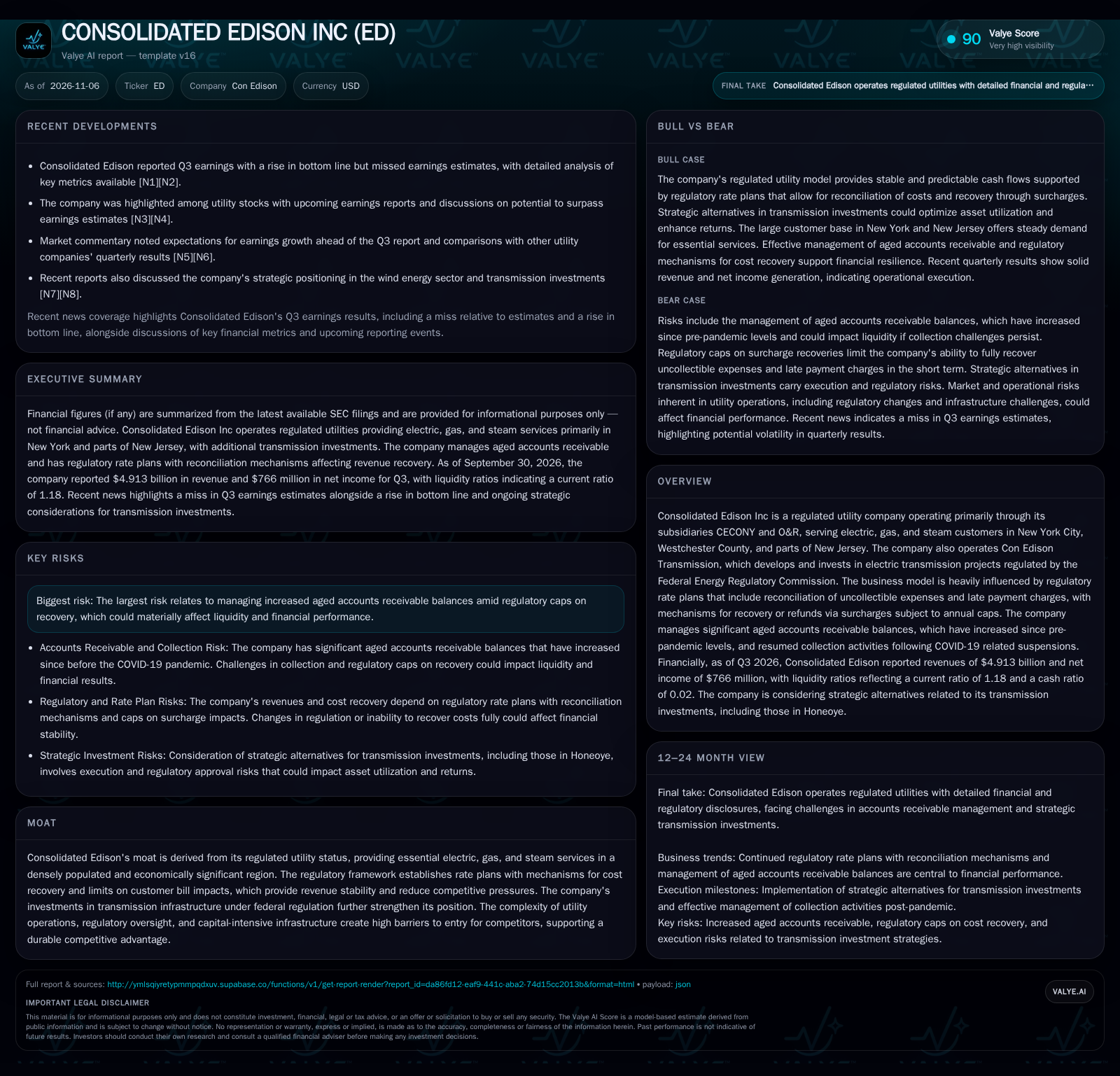
Consolidated Edison continues to generate substantial revenue and net income from its regulated utility operations, but faces increased aged accounts receivable and regulatory caps on recovering certain costs. Strategic alternatives for transmission investments could enhance returns, yet execution and regulatory risks remain material. The company’s ability to manage collections and navigate evolving regulation will be key to future performance. [S2] [S1]
Consolidated Edison stands as a quintessential regulated utility, serving millions in the metropolitan New York area and neighboring regions. Its business model offers revenue predictability through detailed rate plans and regulatory oversight, but the financial picture is complicated by mounting aged receivables and rigid caps on recovery of certain costs. As the company resumes post-pandemic collection activities and evaluates strategic moves in its transmission business, investors must weigh the durability of Con Edison’s cash flows against operational, regulatory, and execution risks that could reshape its risk-reward profile in the coming quarters. [S1] [S2]
Recent Results Highlight Receivables Pressure and Regulatory Recovery Constraints
In the third quarter of 2026, Consolidated Edison reported $4.913 billion in revenue and $766 million in net income, with basic and diluted EPS at $2.07 and $2.06, respectively. These results underline the company’s ongoing ability to generate substantial cash flow from its regulated utility base. However, the company’s aged accounts receivable balances have increased since pre-pandemic levels, reflecting persistent collection challenges. This trend is particularly noteworthy because regulatory mechanisms allow for only partial recovery of uncollectible expenses and late payment charges, with annual caps limiting customer bill impacts to 0.5% per commodity. As a result, while the company has resumed collection activities post-pandemic, its exposure to bad debt and the structural limits on cost recovery present ongoing risks to short-term liquidity and margin stability. [S2] [S1]
Additionally, Con Edison is considering strategic alternatives for certain transmission investments, notably those in Honeoye. This could signal forthcoming changes to the company’s asset base, capital allocation, or earnings mix, introducing a layer of strategic execution risk atop its core operating challenges. [S1]
Regulated Utility Economics: Stability Versus Collection and Capital Allocation Challenges
Con Edison’s fundamental economic engine is its role as a regulated provider of electricity, gas, and steam, with a customer base spanning New York City, Westchester, and parts of New Jersey. The business is capital intensive and highly regulated, with revenues largely determined by rate cases that set allowed returns and include mechanisms for reconciling certain costs, such as uncollectibles and late payment charges. These reconciliation mechanisms help smooth earnings volatility but are subject to annual caps that limit the pace and extent of cost recovery, especially for extraordinary events or sustained increases in bad debt.
The company’s cost structure is characterized by significant fixed costs—primarily infrastructure, labor, and regulatory compliance—while variable costs are largely pass-throughs. This creates potential for operating leverage if demand or rate base grows, but also exposes the company to downside risk if costs or receivables pressures outpace recovery mechanisms. The capital needs are continuous, given the necessity to maintain and upgrade grid infrastructure, comply with evolving regulatory and environmental standards, and pursue growth in transmission and distribution.
The recent rise in aged accounts receivable suggests a growing working capital requirement and, if sustained, could require increased borrowing or asset sales to maintain liquidity. Strategic alternatives for transmission assets may unlock value or improve capital efficiency, but also carry risks of stranded costs, regulatory disallowance, or suboptimal reinvestment if not executed carefully.
Barriers to Entry and Regulatory Shielding Versus Operational and Policy Headwinds
Con Edison’s competitive position is defined by its status as a regulated monopoly in its service territories, benefiting from high barriers to entry due to the capital intensity, regulatory complexity, and essential nature of utility infrastructure. The company’s rate base is protected from direct competition, and its regulatory framework provides a degree of revenue stability and cost recovery not available to unregulated peers.
However, the company is not immune to broader competitive and substitution risks. Distributed energy resources, energy efficiency mandates, and policy shifts toward decarbonization could erode long-term demand growth or require costly adaptation of legacy infrastructure. In the near term, the main competitive challenge comes from regulatory lag—the delay between cost increases or revenue shortfalls and their recovery through rate adjustments. This is especially acute for uncollectibles and late payment charges, where annual caps limit the company’s flexibility to pass through all costs, exposing it to margin compression during periods of economic stress or rising delinquencies.
Peer utilities in densely populated, high-cost urban environments face similar pressures, but Con Edison’s exposure is magnified by the scale of its customer base and the complexity of its service area. The company’s investments in transmission infrastructure—regulated at the federal rather than state level—offer potential for higher returns, but also attract heightened regulatory scrutiny and execution risk.
Effective Receivables Management and Transmission Asset Optimization Drive Outperformance
If Con Edison successfully curtails the growth of aged accounts receivable and demonstrates improved collection rates post-pandemic, it could reduce bad debt expense and free up working capital, supporting stronger cash flow conversion. This would likely require enhanced billing processes, targeted customer outreach, and possibly regulatory support for more flexible recovery mechanisms. Evidence of declining receivables balances and reduced write-offs would confirm this scenario.
On the strategic front, if the company executes value-accretive alternatives for its transmission assets—such as joint ventures, asset sales at attractive multiples, or redeployment into higher-return projects—earnings quality and capital efficiency could improve. Regulatory approval of such moves, coupled with stable or rising allowed returns, would further validate the upside case.
This scenario would be further supported by minimal regulatory lag in cost recovery and stable customer demand, allowing the company to leverage its fixed cost base and deliver above-consensus earnings growth.
Receivables and Regulatory Caps Constrain Margin Expansion Despite Core Stability
The most plausible outcome is that Con Edison continues to generate stable revenues and earnings from its core regulated utility business, but faces ongoing headwinds from elevated aged accounts receivable and the regulatory caps on cost recovery. The company likely manages to prevent further deterioration in collections but does not materially reduce the backlog, resulting in persistent, though not escalating, working capital drag.
Transmission asset strategy may yield incremental improvements or modest capital redeployment, but execution risk and regulatory approval processes limit the pace and magnitude of any value creation. Rate cases and reconciliation mechanisms continue to provide a buffer against cost volatility, but with caps in place, margin expansion remains limited.
Confirmation of this scenario would require evidence of flat to slightly improving receivables balances, steady regulatory outcomes, and earnings tracking close to historical averages without major positive or negative surprises.
Sustained Receivables Deterioration and Regulatory Delays Undermine Potential Financial Flexibility
In a more adverse scenario, Con Edison’s aged accounts receivable climb further, either due to economic weakness, customer non-payment, or operational lapses in collections. With regulatory caps limiting the speed of cost recovery, this could lead to rising bad debt expense, reduced cash flow, and the need for additional borrowing or asset sales to maintain liquidity.
If the company encounters delays or unfavorable outcomes in pursuing strategic alternatives for transmission assets—such as regulatory pushback or failed negotiations—capital may remain tied up in underperforming assets, weighing on returns and constraining future investment.
This scenario would be confirmed by sequential increases in aged receivables, rising bad debt write-offs, negative working capital trends, and either muted or negative impacts from transmission asset initiatives. Earnings would likely fall short of expectations, and liquidity pressures could prompt defensive measures.
Testing the Thesis: Collection Trends, Regulatory Actions, and Strategic Asset Moves
Aged accounts receivable balances: Sequential movement in outstanding balances, especially relative to pre-pandemic levels, will indicate progress or deterioration in collections. [S1]
Bad debt expense and write-off rates: Trends in uncollectibles, if disclosed, would clarify whether credit risk is abating or intensifying.
Regulatory actions on cost recovery: Any changes to the annual cap on surcharge recoveries or approval of more flexible mechanisms would materially impact margin outlook.
Transmission asset transactions: Announcements of asset sales, joint ventures, or redeployment of capital, including outcomes for the Honeoye investment, will test the company’s ability to execute on strategic alternatives. [S1]
Quarterly working capital trends: Changes in working capital requirements, if disclosed, would reflect the operational impact of receivables management.
Rate case outcomes: Approval or denial of proposed rate increases or adjustments to reconciliation mechanisms would shape future revenue and earnings stability.
Earnings volatility relative to consensus: Ongoing misses or beats versus consensus forecasts may signal underlying operational or regulatory shifts. [N1] [N2]
Disclaimer: This is research-only, informational analysis and not investment advice. It may include AI-generated interpretation and general industry context. Always verify important details using primary sources.

Comments