
Bank of Marin Bancorp: Margin Improvement, Real Estate Exposure, and the Sustainability of Regional Banking Economics
Bank of Marin Bancorp’s Q3 2026 results show improved profitability, asset quality, and operational efficiency. Yet, its heavy commercial real estate concentration and California focus pose structural risks if credit or funding conditions shift. The company’s ability to navigate margin management, deposit trends, and regulatory capital requirements will determine its resilience as regional banking dynamics evolve.
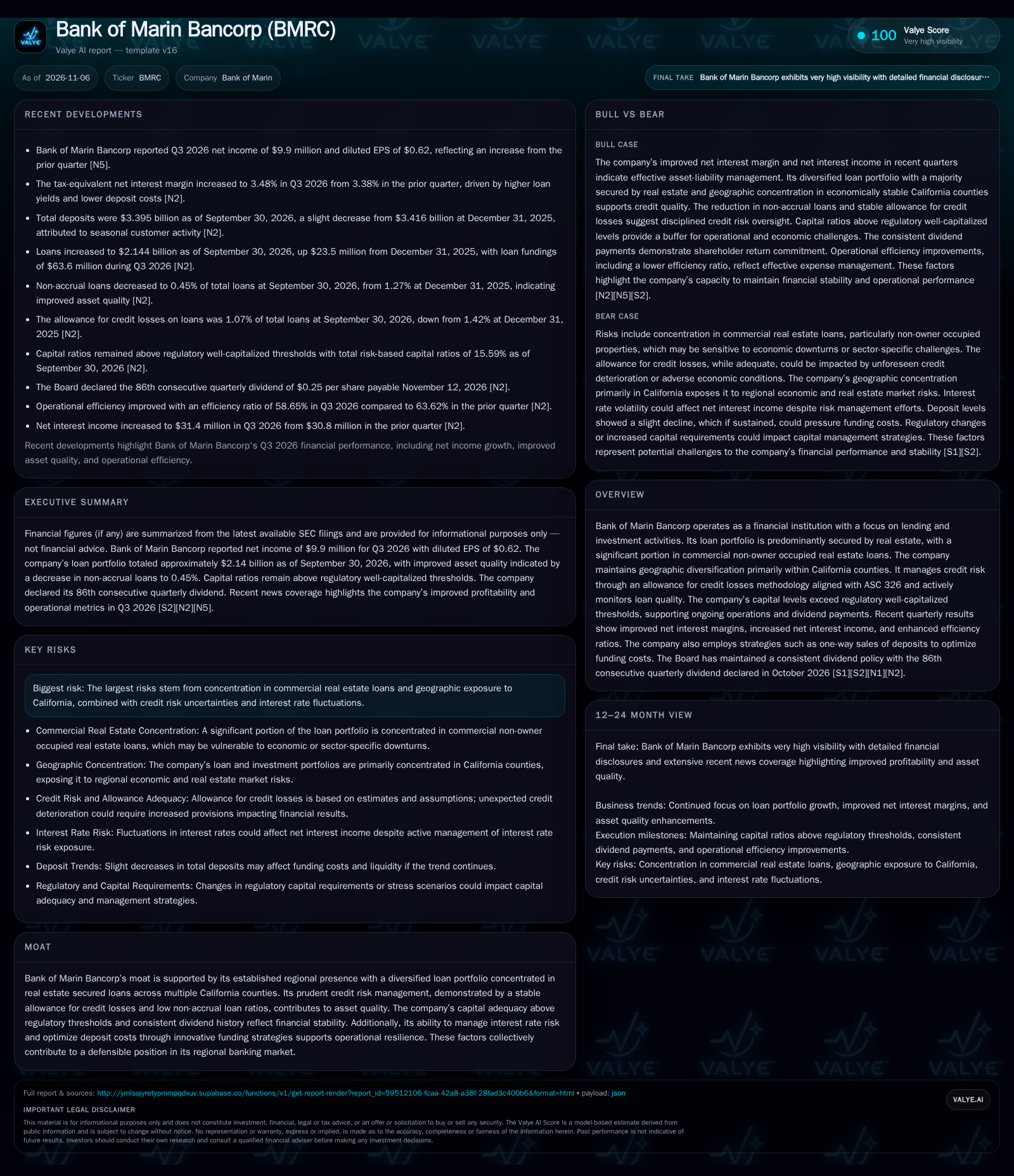
Bank of Marin Bancorp reported stronger Q3 2026 results, with higher net interest margin, improved efficiency, and lower non-accrual loans. However, its loan book remains heavily weighted to California commercial real estate, exposing the bank to sector and geographic risks. The sustainability of recent gains will depend on credit quality, deposit stability, and disciplined capital management in a shifting economic and regulatory environment. [S2] [N2]
Bank of Marin Bancorp’s latest quarter underscores the strengths and vulnerabilities of a disciplined, regionally focused lender. The bank delivered higher net interest income and margin, improved operational efficiency, and marked gains in asset quality. Yet beneath these headline improvements, the institution remains deeply exposed to commercial real estate cycles and regional economic shifts in California. The sustainability of its recent outperformance will be determined by its ability to manage credit risk, defend deposit share, and adapt to evolving regulatory and market conditions.
Recent Margin Gains and Asset Quality Improvements Define Q3 2026
Bank of Marin Bancorp posted net income of $9.9 million for Q3 2026, translating to diluted EPS of $0.62. The bank’s tax-equivalent net interest margin rose to 3.48% from 3.38% in the prior quarter, driven by higher loan yields and reduced deposit costs. Asset quality strengthened, as non-accrual loans fell to 0.45% of total loans (from 1.27% at year-end 2025) and the allowance for credit losses declined to 1.07%. The loan book grew modestly to $2.14 billion, while total deposits edged down to $3.395 billion. The efficiency ratio improved to 58.65% in Q3 2026, highlighting better cost management. These changes reflect a bank that is capturing improved spreads and credit outcomes, but also one that faces ongoing competition for deposits and is heavily exposed to commercial real estate dynamics. [S2] [N2]
How Bank of Marin Converts Lending into Profitable Returns
Bank of Marin earns its core revenue from the spread between interest income on loans and investments and interest paid on deposits and other funding sources. Its Q3 2026 net interest margin of 3.48% signals effective asset-liability management—benefiting from a mix of higher-yielding loans and disciplined deposit pricing. The predominance of real estate-secured loans, especially commercial non-owner occupied properties, can offer above-average yields but also concentrates risk in a cyclical asset class.
The bank’s cost structure is largely fixed in the short term, with a branch network and compliance infrastructure that scale slowly with balance sheet growth. Improvements in the efficiency ratio to 58.65% suggest recent success in controlling non-interest expense relative to revenue. Non-interest income—while a smaller contributor—rose to $3.67 million in Q3, reflecting fee-generating activities such as one-way sales of deposits. The company’s capital ratios (total risk-based capital at 15.59%, Tier 1 leverage above 9%) indicate current surplus capacity, though regulatory or credit shocks could require retention of earnings over distributions.
Deposit funding remains the linchpin of the bank’s economics. A slight decrease in deposits, if it persists, could force higher funding costs or constrain loan growth. The bank’s ability to maintain or grow low-cost core deposits is critical to sustaining net interest margin and competitive positioning.
Regional Strengths and Sector Concentrations Shape Competitive Defensibility
Bank of Marin’s competitive advantage stems from its established presence and relationships in affluent Northern California markets. Its loan book is diversified geographically across several counties (Marin, Sonoma, Alameda, San Francisco, Sacramento, Napa), but remains regionally concentrated. The focus on commercial real estate lending—especially non-owner occupied properties—positions the bank to serve local businesses and investors with tailored credit products.
However, this niche exposes the bank to property value cycles and competitive lending from both larger regionals and non-bank lenders. Digital-first banks and fintechs are intensifying competition for deposits, especially as rates rise and customers seek higher-yielding alternatives. Local relationship banking and credit expertise may help Bank of Marin defend its share, but switching friction is eroding as technology adoption increases.
Peer regional banks with similar real estate concentrations face parallel risks and opportunities. The question is whether Bank of Marin’s underwriting discipline and local knowledge are sufficient to offset the inherent cyclicality of its core lending segments.
If Credit Quality Holds and Deposit Mix Stabilizes, Margin Expansion Could Persist
Should Bank of Marin maintain its current asset quality—evidenced by low non-accruals and controlled charge-offs—while defending or growing its core deposit base, the bank could continue to expand its net interest margin even as broader industry funding costs rise. Operational efficiency gains could further enhance profitability, especially if non-interest income sources (such as fee-based services) are scaled.
The upside scenario would be confirmed by continued declines in non-accrual and criticized loans, stable or rising core deposits, and persistent improvement in the efficiency ratio. Loan growth, especially in higher-yielding but prudently underwritten segments, would support sustained earnings momentum. Evidence of successful deposit acquisition or retention strategies, and resilience in California’s commercial property markets, would further validate this trajectory.
Defending Margins Amid Sector Headwinds and Competitive Deposit Pressures
The most plausible forward path is one of cautious growth and margin defense. Bank of Marin is likely to experience stable but modest loan growth, with net interest margin pressured if deposit costs rise faster than loan yields. Asset quality should remain sound if economic conditions in California remain benign, but the risk of isolated commercial real estate weakness persists given the loan book’s concentration.
Operational efficiency may improve incrementally but is unlikely to deliver large gains absent significant revenue growth or restructuring. Dividend continuity and above-regulatory capital ratios are probable, though payout ratios could be constrained if regulatory requirements tighten or credit costs increase. Confirmation of this scenario would include steady non-accrual loan ratios, manageable provision expenses, and deposit levels that do not materially erode.
A Commercial Real Estate Shock or Deposit Run Could Erode Capital and Earnings
A plausible adverse scenario would involve a downturn in California commercial real estate, leading to higher loan delinquencies, elevated charge-offs, and the need to rebuild loss reserves. Given that 64.5% of loans are commercial non-owner occupied real estate, even a moderate sector correction could have outsized impact on earnings and capital. If deposit attrition accelerates—due to rate competition or loss of customer confidence—the bank could be forced to tap higher-cost wholesale funding, shrinking net interest margin and pressuring profitability.
Regulatory capital ratios, while currently strong, could be tested if credit losses spike or risk-weighted assets increase. A sharp increase in criticized assets, declining deposits, and rising funding costs would confirm this scenario. Evidence of stress would likely appear first in non-accrual loan trends and wholesale funding utilization.
What Will Determine Whether Bank of Marin’s Outperformance Is Durable?
The trend in non-accrual and criticized loans, as a leading indicator of credit quality and potential reserve needs.
Core deposit growth or attrition—especially the mix of non-interest-bearing and interest-bearing deposits, if disclosed.
Quarterly net interest margin movement relative to peer regionals and national banks.
Efficiency ratio trajectory and the sustainability of recent expense control gains.
Loan origination volumes and portfolio mix shifts, particularly further concentration or diversification away from commercial real estate.
Allowance for credit losses as a percentage of loans, and the relationship between provision expense and actual charge-offs.
Regulatory capital ratios under both baseline and stress test scenarios, to assess buffer adequacy.
Disclaimer: This is research-only, informational analysis and not investment advice. It may include AI-generated interpretation and general industry context. Always verify important details using primary sources.

Comments