
DXP Enterprises: Leveraging Acquisitions to Accelerate Industrial Distribution Growth
DXP Enterprises is expanding both organically and through acquisitions, with recent results showing double-digit revenue growth and segment outperformance in Innovative Pumping Solutions. As the company faces economic cyclicality and integration risk, its diversified service model and active capital return strategy offer both resilience and new execution challenges.
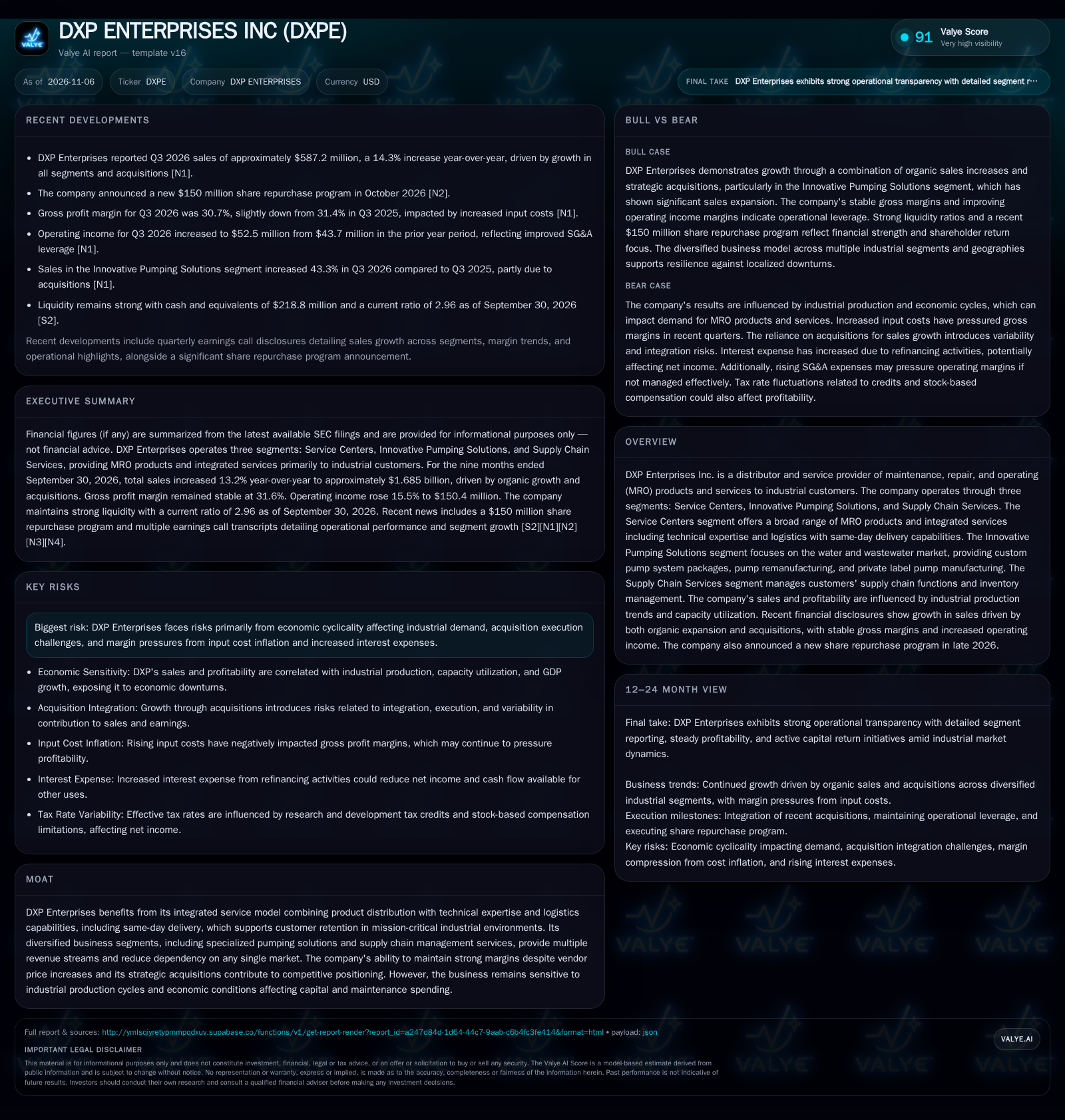
DXP Enterprises reported a 13.2% increase in year-to-date sales to $1.685 billion, fueled by organic momentum and $139 million in acquisition-driven revenue. The Innovative Pumping Solutions segment led Q3 growth with a 43.3% sales jump, while operating income climbed 15.5% year-over-year. A newly announced $150 million share repurchase program highlights a continued focus on shareholder returns, but rising SG&A costs and increased interest expense from refinancing add pressure to the bottom line [S2] [N1] [N2].
DXP Enterprises, a leading distributor and service provider for industrial MRO needs, is demonstrating the operational impact of its dual growth strategy: organic expansion and targeted acquisitions. Recent financials show robust top-line momentum, with standout performance from its Innovative Pumping Solutions segment, and a renewed focus on shareholder returns via a substantial buyback plan. Yet, as the company consolidates these gains, it must also contend with rising costs, integration risks, and the ever-present influence of cyclical industrial demand. The next phase will test DXP’s ability to convert scale into durable margin expansion and operational resilience.
Transformative Growth Trends in Recent Performance
For the nine months ended September 30, 2026, DXP Enterprises generated $1.685 billion in sales, up 13.2% year-over-year, with $139.4 million attributable to acquisitions. The Innovative Pumping Solutions segment was a standout, posting a 43.3% sales increase in Q3 2026 versus the prior year, fueled partly by recent acquisitions. Operating income for the same period reached $150.4 million, a 15.5% uptick, as SG&A expense growth trailed sales expansion. The company’s $150 million share repurchase program, announced in October 2026, signals management’s commitment to capital return. These developments underscore DXP’s strategy of leveraging both organic and inorganic levers for growth, while also raising questions about the sustainability of margin improvement amid increasing SG&A and interest costs [S2] [N1] [N2].
Profitability Influenced by Segment Mix and Operating Leverage
DXP’s business model is built around three segments: Service Centers (MRO distribution and logistics), Innovative Pumping Solutions (custom pump systems, remanufacturing, and private label manufacturing), and Supply Chain Services (integrated inventory management and supply chain outsourcing). Each segment contributes a unique margin and capital-intensity profile. The Service Centers segment, with its logistics capabilities and technical services, likely operates on moderate gross margins but benefits from high inventory turnover and same-day delivery value-add. Innovative Pumping Solutions, which has recently driven outsized growth, may command higher margins due to customization, engineering, and aftermarket service elements, but can also require more working capital and project-based execution risk.
The company’s 11.3% EBITDA margin (11.6% adjusted) for the nine months suggests effective operating leverage as sales scale, but rising SG&A—up 12.6% year-over-year—indicates that cost discipline is crucial to sustaining profit expansion. Capital requirements are driven by both inventory (especially for Service Centers) and integration of acquired businesses, which can temporarily dilute margins until synergies are realized. The recent refinancing, which led to higher interest expense, highlights ongoing funding needs as DXP pursues growth through acquisition alongside organic investments [S2].
Differentiation Through an Integrated Distribution Model
DXP’s competitive position stems from its ability to blend product distribution, technical expertise, and logistics—particularly its same-day delivery capabilities for mission-critical industrial customers. This integrated service offering supports customer retention and can create switching frictions, especially for clients who rely on bundled MRO solutions and just-in-time inventory. The company’s diversification across industrial end-markets, from water/wastewater to general manufacturing, helps mitigate exposure to any one vertical’s cyclicality.
However, the industrial distribution space remains fragmented and price-competitive, with large national players and specialized regional competitors vying for share. Technology-driven supply chain platforms and OEM-direct channels represent ongoing substitution threats, especially if customers prioritize price or digitization over service intimacy. DXP’s acquisition strategy can provide access to new geographies or technical niches, but also introduces integration and culture risk. The question is whether DXP’s value-added services and technical depth can consistently justify premium pricing and margin resilience as the industry digitizes.
Margin Expansion Potential from Acquisition Integration and Industrial Momentum
A favorable outcome for DXP would see the company successfully integrating recent acquisitions, extracting synergies, and leveraging cross-selling opportunities to accelerate both revenue and EBITDA margin expansion. If industrial production and capacity utilization remain robust, demand for MRO products and complex pumping solutions could outpace expectations, especially in infrastructure and water/wastewater projects where DXP’s engineered solutions are differentiated.
Confirmation of this scenario would come from sustained double-digit organic sales growth, expanding EBITDA margins (approaching or exceeding 12%), and visible cost efficiencies in SG&A despite top-line growth. Evidence of improved working capital turns and rising sales per business day would further validate operational leverage. If the company executes on its share repurchase program without compromising organic investment or acquisition capacity, it could signal disciplined capital allocation and strengthen the case for premium valuation multiples.
Managing Growth and Margin Challenges in a Cyclical Market
The most plausible trajectory is for DXP to continue growing sales in the high single to low double digits, with a mix of organic momentum and bolt-on acquisitions. Operating leverage is likely to produce modest EBITDA margin expansion, but SG&A growth and integration costs could offset some gains. The company’s financial performance will remain closely tied to broader industrial production and capital spending cycles; a modest slowdown in end-market demand would likely translate into softer growth, but the diversified segment mix should provide some buffer.
This scenario would be confirmed by quarterly sales growth tracking in line with industrial benchmarks, stable (but not significantly expanding) EBITDA margins, and periodic fluctuations in segment performance depending on project timing and acquisition contribution. If DXP maintains liquidity and executes its share repurchase program without stretching its balance sheet, it would reinforce the company’s ability to manage through cyclical swings while pursuing strategic growth.
Risks from Economic Slowdown and Acquisition Integration Difficulties
A more adverse outcome for DXP would involve a downturn in industrial production or capacity utilization, leading to demand contraction for MRO products and engineered solutions. If recent acquisitions underperform or prove difficult to integrate, margin dilution and operational distraction could result, especially if SG&A costs continue to rise faster than sales. Increased interest expense from refinancing could further compress net income, limiting flexibility for future M&A or capital returns.
This scenario would be evident if organic sales growth decelerates sharply, segment margins contract, and working capital requirements increase due to inventory build or customer delays. Missed synergy targets, rising churn among key accounts, or unexpected write-downs related to acquisitions would also signal risk materialization. If DXP is forced to pause or scale back its share repurchase program to preserve liquidity, it could indicate financial strain.
DXP’s Value Proposition Depends on Specific Market and Operational Developments
Organic sales growth rate by segment—especially in Service Centers and Innovative Pumping Solutions—as a leading indicator of demand and integration effectiveness.
Progress on EBITDA and adjusted EBITDA margin expansion, with a focus on SG&A as a percentage of sales.
Execution pace and financial impact of the $150 million share repurchase program, including any adjustments in the context of macro or company-specific developments.
Quarterly working capital turns and inventory levels, particularly if disclosed by segment, to assess integration progress and capital efficiency.
Interest expense trajectory and any further refinancing activity, as higher debt costs could affect net income and growth optionality.
Acquisition contribution to sales and margins—clarity on integration costs, realized synergies, and any impairment or restructuring activity.
Correlation between DXP’s sales trends and external industrial production/capacity utilization indices, as a real-time check on cyclical exposure.
Retention and churn rates for major customer relationships, if disclosed, to test the stickiness of DXP’s integrated service model.
Disclaimer: This is research-only, informational analysis and not investment advice. It may include AI-generated interpretation and general industry context. Always verify important details using primary sources.

Comments