
Camping World’s Margin Pressures, Shifting Product Mix, and the Challenge of Post-Pandemic RV Demand
Camping World faces a tough reset as RV demand normalizes after the pandemic surge, margin compression intensifies with a shift toward lower-priced travel trailers, and recent losses highlight the importance of precise inventory management and brand positioning in a fragmented, competitive market.
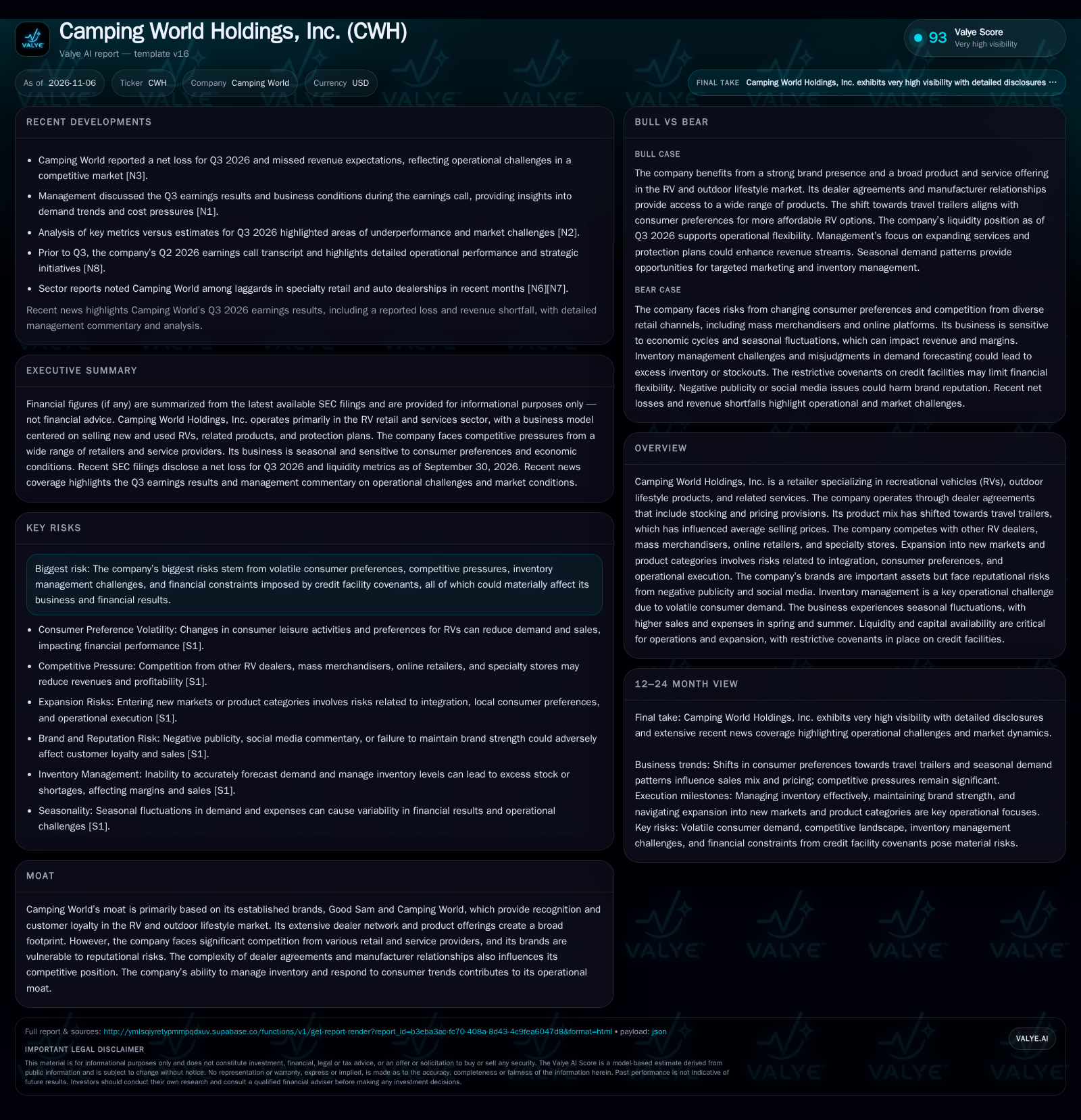
Camping World Holdings reported a significant Q3 2026 net loss and revenue shortfall, reflecting operational and market headwinds as RV demand stabilizes post-pandemic. The company’s mix has shifted heavily toward more affordable travel trailers, compressing average selling prices. With broad, fragmented competition and restrictive credit covenants limiting flexibility, successful adaptation will depend on inventory discipline, brand strength, and the ability to capture value in services and protection plans. The next phase hinges on managing seasonality and consumer preference volatility while navigating margin and cash flow pressures. [S2] [S1] [N3]
Camping World Holdings, the largest U.S. retailer dedicated to RVs and outdoor lifestyle products, is contending with a tough recalibration as pandemic-era tailwinds fade. A sharp pivot in product mix toward more affordable travel trailers has eroded average selling prices, while Q3 2026 brought a notable net loss and revenue miss. With consumer demand now volatile and inventory management more critical than ever, Camping World’s ability to leverage its brand, adapt to shifting preferences, and extract value from ancillary services will determine whether it can regain profitability in a crowded and competitive landscape.
Recent Losses, Margin Compression, and the Impact of a Changing RV Market
Camping World reported a net loss of $197 million for Q3 2026, with revenues falling short of expectations—a marked reversal from the pandemic-driven boom in RV sales. Liquidity as of September 30, 2026, included $263.8 million in cash and equivalents, a current ratio of 1.24, and a cash ratio of 0.14, signaling only modest short-term coverage. The product mix has shifted dramatically: new travel trailers now account for 79% of new vehicle sales, up from 62% in 2015, resulting in an 8% decline in average selling price over that period. These developments underscore both the normalization of RV demand and the margin pressure from a more price-sensitive customer base. [S1] [S2] [N3]
Unit Economics Under Pressure: Pricing, Volume, and the Role of Ancillary Revenue
Camping World’s core revenues derive from new and used RV sales, related products, services, and protection plans. The shift toward travel trailers—generally lower-priced and lower-margin than motorhomes—has compressed average selling prices and likely contributed to recent margin pressure. Dealer agreements with OEMs include minimum stocking and advertised pricing provisions, but wholesale prices are set by manufacturers and can change, limiting Camping World’s pricing autonomy. Fixed costs—such as retail locations, staffing, and inventory carrying—are significant, and the business is highly seasonal, with peak sales in spring and summer.
Operating leverage can be significant in good years, as higher volumes absorb fixed costs, but it works in reverse when demand drops. Inventory mismanagement—either overstocking in anticipation of demand that fails to materialize, or understocking when demand surges—can quickly erode margins through discounting or missed sales. The company’s expansion into services and protection plans offers higher-margin, recurring revenue potential, but the magnitude and stickiness of this segment are not disclosed. Restrictive covenants on credit facilities further constrain capital deployment, limiting the ability to invest aggressively or absorb additional shocks. [S1] [S2]
Brand Leverage, Channel Fragmentation, and the Threat of Substitution
Camping World’s competitive position is anchored by its national footprint and recognizable brands—Camping World and Good Sam—which provide customer acquisition advantages and some loyalty. However, the RV and outdoor retail market is highly fragmented, with competition from independent and chain RV dealers, mass merchandisers, specialty stores, and increasingly, online retailers offering both vehicles and aftermarket products. Insurance and warranty providers also compete for high-margin, service-adjacent revenue.
Switching costs for RV buyers are low, as products are largely substitutable and information is widely available online. The COVID-19 surge in first-time buyers temporarily elevated demand, but as travel and leisure patterns revert, the addressable pool of buyers may shrink, intensifying competition. Negative publicity or social media incidents can quickly erode brand equity. Inventory management, breadth of product offerings, and the ability to cross-sell services are key differentiators, but none provide a fully durable moat against aggressive pricing or new digital entrants. [S1]
Leveraging Services and Brand Loyalty to Offset Margin Pressure
A bullish outcome would see Camping World successfully driving higher-margin ancillary revenues from services, protection plans, and aftermarket products, offsetting the gross margin compression from the shift toward travel trailers. If the company can capitalize on its brand and loyalty programs—particularly Good Sam—to deepen customer relationships and boost retention, it could stabilize pricing and increase the lifetime value of each buyer.
Confirmation would come from a return to profitability despite continued pressure on new unit ASPs, with disclosed growth in service, protection plan, or membership revenue outpacing declines in vehicle margins. Improved inventory turnover, positive same-store sales growth, and evidence of brand-driven pricing power—such as smaller discounting gaps versus competitors—would also support the upside case. Expansion into new markets or product categories would need to show early traction without major integration or inventory write-downs. Evidence against this scenario would include continued net losses, shrinking ancillary revenue, or visible customer churn despite service expansion. [S1] [S2]
Navigating Normalization: Volume Recovery and Persistent Margin Constraints
The most plausible scenario is one of ongoing normalization. RV demand stabilizes at pre-pandemic levels, with Camping World maintaining share through aggressive promotions, but average selling prices remain under pressure as travel trailers dominate the mix. Margins are thin, and profitability is intermittently achieved during peak selling seasons, but off-peak quarters remain challenging. Inventory discipline improves, but the risk of overstocking lingers due to volatile demand forecasting.
Confirmation would come from modest sequential improvements in gross margin and inventory turnover, stabilization of net loss or return to break-even in seasonally strong quarters, and limited expansion activity. Evidence against this path would include a new wave of margin compression, persistent losses across multiple quarters, or forced asset sales to meet covenant requirements. [S1] [S2] [N1]
Inventory Missteps and Brand Erosion Drive a Prolonged Downturn
The bear case centers on a combination of demand misjudgments and brand setbacks. If Camping World overestimates demand and overbuilds inventory, it could be forced into heavy discounting, further compressing margins and leading to additional net losses. A negative publicity event—whether product-related, service-related, or viral on social media—could materially damage the Good Sam or Camping World brands, eroding customer loyalty and driving share losses to competitors.
In this scenario, credit covenant breaches become a real risk, potentially triggering restrictions on operations or forced deleveraging. Expansion efforts into new markets or categories could backfire, resulting in integration failures or costly write-downs. Confirmation would come from further swelling of inventory relative to sales, deepening quarterly losses, adverse changes to credit terms, or a visible decline in membership or repeat business metrics. [S1] [S2]
Signals That Will Define Camping World’s Strategic Reset
Sequential changes in gross margin by product segment—especially the mix between travel trailers and higher-priced RVs—would help clarify whether margin pressures are easing or intensifying, if disclosed.
Growth rates and dollar contribution from services, protection plans, and membership programs such as Good Sam would help assess the success of ancillary revenue strategies.
Inventory turnover and days inventory outstanding: A rising trend here would signal demand misalignment or forecasting errors.
Same-store sales growth, segmented by new and used vehicles, would clarify whether Camping World is regaining core retail momentum.
Disclosure of customer retention or repeat purchase rates, particularly among Good Sam members, would help test brand loyalty and switching costs.
Covenant compliance disclosures or changes to credit facility terms: Breaches or amendments would signal liquidity or potential financial flexibility stress.
Net cash flow from operations, especially during off-peak quarters, as a measure of underlying business resilience.
Any major negative publicity or social media incidents, and management’s response, as a test of brand resilience and crisis management.
Disclaimer: This is research-only, informational analysis and not investment advice. It may include AI-generated interpretation and general industry context. Always verify important details using primary sources.

Comments