
Serve Robotics Poised for Growth: Scaling Autonomy, Broadening Applications, and Managing Customer Fluctuations
Serve Robotics is doubling down on advanced autonomous delivery and healthcare robotics, leveraging a growing fleet and Level 4 AI to reduce costs and access new markets. Yet, concentrated revenue exposure and regulatory hurdles create real tests for the company’s model as it seeks both scale and commercial resilience.
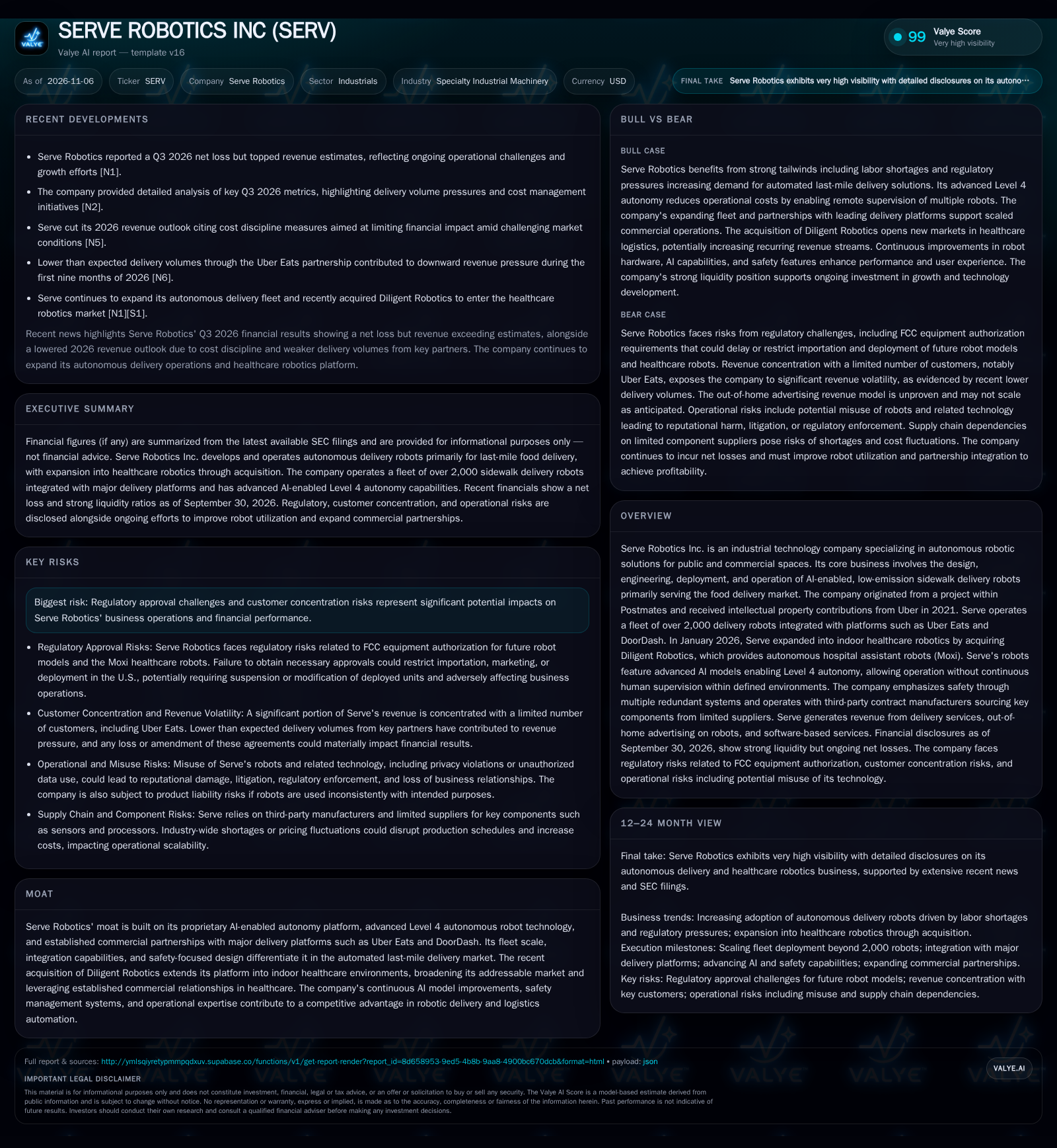
Serve Robotics operates over 2,000 AI-enabled delivery robots and recently acquired Diligent Robotics to enter healthcare, but faces ongoing net losses, high customer concentration (notably Uber Eats), and regulatory risks. The company’s Level 4 autonomy and expansion into hospital logistics offer potential for greater efficiency and market reach, yet depend on successful integration, utilization, and regulatory approvals. Near-term performance will hinge on partnership diversification and proving new revenue streams such as out-of-home robot advertising. [S2] [N1] [N6]
Serve Robotics stands at a strategic crossroads: its advanced sidewalk delivery robots and recent expansion into healthcare robotics offer a pathway to operational leverage and market diversification, but the company remains exposed to concentrated revenue streams and regulatory risk. With a fleet exceeding 2,000 robots integrated into major delivery platforms and new hospital deployments via its Moxi acquisition, Serve aims to prove that Level 4 autonomy can drive down unit costs and unlock new verticals. The next phase will test whether Serve can turn technical advantage and liquidity into sustainable, less volatile growth—or if customer and compliance dependencies will constrain its ambitions. [S2] [N1] [N6]
Recent Progress: Expanding Fleet, Entering Healthcare, and Concentration in Revenue
Serve Robotics currently operates more than 2,000 autonomous delivery robots, primarily serving food delivery through integrations with Uber Eats and DoorDash. In January 2026, the company acquired Diligent Robotics, gaining the Moxi platform for indoor hospital logistics—a move expanding Serve’s reach into healthcare environments. However, the company’s revenue remains highly concentrated, with Uber Eats as a major partner. Recent quarters saw lower delivery volumes from Uber, directly pressuring Serve’s top line. As of September 30, 2026, Serve reported $50.8 million in cash and equivalents, a current ratio of 10.85, and a net loss of $59.2 million for the first nine months of the year. The company has also cut its 2026 revenue outlook, citing both market headwinds and internal cost discipline efforts. [S2] [N1] [N5] [N6]
Economic Drivers Behind Serve Robotics: Autonomy, Utilization, and Platform Synergies
Serve’s core business model depends on monetizing robot deliveries, with additional upside from out-of-home advertising and software-based services. The company’s Level 4 AI autonomy is designed to reduce per-unit labor costs by enabling one remote supervisor to monitor multiple robots—a key lever for scaling margins, especially as robot density rises in urban deployment zones. Hardware manufacturing is outsourced, keeping fixed capital needs relatively contained but exposing Serve to variable component costs and supply chain risks.
Revenue mix is currently weighted toward delivery operations, with out-of-home branding (advertising on robots) still unproven as a scalable income stream. If Serve can achieve higher robot utilization—through denser deployment, broader merchant integration, or by layering in new use cases such as healthcare logistics—the incremental cost per delivery could decline, unlocking operating leverage. However, persistent net losses indicate that current volumes and pricing have not yet reached break-even, and the economics of the newly acquired healthcare vertical are not fully established.
Serve’s balance sheet shows substantial current assets relative to liabilities, but continued losses mean that cash burn and the path to positive unit economics are central to the company’s sustainability. The ability to shift customer mix, increase robot utilization, and validate new revenue streams will determine whether Serve can transition from a capital-consuming to a capital-generating model. [S2]
Competitive Dynamics in Autonomous Delivery: Technology Edge, Alliances, and Replacement Risks
Serve’s competitive positioning hinges on its AI-enabled Level 4 autonomy, safety features, and platform integrations. The fleet scale and ability to operate with minimal human oversight distinguish Serve from smaller or less advanced robotic delivery startups, while partnerships with Uber Eats and DoorDash provide access to broad order flows and merchant networks.
Yet, the company faces competition from other autonomous delivery solutions, including ground-based robots, drones, and human-driven alternatives. Larger technology firms and logistics platforms may have the resources to develop or acquire similar capabilities, while incumbent human delivery networks offer flexibility and established customer relationships. Serve’s reliance on a few major partners also creates switching risk; should a partner internalize robotics or shift to another provider, Serve’s volumes could decline abruptly.
In healthcare, the acquisition of Diligent Robotics positions Serve in a less crowded but highly regulated segment. Here, success will depend on integration with hospital workflows, reliability, and the ability to demonstrate cost savings or productivity gains versus both human and robotic alternatives. The question is whether Serve can use its technology and operational experience to build sticky relationships and defend margins as the market matures.
Success Scenario: Boosted Utilization, Healthcare Market Penetration, and Validated Advertising Income
In a favorable scenario, Serve leverages its advanced autonomy to drive up robot utilization rates and reduces per-delivery costs, allowing it to capture a larger share of urban food delivery and logistics. The acquisition of Diligent Robotics pays off with successful integration of Moxi robots into hospital operations, generating recurring revenue from healthcare clients and showcasing the flexibility of Serve’s platform beyond food delivery.
Out-of-home advertising on robots, if proven effective and scalable, could add a high-margin ancillary revenue stream, especially in dense markets where robots are highly visible. Serve’s partnerships with major platforms remain stable or diversify further, reducing revenue concentration risk. Regulatory approvals for new robot models and healthcare deployments proceed smoothly, enabling expansion into new cities and verticals.
Evidence supporting this scenario would include rising delivery volumes, improved gross margins, successful hospital deployments with contract wins or renewals, and traction in OOH advertising revenue. Announcements of new partnerships or expanded geographic footprints would also help confirm Serve’s ability to scale and diversify. [S2] [N1]
Expected Path: Steady Growth, Continued Losses, and Prudent Market Expansion
The most plausible near-term outcome is one where Serve achieves moderate growth in delivery volumes and incremental penetration of the healthcare vertical but continues to face customer concentration and regulatory friction. Robot utilization improves gradually as the fleet expands and new use cases are piloted, but persistent net losses remain due to high R&D and operational expenses.
The OOH advertising model remains in a testing phase, contributing limited revenue. Supply chain and regulatory hurdles are managed but continue to constrain the pace of hardware deployment, especially for new models and healthcare robots.
Evidence for this scenario would be continued net losses, slow but steady increases in delivery or healthcare deployments, and recurring commentary on customer and regulatory risks in company disclosures. Expansion announcements may be offset by revised guidance or cost management measures. [S2] [N2] [N5] [N6]
Downside Risks: Regulatory Challenges, Loss of Partners, and Revenue Uncertainties
In a negative scenario, Serve faces regulatory setbacks—such as delays or denials in FCC equipment authorization—that slow or halt deployment of new robot models or the Moxi healthcare robots. Simultaneously, a key partner such as Uber Eats could further reduce order volumes or terminate the relationship, causing a sharp drop in Serve’s revenue. The OOH advertising model may fail to gain traction, leaving Serve heavily reliant on a delivery revenue stream that is itself volatile.
Persistent supply chain disruptions or cost inflation from key component suppliers could erode margins further. If net losses accelerate and the company is forced to raise capital under unfavorable terms, dilution or operational contraction could follow. Adverse press or litigation related to robot misuse, privacy, or safety incidents could trigger regulatory scrutiny and reputational harm, further limiting growth.
Confirmation of this scenario would include regulatory non-approvals, customer loss announcements, widening net losses, or negative news related to robot safety or misuse. Failure to secure new partnerships or diversify revenue beyond the current base would also support a bearish thesis. [S2] [N5] [N6]
Serve Robotics’ Commercial Stability and Growth Challenges in Focus
Delivery volume growth and robot utilization rates—especially changes in deliveries per robot per day, if disclosed, would directly measure operational leverage and adoption.
Revenue mix evolution, particularly the share attributable to out-of-home advertising and software-based services, would help test the scalability of new business lines.
Updates on customer concentration, including the proportion of revenue from Uber Eats and any new large platform partnerships, would gauge diversification progress.
Healthcare segment milestones such as hospital deployments, contract wins, and recurring revenue from Moxi robots would clarify the impact of the Diligent Robotics acquisition.
Progress on regulatory approvals for new robot models and Moxi, including FCC equipment authorization outcomes, would determine Serve’s ability to expand U.S. operations.
Gross margin trends and cost-per-delivery metrics, if disclosed, would provide a window into whether Serve is realizing the promised efficiencies of Level 4 autonomy.
Supply chain updates, particularly regarding key component suppliers and manufacturing capacity, would signal vulnerability or resilience to hardware disruptions.
Disclosures of any material adverse events related to robot misuse, privacy, or safety incidents would be crucial in assessing operational and reputational risk.
Disclaimer: This is research-only, informational analysis and not investment advice. It may include AI-generated interpretation and general industry context. Always verify important details using primary sources.

Comments