
Five9’s AI-Native CX Platform: Scaling Cloud Contact Centers in an Era of Intelligent Automation
With AI-powered features driving adoption across more than 3,000 enterprise customers, Five9’s evolution into an AI-native contact center platform is reshaping operational efficiency and customer engagement. The company’s financial inflection—evidenced by sustained revenue growth and a shift to profitability—raises questions about competitive longevity, cloud migration pace, and the durability of its SaaS economics as generative AI becomes table stakes in customer experience software.
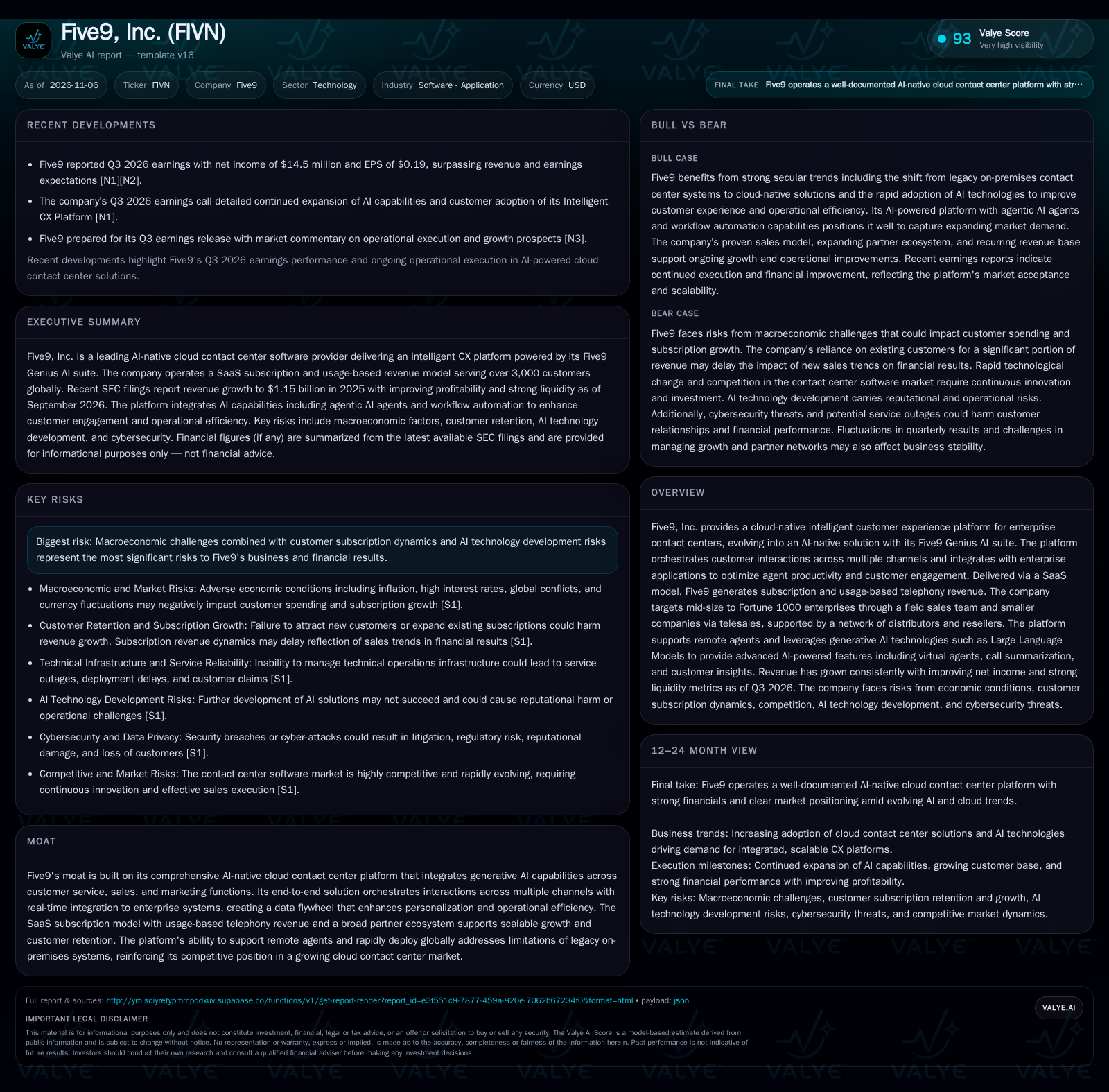
Five9 is leveraging its AI-native CX platform, now serving over 3,000 customers, to capture secular growth as enterprises shift from legacy on-premises contact centers to cloud-based, AI-enhanced solutions. Revenue rose from $910.5M in 2023 to $1,149.1M in 2025, with net income turning positive. [S1] [S2]
Five9’s transformation into an AI-native customer experience platform provider positions it as a key beneficiary of two powerful trends: the migration of enterprise contact centers to the cloud and the integration of generative AI to automate, personalize, and optimize customer interactions. The company’s ability to deliver consistent revenue growth and a newly positive bottom line underscores operational scalability and market validation. However, as AI capabilities become increasingly commoditized and the competitive field intensifies, Five9’s future will hinge on its ability to maintain technical differentiation, deepen customer integration, and continue expanding its partner ecosystem to defend its recurring revenue base.
Recent Financial and Platform Milestones Affirm Strategic Progress
Five9 reported revenue of $1,149.1 million for 2025, up from $1,041.9 million in 2024 and $910.5 million in 2023, demonstrating sustained top-line growth. The company achieved net income of $39.4 million in 2025, reversing prior losses and signaling improved operating leverage. As of September 30, 2026, Five9 held $263.83 million in cash and equivalents, with a current ratio of 4.0 and a cash ratio of 1.02, reflecting a reported liquidity position. Its Intelligent CX Platform now serves over 3,000 customers and continues to expand AI capabilities, including agentic AI, workflow automation, and workforce engagement features. These milestones collectively highlight Five9’s operational execution and traction in a dynamic, high-growth market. [S1] [S2]
Subscription and Usage Models Drive Predictable Revenue—But Margins Rely on AI Adoption and Scale
Five9’s core economics are built around a SaaS subscription model, with revenue derived from licensed seats and usage-based telephony fees. This hybrid structure offers baseline revenue visibility and the potential for incremental upside as customer usage scales. AI-powered features—sold on a consumption or capacity basis—introduce new monetization vectors, but their margin profile depends on the pace of enterprise AI adoption and the cost of underlying compute and data infrastructure.
Operating leverage is increasingly evident as the company’s revenue base expands faster than fixed costs, reflected in the recent shift to net profitability. However, scaling AI services could introduce variable costs, particularly if generative AI features require substantial third-party compute or data licensing. The company reported cash and liquidity metrics for the period; these figures do not by themselves establish operating runway, investment capacity, financial flexibility, or financing capacity. The main economic watchpoint is whether higher-value AI modules can consistently command premium pricing and attach rates as AI becomes more commoditized across the industry.
Defending Differentiation as AI Capabilities Become Table Stakes
Five9’s competitive position is grounded in its end-to-end, cloud-native CX platform with integrated AI features, real-time omnichannel orchestration, and deep CRM connectivity. This breadth enables large enterprises to consolidate disparate legacy systems and deploy remote agents at scale. The company’s robust partner ecosystem and multi-channel integration further reinforce switching costs, especially for customers seeking unified data and workflow automation.
However, the competitive landscape is rapidly evolving. Both cloud-native software providers and legacy vendors are accelerating their AI investments, narrowing the feature gap. The question is whether Five9 can maintain a sustainable advantage through continual AI innovation, ecosystem depth, and operational reliability—or whether generative AI will erode differentiation as it becomes ubiquitous. Platform extensibility, speed of feature deployment, and ecosystem integration will be critical battlegrounds.
AI-Driven Expansion Unlocks New Revenue Streams and Higher Customer Lifetime Value
In a favorable scenario, Five9 leverages its AI-native platform to deepen wallet share with existing enterprise customers and accelerate migration from legacy on-premises systems. As AI modules such as agentic virtual agents, automated summaries, and workflow orchestration become embedded in customer operations, attach rates and per-seat pricing could rise. Successful integration with leading CRM and ERP providers would further entrench Five9 as the core orchestration layer for customer experience.
Confirmation of this scenario would come from sustained double-digit revenue growth, expanding gross margins (reflecting higher-value AI sales), and increasing average revenue per customer. Additional signals would include new marquee enterprise wins, rapid growth in AI feature utilization, and evidence that customers are standardizing on Five9 for multi-channel orchestration rather than treating it as a point solution.
Sustaining Growth Through Cloud Migration and Steady AI Uptake
The most plausible trajectory is continued steady growth as enterprises gradually migrate to cloud-based contact center solutions and incrementally adopt AI features. Five9’s installed base provides a buffer against macro volatility, while its SaaS model supports predictable recurring revenue. AI adoption may proceed in waves, with some customers moving rapidly and others lagging due to integration complexity or budget constraints.
Evidence supporting this scenario would include stable or modestly improving revenue growth, ongoing profitability, and retention rates holding steady. The company would likely continue expanding its partner ecosystem and rolling out incremental AI enhancements. Signs of potential deviation would be stagnating attach rates for new AI modules, rising customer churn, or margin compression if price competition intensifies or AI costs outpace revenue growth.
Competitive Pricing and AI Commoditization Pressure Margins and Retention
Adverse outcomes could arise if generative AI capabilities become widely available, driving down pricing for AI-powered CX features and enabling both cloud-native and legacy competitors to match Five9’s core value proposition. In this context, customers could negotiate lower renewal rates, reduce seat counts, or migrate to alternative vendors offering integrated AI at lower cost. Slower-than-expected adoption of premium AI modules would limit upside and expose Five9 to margin compression.
Early warning signs would be decelerating revenue growth, declining gross margins, increasing customer churn, and public announcements of major customer defections or competitive wins. If AI-related security incidents or service outages occur, reputational damage could further accelerate customer attrition.
Benchmarks for Five9’s Competitive Edge and Platform Evolution
Growth in average revenue per customer, especially attributable to AI module adoption, would help test the thesis that Five9 can monetize its AI investments beyond baseline SaaS fees.
AI feature utilization rates (if disclosed), such as the penetration of agentic AI or workflow automation among enterprise accounts, would indicate the depth of platform integration.
Retention and churn rates across customer cohorts—particularly among large enterprise clients—will reveal Five9’s ability to defend its recurring revenue base as competition intensifies.
Gross margin trends, especially as AI usage scales, would signal whether premium AI features are accretive or margin-dilutive.
The pace of new enterprise customer wins and the size of those contracts will be important for validating continued market share gains.
Third-party integration activity and expansion of the partner ecosystem (e.g., new system integrator deals or CRM partnerships) would confirm Five9’s value as a core CX orchestration layer.
Incidents or disclosures related to AI reliability, security, or regulatory compliance could materially impact customer trust and adoption trajectories.
If available, the share of total revenue from AI-powered features versus core telephony/SaaS would provide insight into Five9’s progress transitioning to an AI-centric business model.
Disclaimer: This is research-only, informational analysis and not investment advice. It may include AI-generated interpretation and general industry context. Always verify important details using primary sources.

Comments