
Mobia Medical’s Stroke Therapy: Guideline Validation, Commercial Hurdles, and the Economics of Clinical Adoption
Mobia Medical’s paired vagus nerve stimulation (VNS) therapy gained a crucial nod from the American Heart Association in 2026, signaling clinical legitimacy and potentially reshaping its growth prospects. Yet, persistent net losses, limited operational disclosure, and unclear adoption mechanics leave the company at a crossroads between opportunity and execution risk.
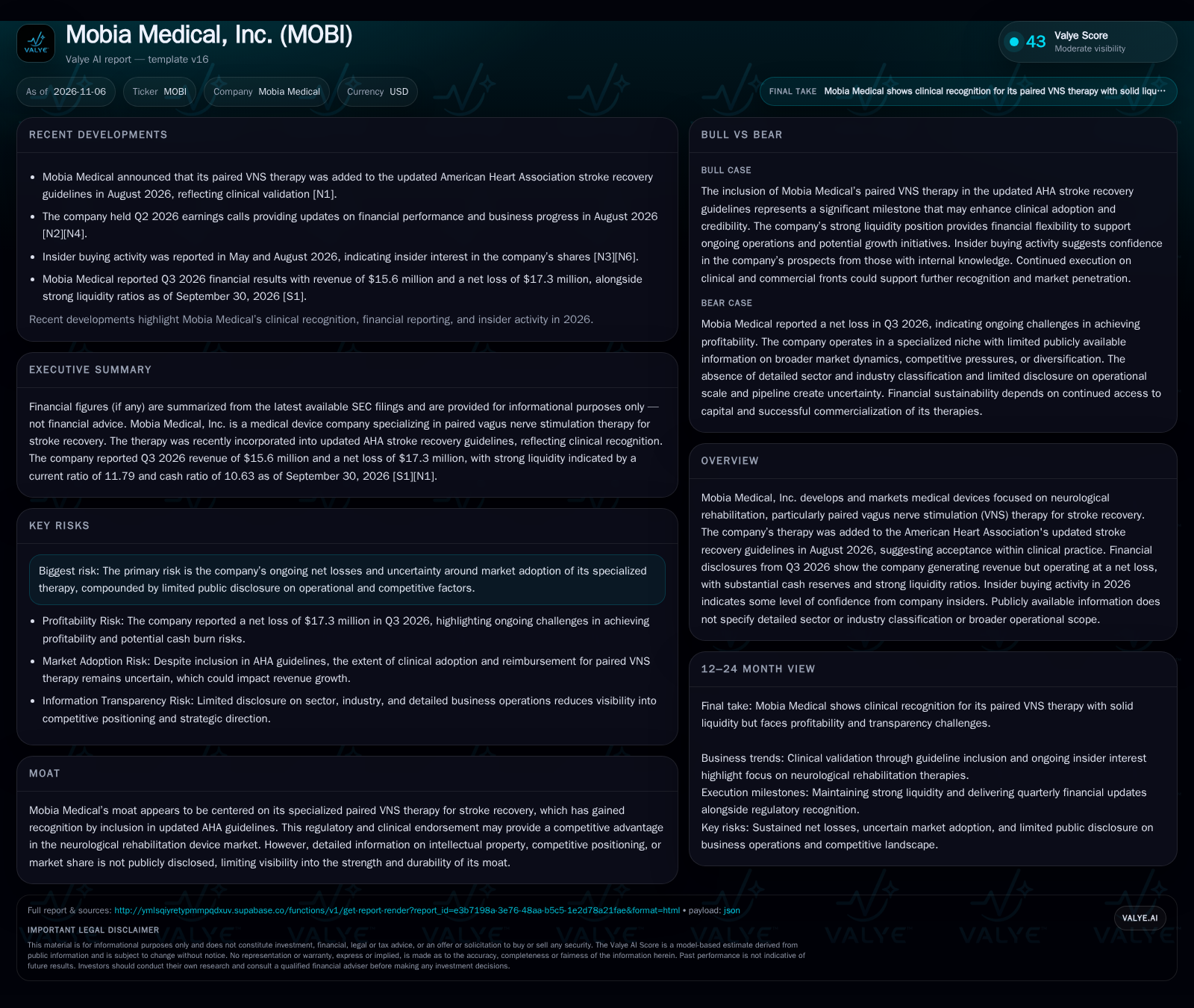
Mobia Medical’s VNS therapy for stroke recovery achieved a milestone with inclusion in updated AHA guidelines, potentially supporting broader clinical adoption. Despite this, the company reported a $17.3 million net loss in Q3 2026 on $15.6 million in revenue and maintains a reported cash position. The commercial pathway, pace of adoption, and ability to convert clinical validation into durable profitability remain open questions. Insider buying in 2026 hints at internal optimism, but the absence of detailed market and competitive disclosures clouds visibility on long-term economics. [S1] [N1] [N3] [N6]
Mobia Medical stands at a pivotal moment: its paired VNS therapy for stroke recovery was recognized in the American Heart Association’s updated 2026 guidelines, a signal of clinical acceptance that could set the stage for wider adoption. However, the company’s Q3 2026 financials show persistent losses and its public disclosures leave open questions about the speed and scale of commercial traction.
Clinical Guidelines Endorsement and Financial Status: Twin Catalysts and Constraints
Mobia Medical’s paired VNS therapy was incorporated into the American Heart Association’s updated stroke recovery guidelines in August 2026, a move that elevates the therapy’s clinical profile and could drive acceptance among physicians and payers [N1]. This milestone comes as the company reported Q3 2026 revenue of $15.6 million but continued to operate at a net loss of $17.3 million, with negative $0.52 EPS for the quarter [S1]. Despite these losses, Mobia Medical’s balance sheet remains robust, with $160.7 million in cash and a current ratio of 11.79 as of September 30, 2026 [S1].Insider transaction activity was reported in the cited source; this activity does not by itself establish insider confidence. [N3] [N6] The interplay between clinical validation, financial runway, and operational execution now shapes the company’s near-term thesis.
How Clinical Validation Could Translate Into Revenue Scale—and Where the Friction Lies
Mobia Medical’s core economic opportunity stems from its ability to convert clinical guideline inclusion into widespread adoption of its paired VNS therapy within stroke rehabilitation centers. In principle, guideline endorsement can boost physician confidence, facilitate payer reimbursement, and expand the addressable market. However, the pathway from validation to revenue scale is rarely linear in medtech: hospitals and rehabilitation clinics often require real-world outcomes, robust training, and clear reimbursement structures before ramping up purchases.
The company’s reported Q3 2026 revenue of $15.6 million suggests early commercial traction but also highlights a significant gap between current sales and the scale needed for profitability [S1]. Device-based therapy models typically involve a blend of up-front capital equipment sales and recurring revenue from consumables, service contracts, or software (if applicable). Without disclosure on pricing, contract structure, or per-patient economics, it remains unclear whether Mobia’s revenue mix is currently weighted toward one-time sales or if there is a recurring component. High gross margins are common in medtech once scale is reached, but heavy fixed costs in R&D, clinical education, and sales infrastructure can weigh on operating leverage during early adoption phases.
The company reported cash and liquidity metrics for the period; these figures do not by themselves establish operating runway, investment capacity, financial flexibility, or financing capacity. The company’s capital needs will hinge on the pace of adoption, required investments in market access and clinical training, and potential expansion into adjacent indications or geographies.
Market Niche, Barriers, and the Uncertain Competitive Map
Mobia Medical’s competitive positioning is anchored by its specialized focus on paired VNS therapy for stroke recovery—a niche within the broader neurological rehabilitation device market. The addition of its therapy to AHA guidelines provides a form of regulatory and clinical differentiation, potentially creating a first-mover advantage and some degree of switching friction for providers who integrate the therapy into care pathways.
However, the durability of this edge depends on several factors: the strength and breadth of Mobia’s intellectual property (which is not disclosed), the presence of competing neuromodulation or rehabilitation technologies, and the willingness of clinicians and payers to adopt new protocols. Larger medtech incumbents may possess broader distribution networks, established reimbursement relationships, and the resources to invest in competing or adjacent solutions. Substitution risk could emerge from alternative neurostimulation devices, pharmacological interventions, or evolving rehabilitation techniques.
Without detailed public disclosure, it is uncertain whether Mobia commands a sustainable cost or efficacy advantage. The real test will be whether guideline inclusion translates into standard-of-care status, driving durable share gains and potential network effects in clinical adoption.
If Guideline Inclusion Unlocks Rapid Market Adoption
The most favorable scenario for Mobia Medical is that the AHA guideline inclusion acts as a catalyst for accelerated therapy adoption across stroke treatment centers and rehabilitation clinics. If payers respond by expanding reimbursement and clinicians rapidly integrate the therapy into standard protocols, Mobia could see a step-change in both unit sales and recurring revenue from service or consumable components. This would drive operating leverage as fixed costs are absorbed by higher volumes.
Evidence for this scenario would include sequential acceleration in revenue growth, expansion in gross margins, and increasing sales to new hospital systems or geographic markets. Clear disclosure of recurring revenue metrics, contracted customer pipelines, and growing reimbursement coverage would further validate the upside case. If Mobia leverages its cash reserves to scale commercialization efficiently—without a proportional rise in operating expenses—profitability could become plausible sooner than expected.
Adoption Proceeds, but at a Measured Pace Amid Healthcare Frictions
The most plausible near-term scenario is that Mobia Medical experiences gradual, rather than explosive, adoption of its VNS therapy. In this pathway, guideline inclusion opens doors but does not guarantee immediate standard-of-care uptake. Hospitals and clinics may pilot the therapy in select patient cohorts, while payers and policymakers scrutinize real-world outcomes and cost-effectiveness before approving widespread reimbursement.
Revenue grows modestly, supported by early adopters, but the company continues to post net losses as it invests in education, market access, and data generation. Operating leverage remains constrained until a critical mass of installations or patients is reached. Confirmation would come from steady but incremental revenue gains, flat or slowly improving gross margins, and ongoing cash burn. Falsification would be signaled by stagnating sales or evidence that clinical enthusiasm is not translating into commercial orders.
Validation Fails to Overcome Market Barriers, Prolonging Losses
The adverse scenario is that, despite guideline endorsement, Mobia Medical struggles to convert clinical validation into meaningful sales. Barriers could include slow-moving hospital procurement cycles, payer reluctance to reimburse, insufficient physician training, or the emergence of competitive or substitute therapies. If the therapy fails to demonstrate clear cost-effectiveness or real-world benefit, adoption could stall.
In this scenario, revenue remains flat or grows below expectations, while fixed costs remain elevated. Evidence would include declining quarter-over-quarter revenue, persistent or widening net losses, and management commentary signaling slower-than-anticipated adoption or market resistance.
Testing the Mobia Medical Thesis: Adoption, Economics, and Market Signals
Sequential revenue growth by quarter: Acceleration would support the adoption thesis; stagnation or decline would challenge it.
Gross margin evolution: Improvement would suggest scale efficiencies or favorable pricing; compression could indicate discounting or high delivery costs.
Disclosure of recurring revenue mix, if provided: Growing recurring revenue would point to a more durable business model.
Updates on payer reimbursement coverage or new contracts: Expansion would validate broader acceptance and market access.
Cash burn rate relative to revenue growth: A decoupling of expense growth from revenue would indicate improving operating leverage.
Physician and hospital account growth, if disclosed: New customer wins and geographic expansion would confirm commercial traction.
Competitive developments in neuromodulation or stroke rehabilitation: Emergence of rivals or new therapies could alter the adoption curve.
Management commentary on post-guideline adoption trends: Specifics on order pipeline, conversion rates, and customer feedback would provide important leading indicators.
Disclaimer: This is research-only, informational analysis and not investment advice. It may include AI-generated interpretation and general industry context. Always verify important details using primary sources.

Comments