
Northwest Bancshares: Banking Margin Dynamics, Risk Management, and the Search for Durable Profitability
Northwest Bancshares, Inc. is navigating a competitive regional banking landscape with steady net income, active risk management via derivatives, and a focus on core lending and deposit services. The company’s recent financial results and dividend continuity underscore operational stability, but the path forward depends on credit quality, interest rate management, and the ability to defend margins as industry pressures mount.
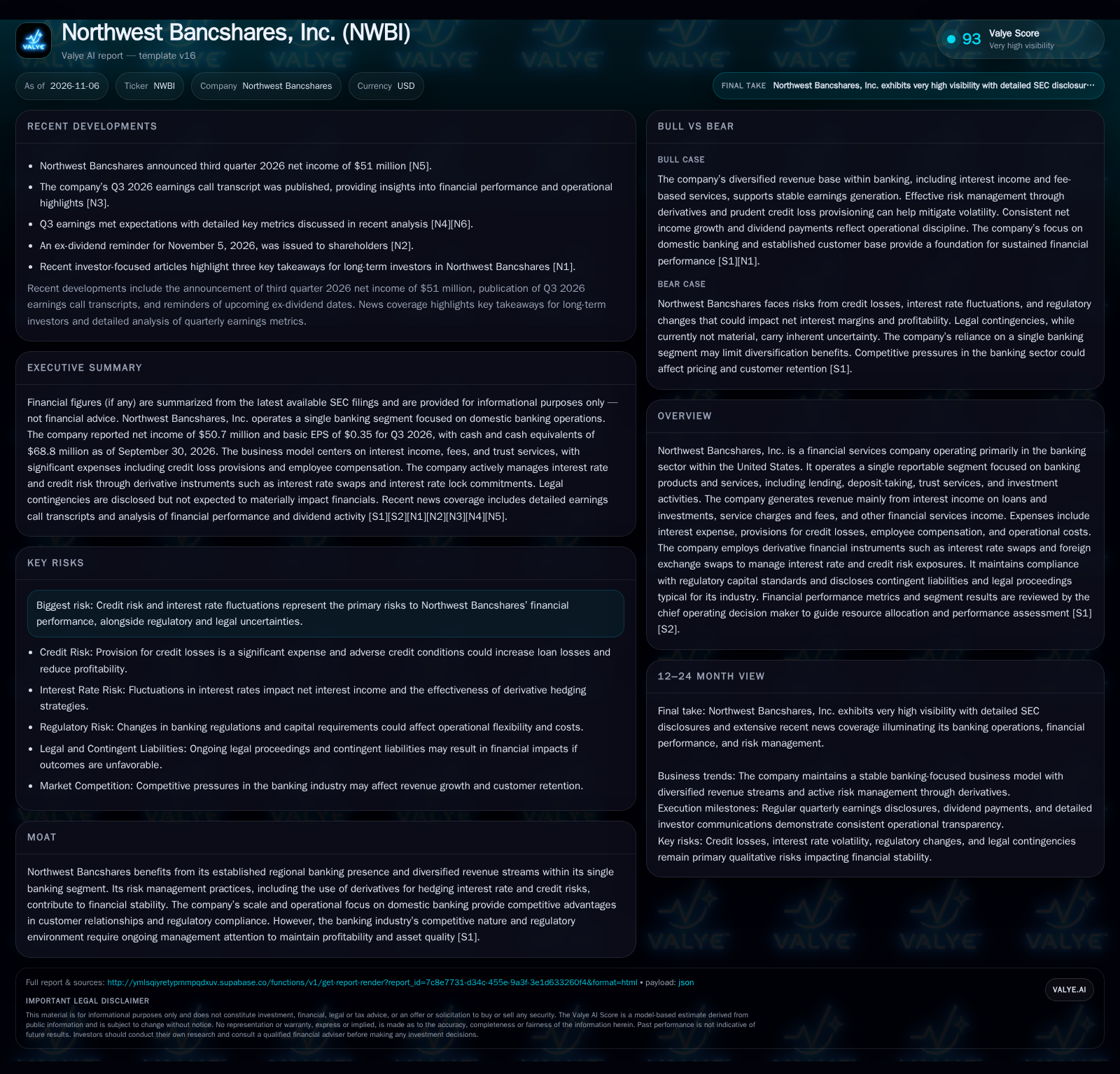
Northwest Bancshares reported $51 million in Q3 2026 net income, maintaining dividend payments and stable banking operations. The company’s performance hinges on its ability to manage credit and interest rate risks, defend net interest margins, and adapt to a competitive, regulated environment. Key levers include the effectiveness of its derivatives hedging, credit loss provisioning, and balancing fee-based versus interest-driven revenues. [S2] [N2] [N5]
The cited source reports dividend-related activity; that disclosure alone does not establish dividend-policy continuity, management confidence, or a material constraint on capital flexibility. The company’s business model remains rooted in traditional banking—generating revenue from interest income on loans and investments, complemented by service fees and trust activities. As the banking sector contends with interest rate volatility, credit risks, and regulatory scrutiny, Northwest’s ability to actively hedge exposures and maintain asset quality will be critical to defending margins and shareholder returns. The next phase for Northwest hinges on its capacity to manage these external forces while seeking incremental revenue and cost efficiencies.
Steady Profitability and Operational Focus Define Recent Performance
Northwest Bancshares reported net income of $51 million for the third quarter of 2026, with basic earnings per share of $0.35 [S2] [N5]. This result demonstrates continued profitability in a challenging interest rate environment. The company reported cash and liquidity metrics for the period; these figures do not by themselves establish operating runway, investment capacity, financial flexibility, or financing capacity. The cited source reports dividend-related activity; that disclosure alone does not establish dividend-policy continuity, management confidence, or a material constraint on capital flexibility. [S2] [N2] Management has not identified any material legal or contingent liabilities as of year-end 2025, suggesting no immediate legal overhang [S1]. These facts collectively reflect a stable, disciplined approach but highlight the importance of ongoing vigilance in risk management and capital allocation.
How Northwest Earns and Defends Its Margins
The company’s core economics revolve around net interest income—revenue generated from the spread between interest earned on loans/investments and interest paid on deposits and borrowings. For the year ended December 31, 2025, interest income was $750 million out of approximately $879 million in total revenues, underscoring the business’s sensitivity to changes in interest rates and loan demand [S1]. Fee-based revenues from service charges, trust, and other financial services provide some diversification, but do not fundamentally alter the company’s reliance on the lending-deposit spread.
Significant expenses include interest expense, credit loss provisions, compensation, and operational costs—most of which are partially fixed in the short term. The use of derivative financial instruments (e.g., interest rate swaps, lock commitments) is intended to manage interest rate and credit risk exposures, potentially smoothing net interest income but also introducing complexity and basis risk [S1]. Capital needs are determined by regulatory requirements and the need to support loan growth. The company’s efficiency ratio and return metrics are key internal benchmarks, with operating leverage dependent on maintaining stable costs as revenue grows. In periods of rising rates or credit stress, operating leverage can rapidly turn negative if credit costs or funding expenses outpace revenue gains.
Regional Banking Pressures: Defending Share in a Crowded Field
Northwest Bancshares operates in the intensely competitive U.S. regional banking sector, where product differentiation is limited and pricing pressure is persistent. Its established regional presence offers advantages in customer relationships and regulatory familiarity, but these are not insurmountable barriers. Competitors include other community and regional banks, credit unions, and increasingly, fintechs and larger national banks offering digital-first services.
The company’s ability to retain and grow its deposit base, maintain loan quality, and offer relevant financial services is constantly tested by alternative providers and evolving customer expectations. While its risk management practices—particularly the use of derivatives—may offer some protection against rate and credit volatility, these tools are widely available in the sector and do not confer a lasting structural advantage. Northwest must continually invest in technology, compliance, and product innovation to avoid margin erosion and customer attrition.
Margin Expansion through Prudent Credit and Rate Management
A favorable scenario for Northwest Bancshares would see stable or declining credit losses, effective deployment of hedging strategies to protect net interest margin, and modest growth in fee-based revenues. If the economic environment supports healthy loan demand and deposit growth—without a material rise in funding costs—the company could achieve positive operating leverage and incremental margin expansion.
Confirmation of this scenario would come from sequential improvement in the efficiency ratio, stable or improving net interest margin, and loan growth outpacing increases in credit loss provisions. Further, if the company demonstrates an ability to grow non-interest income through expanded trust or advisory services, its revenue base would become more resilient. Evidence to the contrary would include a sharp increase in non-performing loans, a decline in the margin despite stable rates, or rising deposit betas (the rate at which deposit costs rise relative to broader interest rates).
Sustained Profitability, Margin Pressures, and Incremental Adjustments
Net interest margin is likely to remain under pressure as deposit costs adjust upward and loan yields lag, reflecting the broader regional banking landscape. Credit costs are expected to remain manageable but could drift higher if economic conditions soften.
This scenario would be confirmed by modest fluctuations in quarterly net income, a stable efficiency ratio, and no major shifts in loan or deposit composition. A useful falsification would be evidence of sustained negative operating leverage—where expenses rise faster than revenues—or a notable uptick in credit loss provisions relative to historical norms. The company’s reliance on traditional banking fundamentals means that transformative growth or margin expansion is unlikely without a change in strategy or market structure.
Credit Quality Deterioration and Margin Compression Threaten Stability
The principal risk for Northwest Bancshares is a negative turn in credit quality, leading to higher provisions for loan losses and potential net charge-offs. This could be triggered by a regional economic downturn, sector-specific stress (e.g., commercial real estate), or a misstep in underwriting standards. Margin compression could intensify if funding costs rise faster than asset yields, especially if the company is forced to compete aggressively for deposits.
Rising regulatory or compliance costs could further erode profitability. If the company’s derivatives strategies fail to offset these pressures—or introduce unintended risks—the impact could be magnified. A mitigating factor would be evidence of proactive credit management or successful cost controls, but the risk remains that structural headwinds could overwhelm incremental adjustments.
Benchmarks for Testing Northwest Bancshares’ Earnings Durability
Quarterly net interest margin trends, especially relative to peer regional banks, would help assess the effectiveness of rate management.
Provision for credit losses and trends in non-performing loans, if disclosed, are critical for evaluating credit quality resilience.
Growth or contraction in total loans and deposits, by segment, would indicate competitiveness and balance sheet health.
Changes in the efficiency ratio and operating expense trends, if disclosed, would signal operating leverage and cost discipline.
Breakdown of non-interest income sources and any evidence of successful expansion in fee-based services would help test revenue diversification.
Updates on the use and results of derivative hedging strategies—such as realized gains/losses or impact on comprehensive income—could reveal risk management effectiveness.
Dividend sustainability, including payout ratio trends and any explicit management commentary on capital allocation, would confirm or challenge the underlying earnings power.
Any regulatory or legal updates affecting capital, compliance costs, or contingent liabilities should be monitored for potential adverse effects.
Disclaimer: This is research-only, informational analysis and not investment advice. It may include AI-generated interpretation and general industry context. Always verify important details using primary sources.

Comments