
Investar Holding Corp: Capital Strength, Credit Management, and the Profitability Challenge in Regional Banking
Investar Holding Corp maintains robust capital ratios and consistent profitability in 2026, but faces persistent questions about credit risk, off-balance sheet exposures, and the durability of earnings in a shifting interest rate and regulatory landscape.
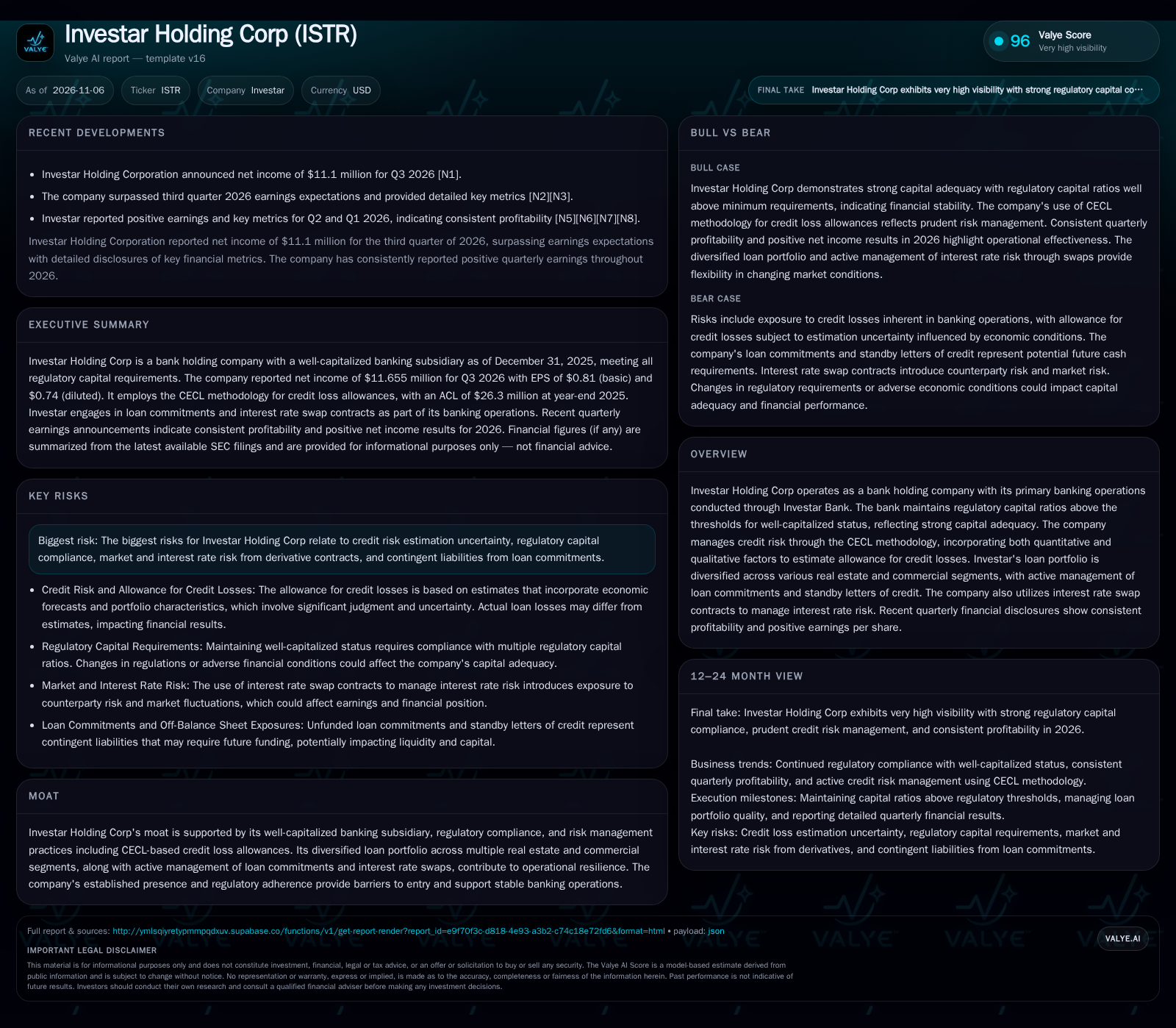
Investar Holding Corp posts steady profits and maintains capital ratios well above regulatory minimums, demonstrating prudent risk management across a diversified loan book. The company’s use of CECL for credit loss allowances and active interest rate risk management are strengths, but the scale of unfunded loan commitments and exposure to economic cycles keep risk assessment central to the thesis. Sustained profitability will depend on asset quality, funding costs, and the company’s ability to navigate evolving credit and regulatory landscapes. [S1] [S2] [N1] [N2] [N3]
Investar Holding Corp’s 2026 financials highlight a regional bank with strong capital ratios and a disciplined approach to credit risk. With net income surpassing expectations in recent quarters and capital adequacy ratios comfortably above regulatory minimums, the company appears well-positioned on the surface. However, in a sector where credit quality and off-balance sheet exposures can shift rapidly with the economic cycle, the durability of these strengths—and the bank’s ability to sustain profitability—warrants deeper examination. The key questions for investors are whether Investar’s risk management practices and capital buffer are sufficient to absorb potential shocks, and how the company will adapt as macro and regulatory pressures evolve.
Profitability Holds Steady While Capital Ratios Signal Strength
Investar Holding Corp reported net income of $11.655 million for the third quarter of 2026, with both basic and diluted EPS showing positive results. This marks the continuation of consistent quarterly profitability throughout 2026, as confirmed by multiple earnings announcements [S2] [N1] [N2] [N3]. At the same time, Investar’s capital position remains robust: the Tier 1 capital to average assets ratio stood at 10.73% at December 31, 2025, and the total capital to risk-weighted assets ratio was 14.66%, both comfortably above the regulatory thresholds for 'well-capitalized' status [S1]. These facts together suggest a bank operating from a position of financial strength, with the capacity to absorb moderate adverse events.
How Investar Earns: Lending Margins, Credit Costs, and Balance Sheet Leverage
Investar generates the bulk of its revenue from net interest income—primarily the spread between interest earned on loans and securities and interest paid on deposits and borrowings. The bank’s diversified loan portfolio includes construction, residential, multifamily, farmland, and commercial real estate segments, which helps manage concentration risk but also exposes the bank to cyclical sectors. The use of interest rate swaps allows Investar to hedge interest rate risk, but these instruments can introduce complexity and counterparty risk if not closely managed [S2].
Operating leverage in regional banking is driven by the interplay of loan growth, net interest margin, and efficiency in managing non-interest expenses. Fixed costs such as personnel, branch operations, and regulatory compliance create a baseline that must be covered by margin spread and fee income. The company’s allowance for credit losses (ACL) of $26.3 million at year-end 2025 reflects a cautious approach to potential credit impairment, but the actual realized credit cost will depend on economic conditions and borrower performance [S1].
Material unfunded loan commitments—$431.8 million as of December 31, 2025—represent potential future draws that could pressure liquidity and capital if credit conditions deteriorate. While these commitments are not immediate cash outlays, they can become binding in a downturn, potentially increasing Investar’s risk-weighted assets and capital needs [S1].
Where Investar Stands in the Regional Banking Landscape
Investar’s competitive advantages are rooted in its strong capital ratios, prudent credit risk management, and a diversified loan book. In the regional banking sector, these features offer some insulation against shocks and position the company favorably with regulators and institutional depositors. However, Investar operates in a crowded field of community and regional banks, credit unions, and increasingly, fintech lenders targeting commercial and real estate segments.
The company’s use of CECL and detailed risk assessment practices suggests a level of sophistication that can help mitigate losses in adverse cycles. Still, switching costs for commercial and individual borrowers are relatively low outside of specialized relationships, and pricing power is limited by intense competition for both deposits and quality loans. Digital transformation and customer experience are increasingly important, and while Investar’s regulatory and risk credentials are strengths, its ability to compete on technology, speed, and product breadth is less clear from current disclosures.
Substitute products—such as non-bank lenders, online banks, and capital markets solutions—can erode traditional lending margins, especially during periods of low credit stress. The question is whether Investar can leverage its capital strength and risk management to grow profitable relationships faster than these competitors erode its core business.
Margin Expansion and Asset Quality Stability Could Drive Outperformance
A favorable scenario for Investar would see the company sustaining or expanding net interest margins, supported by disciplined deposit pricing and stable or improving asset quality. If economic conditions remain benign and the bank’s credit risk management continues to keep loan losses below historical averages, the provision for credit losses could remain modest, allowing more of each dollar of revenue to fall to the bottom line.
Further, if the bank is able to prudently fund new loan commitments—particularly in higher-margin segments—without significantly increasing credit risk, loan growth could drive operating leverage and scale benefits. Success in cross-selling fee-based products or capturing market share from weaker competitors would also support higher returns.
Evidence confirming this scenario would include continued beats versus earnings estimates, further improvement or stability in non-performing loan ratios, and disclosure of widening net interest margins without a corresponding spike in credit costs or a deterioration in regulatory capital ratios. Regular reporting of new high-quality loan growth and stable deposit costs would further validate the upside.
Sustained Profitability Amidst Cyclical Credit and Margin Pressure
The most plausible trajectory for Investar is continued modest profitability, with capital ratios maintained above regulatory minimums and credit losses managed within historical ranges. Margins may come under pressure as competition for deposits intensifies or as the yield curve flattens, but the bank’s risk management practices limit the likelihood of severe credit shocks.
Periodic fluctuations in non-performing loans and provisions are likely as the macro environment evolves, but the diversified loan book and CECL-based allowances should prevent outsized losses in all but the most severe downturns. The company’s off-balance sheet exposures—particularly unfunded commitments—will bear close watching, as a broad-based drawdown could stress liquidity and capital buffers.
Confirmation of this scenario would come from steady quarterly profits, maintenance of well-capitalized ratios, and stable or slowly rising credit loss allowances. Falsification would require a material spike in non-performing loans, a sharp increase in provision expense, or a regulatory breach.
Credit Deterioration or Funding Shocks Could Erode Capital and Earnings
In a negative scenario, macroeconomic deterioration—such as rising unemployment, falling real estate values, or sector-specific shocks—could lead to higher non-performing loans and actual credit losses exceeding CECL allowances. This would force Investar to increase provisions, eroding profitability and potentially its capital ratios.
A surge in draws on unfunded loan commitments or unexpected deposit outflows could further strain liquidity, while market volatility or counterparty failures related to interest rate swaps could introduce additional losses or operational complexity. Regulatory scrutiny would likely intensify if capital ratios approached minimum requirements, constraining the bank’s ability to grow or return capital.
Evidence of this adverse scenario would include a sharp increase in non-performing assets, significant upward revisions to the allowance for credit losses, or a drop in the Tier 1 capital ratio toward regulatory minimums. Warnings from management about credit quality, liquidity, or regulatory challenges would further confirm downside risk.
Milestones and Metrics That Will Reveal Investar’s Resilience
Quarterly trends in net interest margin—whether Investar can defend or expand margins in the face of funding cost pressures and competitive loan pricing.
Non-performing loan ratios and charge-off rates, especially in commercial real estate and construction portfolios, which would indicate underlying asset quality shifts.
Provision for credit losses as a percentage of average loans, and any significant changes in CECL assumptions or qualitative overlays.
Level and composition of unfunded loan commitments—whether these are trending up or down, and in which segments.
Tier 1 capital and total risk-based capital ratios, particularly if they begin to trend toward minimum regulatory thresholds.
Deposit growth and cost of funds, as competition for core deposits remains fierce in the regional banking sector.
Counterparty exposures and any realized gains or losses on interest rate swap contracts, if disclosed, as these can impact both earnings volatility and risk profile.
Disclaimer: This is research-only, informational analysis and not investment advice. It may include AI-generated interpretation and general industry context. Always verify important details using primary sources.

Comments