
Network-1 Technologies: Patent Monetization at a Crossroads Amid Litigation Uncertainty and Asset Diversification
With the expiration of its major revenue-generating patent and a net loss for 2026, Network-1 Technologies faces a pivotal period. The company's fortunes now hinge on the outcomes of ongoing litigation, the potential of smaller patent portfolios, and the risks and opportunities in its biotech investment.
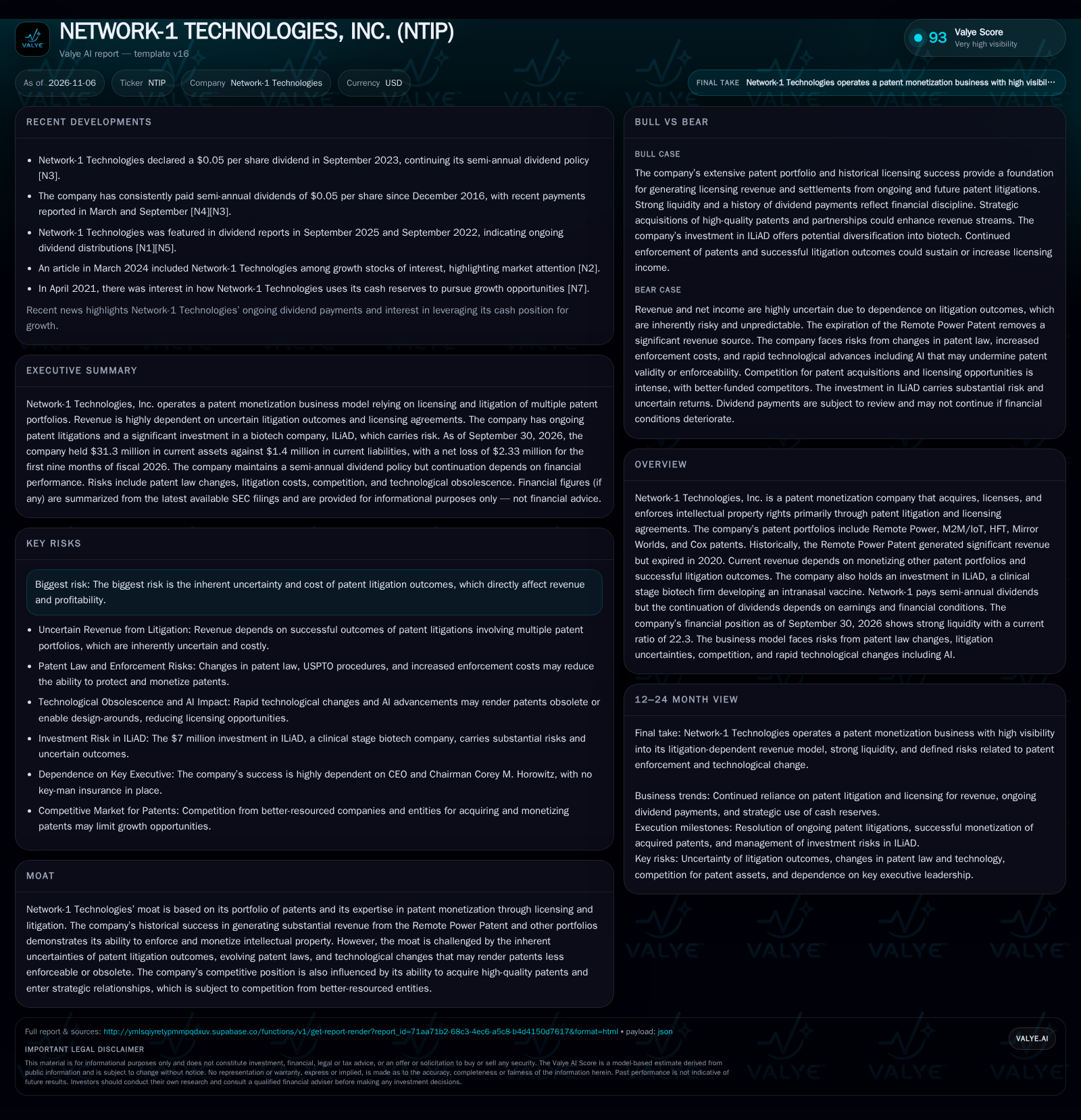
Network-1 Technologies, once sustained by its Remote Power Patent, now relies on uncertain litigation outcomes and new patent monetization efforts after that patent's expiration. The next phase for Network-1 will be defined by its ability to win or settle current suits, successfully monetize its remaining IP, and manage risks in both its core and diversified assets. [S2] [N3] [N4]
Network-1 Technologies, Inc. stands at a critical inflection point following the expiration of its flagship Remote Power Patent, which once underpinned the firm’s economics. Having generated over $188 million from that single asset, the company now finds itself with sharply reduced revenue, a net loss for 2026, and a business model that is fundamentally reliant on high-stakes, unpredictable patent litigation. With a substantial cash and short-term investment cushion, Network-1 is not in immediate financial distress, but its future viability depends on successfully monetizing its remaining patent portfolios and navigating the inherent risks of both litigation and its new venture into biotech. The company’s next chapter will be shaped by its ability to convert legal claims into cash flow and to manage the volatility of its diversification efforts. [S2]
After Remote Power: The New Revenue Reality and Litigation Dependency
Network-1 Technologies’ financial landscape has shifted dramatically since the expiration of its Remote Power Patent in March 2020. This patent generated more than $188 million in revenue over its lifespan, but with its expiration, the company’s 2025 revenue plummeted to $150,000, all attributable to residual Remote Power income. For the first nine months of 2026, Network-1 posted a net loss of $2.33 million. The company’s cash reserves and short-term investments total $31.3 million versus $1.4 million in current liabilities, resulting in a current ratio over 22. However, this liquidity position does not resolve the core issue: future revenues now depend on the outcomes of ongoing and future patent litigations involving the M2M/IoT, HFT, and Cox portfolios, all of which are inherently uncertain and time-consuming. [S2]
The reliance on litigation outcomes for revenue generation introduces significant timing and predictability challenges. Patent enforcement cases often involve protracted legal processes, including appeals and potential settlements that can take years to resolve. This extended timeline complicates financial planning and investor confidence, as interim periods may see ongoing legal expenses without corresponding income. Additionally, the inherent uncertainty of patent validity and infringement rulings means that even strong portfolios may fail to produce expected returns, underscoring the importance of maintaining reported liquidity position and exploring alternative monetization strategies to bridge revenue gaps.
Monetizing Intellectual Property: The Economics Behind Licensing and Litigation
Network-1’s business model centers on acquiring, enforcing, and licensing patents, extracting value primarily through settlements or court-awarded damages. Revenue is episodic, tied to litigation milestones or licensing deals, rather than recurring contracts. The cost structure is skewed by the high fixed costs of legal action, expert testimony, and patent maintenance, which can devour capital for years before any payout. When successful, settlements can yield windfall-like cash flow with high margins, but the timing and amount are unpredictable. The company’s operating leverage is pronounced: legal expenses are incurred upfront and may not be matched by revenue for extended periods, leading to volatile earnings. The $7 million investment in ILiAD signals an attempt to diversify, but introduces biotech development risk, long timelines, and uncertain commercialization economics. Dividend payments, while a sign of discipline, are not sustainable without a return to profitable operations or new monetization wins. [S2]
The episodic nature of patent monetization revenue demands a capital structure capable of absorbing long periods without income while sustaining costly legal campaigns. This dynamic creates a high-risk, high-reward profile where successful enforcement can generate outsized returns, but failures or delays can erode capital rapidly. The cost-benefit calculus of pursuing litigation versus licensing negotiations requires careful assessment of patent strength, defendant financial health, and market conditions. Moreover, diversification into biotech, while potentially lucrative, introduces a distinct risk profile characterized by extended development cycles, regulatory hurdles, and commercialization uncertainty, which may not align with the company’s historical expertise or liquidity needs.
Patent Enforcement in a Crowded and Changing Landscape
Network-1 operates in an environment where the competition includes larger patent assertion entities, technology companies with their own legal resources, and aggregators seeking to acquire and monetize intellectual property. The company’s historical success with the Remote Power Patent demonstrates some capability in patent enforcement, but the landscape is shifting: changes in patent law, court precedents, and the rise of AI-enabled design-arounds make it harder to assert broad claims or secure large settlements. Well-capitalized competitors can outbid Network-1 for high-quality patents or withstand longer legal battles. The company’s moat is based on the perceived strength and relevance of its portfolios, its litigation expertise, and its ability to identify undervalued IP. However, the company is exposed to the risk that its remaining patents may be invalidated, designed around, or simply fail to attract lucrative licensees in a rapidly evolving tech market. [S2]
Transformative Litigation Wins and New Licensing Opportunities Could Restore Growth
The most constructive scenario for Network-1 involves favorable litigation outcomes for its M2M/IoT, HFT, or Cox portfolios. The company reported profitability for the period. Success would also provide resources to acquire additional patents or invest in new IP verticals, reinforcing the monetization flywheel. In this scenario, evidence would include major licensing agreements, public disclosure of settlement amounts, or court victories resulting in meaningful damages. Additionally, if ILiAD’s intranasal pertussis vaccine achieves clinical success and commercial viability, Network-1’s equity stake could provide a new, non-correlated revenue stream. Confirmation would come from regulatory milestones, successful licensing of the vaccine, or a liquidity event such as an IPO or acquisition of ILiAD.
Managing Volatility: A Waiting Game Pending Litigation Outcomes
The company will proceed with current legal actions but may not realize material revenue unless or until a favorable outcome is reached—a process that could span several years. Dividend payments may persist in the short run, but could be reduced or suspended if losses continue and no new licensing deals are struck. Evidence confirming this scenario would include continued low or negative net income, cash burn without offsetting settlements, and ongoing references to pending litigation as the core business activity. Falsification would require either a major legal win or a new, recurring licensing relationship that meaningfully boosts top-line results.
Patent Litigation Setbacks and Asset Erosion Threaten Sustainability
The adverse scenario materializes if Network-1 loses key legal battles, sees its patents invalidated, or fails to secure new licensing partners. In this case, legal expenses would continue to drain cash, with no offsetting revenue, leading to accelerating net losses. The company could be forced to curtail dividend payments and potentially downsize operations. An unfavorable outcome in the ILiAD investment—such as failed clinical trials or inability to secure regulatory approval—could further impair the company’s balance sheet. Confirmation of this scenario would include legal defeats, the absence of new settlements or licenses, accelerated cash burn, dividend suspension, or impairment charges related to the biotech stake.
Milestones That Will Define Network-1’s Next Chapter
Resolution of ongoing patent litigations involving the M2M/IoT, HFT, and Cox portfolios—court victories, settlements, or adverse rulings will be pivotal in determining future revenue.
Any new patent acquisitions or entry into new IP verticals, as these could replenish the revenue pipeline and signal management’s ability to adapt.
Material developments in the ILiAD investment, such as clinical trial results, regulatory submissions, or commercialization milestones.
Trends in legal expenses versus revenue; an increasing gap would highlight sustainability concerns.
If disclosed, the average duration and cost of litigation cycles, which would inform capital allocation and risk assessment.
Management commentary or disclosures regarding succession planning or key-man risk, given the concentration of leadership in the CEO.
Disclaimer: This is research-only, informational analysis and not investment advice. It may include AI-generated interpretation and general industry context. Always verify important details using primary sources.

Comments