
Quantum-Si’s Delayed Proteus Platform: Development Risks, Liquidity, and the Road to Protein Sequencing Commercialization
Quantum-Si’s high-profile Proteus protein sequencing platform faces a delayed commercial launch, ongoing financial losses, and operational uncertainty.
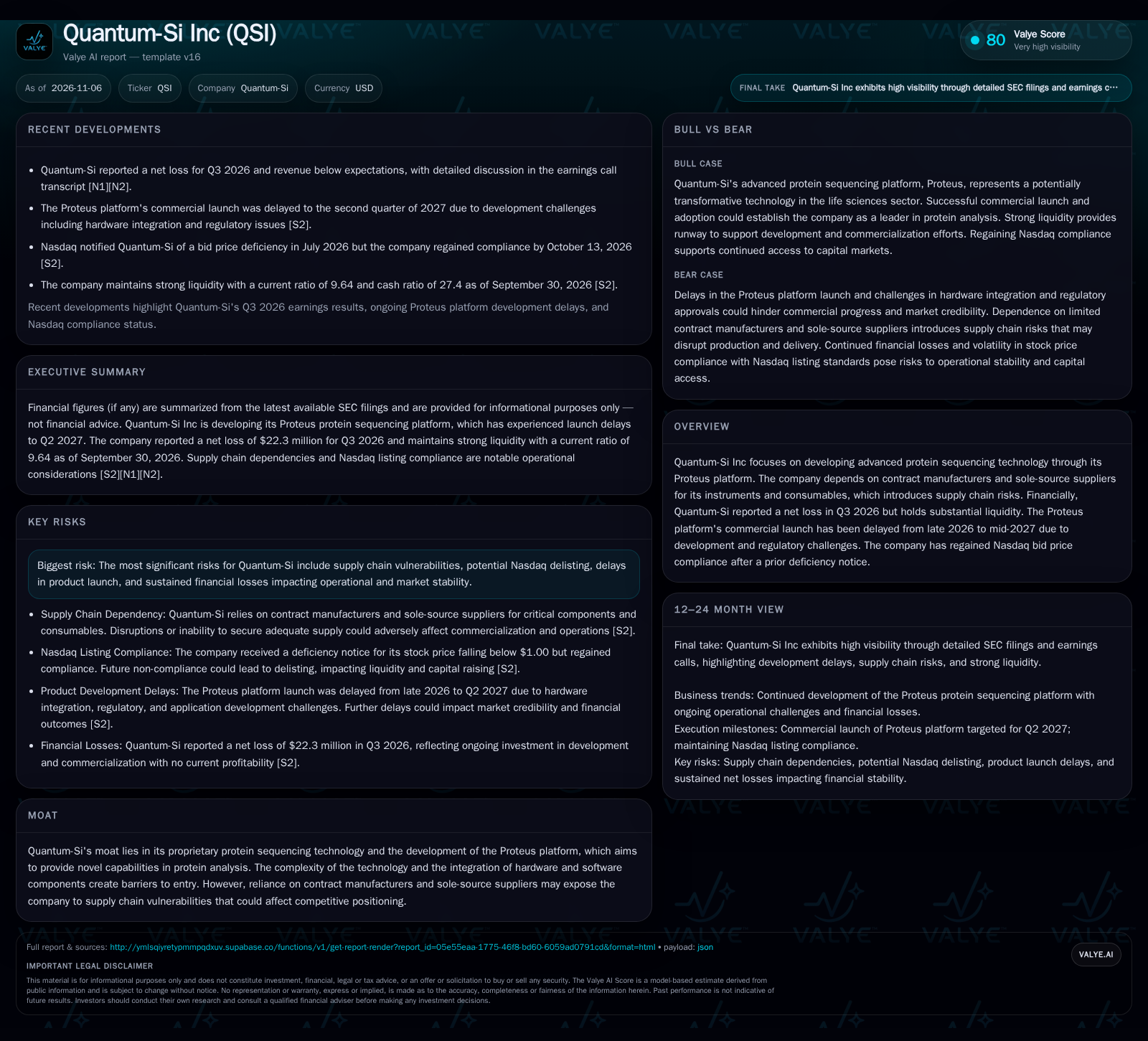
Quantum-Si’s Proteus platform launch has slipped to Q2 2027 due to hardware and regulatory hurdles. The company reported a Q3 2026 net loss and revenue miss but maintains reported liquidity position. Execution risk dominates: successful launch and adoption could be transformative, but delays and supply chain dependencies threaten momentum and credibility. [S2] [N1] [N2]
Quantum-Si Inc stands at a pivotal juncture as it pushes to commercialize its Proteus protein sequencing platform, a technology with the potential to disrupt proteomics research and diagnostics. Continued financial losses and operational dependencies on external suppliers compound the uncertainty. The coming quarters will test Quantum-Si’s ability to translate technical promise into commercial traction and sustainable economics, with execution risk and capital market access in sharp focus. [S2] [N1] [N2]
Development Delays, Financial Losses, and Liquidity: Where Quantum-Si Stands Now
Quantum-Si has postponed the commercial debut of its Proteus protein sequencing platform to the second quarter of 2027, citing ongoing hardware integration and regulatory challenges. This delay follows earlier expectations for a late 2026 launch and signals persistent technical and operational hurdles. The company reported a net loss of $22.3 million in Q3 2026, with revenue missing analyst expectations. The company reported cash and liquidity metrics for the period; these figures do not by themselves establish operating runway, investment capacity, financial flexibility, or financing capacity. Additionally, after receiving a Nasdaq bid price deficiency notice in July, the company regained compliance by October 13, 2026. These facts together highlight a business with ample near-term resources but heightened execution and credibility risk as it strives to commercialize a complex new technology [S2] [N1] [N2].
How Quantum-Si’s Business Model Could Evolve with Proteus Commercialization
Quantum-Si’s core economic proposition is built around the Proteus platform, which aims to enable advanced, high-throughput protein sequencing. If the platform follows the pattern of other life science instrument launches, the company could generate revenue from both capital equipment sales (the Proteus instruments themselves) and recurring consumables (reagents, chips, or cartridges necessary for each run). The upfront instrument sale typically carries lower margins due to hardware complexity and competitive pressure, while consumables—if proprietary—could drive higher-margin, recurring revenue.
The company’s reliance on contract manufacturing and sole-source suppliers introduces both margin and supply chain risk. If Quantum-Si cannot secure volume discounts or has to absorb higher component costs, gross margins on hardware could be pressured, especially in the early phases of commercialization. Variable costs are likely to be dominated by manufacturing and logistics, while fixed costs—R&D, regulatory, and sales infrastructure—will remain high until the business achieves significant scale. This dynamic creates operating leverage: as installed base grows and consumable pull-through increases, fixed costs can be spread over a larger revenue base, potentially improving margins. However, continued net losses indicate that the company is currently in a heavy investment phase, and profitability will depend on both adoption rates and the ability to manage cost structure as production ramps.
Barriers, Substitutes, and Competitive Pressures in Protein Sequencing
Quantum-Si’s moat is grounded in the proprietary nature of its protein sequencing technology and the complexity of integrating hardware and software for high-throughput applications. This could create technical barriers to entry for new competitors. However, the company faces several counterforces: established genomics and proteomics instrument providers, emerging single-molecule sequencing startups, and the risk that alternative technologies (such as mass spectrometry or next-generation sequencing adaptations) will continue to improve and erode the value proposition of Proteus.
Switching costs for customers in the life sciences sector can be significant, particularly if platform-specific consumables and workflows are required. Still, adoption is highly contingent on demonstrated reliability, accuracy, and cost-effectiveness relative to incumbent solutions. If Quantum-Si’s supply chain dependencies result in product delays or quality issues, competitors could capitalize on the credibility gap. The need for regulatory clearance and robust application data further raises the bar for market entry and customer trust, amplifying the consequences of execution missteps.
What a Successful Proteus Launch Would Require—and Evidence to Watch For
If Quantum-Si overcomes its development and regulatory challenges, a successful Proteus launch could establish the company as a leader in next-generation protein sequencing. The favorable causal chain would be: (1) regulatory clearance and validated performance data; (2) initial instrument placements with marquee research institutions or clinical labs; (3) strong consumable uptake indicating recurring usage; (4) positive customer feedback, leading to reference accounts and broader adoption; and (5) a scaling installed base driving operating leverage and margin expansion.
Evidence that would confirm this scenario includes public announcements of regulatory approvals, published validation studies, disclosed purchase agreements or collaborations with leading life science customers, and sequential growth in both instrument placements and consumables revenue (if reported). Conversely, lack of regulatory progress, weak order flow, or continued revenue underperformance would challenge the upside case.
Execution Strain: Likely Trajectory Without Major Surprises
The most plausible near-term outcome is that Quantum-Si continues to face execution risk as it works to bring Proteus to market. Development and regulatory milestones may be met with further delays or incremental progress, rather than a dramatic breakthrough. Financial losses are likely to persist through 2027 as the company invests in R&D, manufacturing readiness, and commercial infrastructure. Liquidity appears sufficient for now, but additional capital may be needed if timelines slip or commercialization is slower than expected.
Confirmation of this scenario would come from periodic updates indicating progress on development and regulatory fronts, but with cautious guidance and continued net losses. Falsification would require either a clear acceleration in adoption and revenue or, conversely, a material deterioration in liquidity or a major setback in product readiness.
How Delays, Supply Chain Shocks, or Market Skepticism Could Derail Quantum-Si
The adverse scenario for Quantum-Si centers on prolonged development challenges, regulatory setbacks, or supply chain disruptions that further delay or impair the Proteus platform launch. If technical problems persist or key components become unavailable due to reliance on sole-source suppliers, the company could face additional costs, missed milestones, and eroding customer confidence. This could be compounded by competitive advances from incumbent or alternative technologies, making market entry harder even if Proteus eventually launches.
In this scenario, cash burn continues without meaningful revenue inflection, potentially forcing Quantum-Si to seek dilutive financing or face renewed Nasdaq compliance issues. Evidence confirming the downside would include further launch postponements, negative updates on supply chain or regulatory progress, declining liquidity, or renewed warnings regarding listing status. Evidence against this outcome would be rapid resolution of identified challenges and improved financial performance.
Milestones and Metrics to Gauge Quantum-Si’s Execution and Commercialization Progress
Regulatory clearance milestones for the Proteus platform—any FDA or relevant agency filings, feedback, or approvals.
Public disclosure of initial customer agreements or instrument placements, particularly with high-profile research or clinical partners.
Sequential growth in consumables revenue and instrument sales, if disclosed, to demonstrate recurring adoption.
Supply chain updates, especially regarding contract manufacturer relationships and mitigation of sole-source component risks.
Quarterly operating expense trends and cash burn rate, to assess runway and capital needs.
Updates on Nasdaq listing status or any new compliance warnings.
Publication of independent validation or performance studies supporting Proteus’s technical claims.
Management commentary on market feedback, application development, and competitive positioning during earnings calls.
Disclaimer: This is research-only, informational analysis and not investment advice. It may include AI-generated interpretation and general industry context. Always verify important details using primary sources.

Comments