
Ring Energy’s Liquidity Squeeze: Surpassing Estimates Amid Mounting Short-Term Pressure
Ring Energy reported a Q3 2026 net loss of $16.6 million and reported liquidity-ratio trends of just 0.01, despite beating expectations on both earnings and revenue.
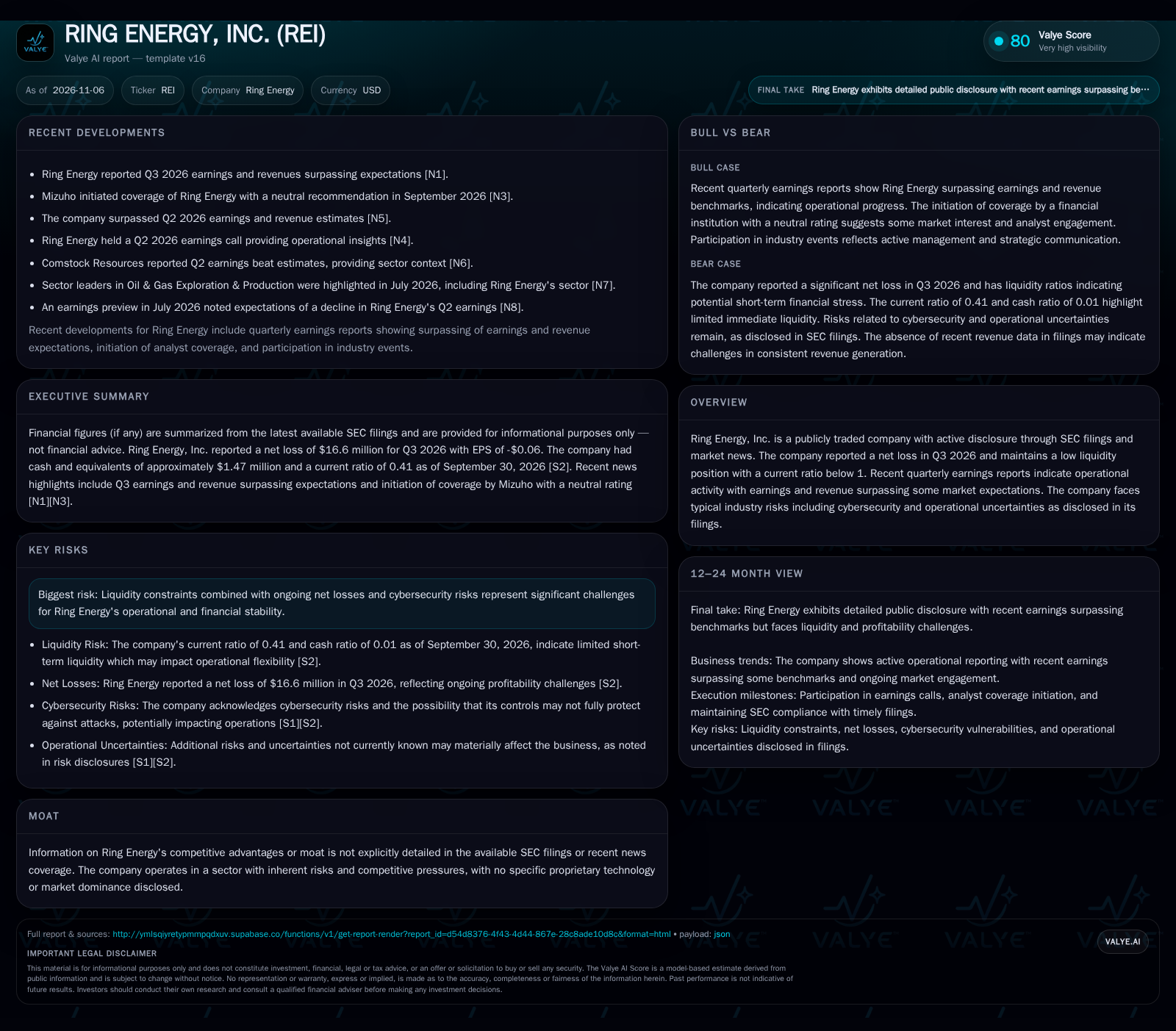
Ring Energy reported a Q3 2026 net loss of $16.6 million and reported liquidity-ratio trends of just 0.01, despite beating expectations on both earnings and revenue. Near-term viability hinges on management’s ability to address operational losses and navigate industry headwinds while preserving access to capital and mitigating cybersecurity and execution risks. [S2] [N1] [N3] [N5]
Ring Energy’s recent financial disclosures and earnings outcomes paint a picture of a company at a crossroads. The company’s ability to stabilize its cash flows, manage risk, and maintain access to capital will determine whether recent positive surprises can translate into sustainable recovery or if structural challenges will dominate the narrative.
Recent Results Reveal Surpassing Expectations Amid Mounting Financial Strain
Ring Energy reported a net loss of $16.6 million for Q3 2026, with basic and diluted EPS at -$0.06 per share [S2]. As of September 30, 2026, the company’s cash and equivalents stood at $1.47 million, current assets at $67.9 million, and current liabilities at $164.1 million, resulting in a current ratio of 0.41 and a cash ratio of 0.01 [S2]. Despite these strained balance sheet metrics, Ring Energy outperformed analyst earnings and revenue expectations in both Q2 and Q3 2026, as reflected in recent news coverage [N1] [N5]. Further, Mizuho initiated analyst coverage with a neutral rating, underscoring ongoing market engagement but also signaling uncertainty about the company’s direction [N3]. These facts highlight a business under short-term financial pressure but still able to deliver operational surprises—raising the stakes for how management navigates the next phase.
How Ring Energy’s Cost Structure and Funding Needs Shape Its Options
The company’s acute liquidity constraints and ongoing net losses suggest a structurally challenged business model. In oil and gas E&P (exploration and production), revenue is typically a function of production volumes and realized commodity prices, while costs are driven by lease operating expenses, drilling and completion costs, and G&A. The company reported cash and liquidity metrics for the period; these figures do not by themselves establish operating runway, investment capacity, financial flexibility, or financing capacity. [S2]
With a current ratio of 0.41, Ring Energy’s short-term liabilities substantially outstrip its liquid resources. This may limit flexibility to invest in new wells, sustain production, or weather commodity-price swings. Fixed costs—such as leasehold expenses and debt service—could create negative operating leverage if production volumes or commodity prices weaken. Conversely, if the company can optimize its cost structure or enhance realized pricing through hedging, there may be scope to compress losses or return to breakeven. In practice, capital-intensive upstream businesses often rely on periodic access to external financing, asset monetization, or farm-out agreements to fund drilling programs and manage working capital cycles.
Given the capital-intensive nature of upstream oil and gas operations, the timing and structure of financing arrangements critically influence Ring Energy’s operational flexibility. Short-term liquidity constraints may force the company to prioritize immediate obligations over longer-term investments, potentially leading to deferred maintenance or postponed drilling activities. Such trade-offs can impair production growth and exacerbate cost inefficiencies. Additionally, the company's ability to negotiate favorable terms on debt or equity financing is likely contingent on prevailing market conditions and investor sentiment toward the sector, which can be volatile. Therefore, the interplay between external financing availability and internal cost management will be pivotal in shaping the company’s financial trajectory.
Competitive Pressures and the Search for Differentiation in a Crowded Upstream Market
Ring Energy operates in a sector characterized by commodity price volatility, high capital intensity, and a fragmented field of independent producers. Without disclosure of proprietary technology, premium acreage, or low-cost leadership, the company’s competitive position appears undifferentiated. Larger, better-capitalized peers can often weather downturns or capitalize on distressed asset sales, while smaller players like Ring Energy may be more exposed to liquidity-driven constraints and forced asset sales.
Competitive counterforces include substitute energy sources, regulatory tightening, and the ongoing shift toward decarbonization, all of which can pressure both realized prices and access to capital. The lack of explicit mention of recurring revenue streams, long-term contracts, or integrated midstream/logistics advantages suggests that Ring Energy’s switching costs and customer stickiness may be low—typical for independent E&Ps. Any attempt to carve out a niche would likely require either superior cost discipline, technological enhancement (such as advanced recovery techniques), or strategic asset repositioning.
In an environment of intense competition and capital scarcity, differentiation often hinges on operational efficiency and strategic asset positioning. For Ring Energy, achieving cost leadership could involve leveraging economies of scale, optimizing supply chain logistics, or adopting advanced drilling and completion technologies that reduce per-unit extraction costs. Furthermore, the company’s geographic footprint and regulatory environment can materially affect its cost base and operational risk profile. Competitors with access to lower-cost reserves or more favorable regulatory regimes may sustain profitability at lower commodity prices, thereby exerting pricing pressure on less advantaged peers. Consequently, Ring Energy’s capacity to adapt its asset portfolio and operational practices in response to these dynamics will influence its competitive resilience.
Operational Discipline and Commodity Upside as Catalysts for Recovery
A favorable scenario for Ring Energy would see the company stabilizing or growing production volumes while containing operating and capital costs, resulting in narrowing or reversing net losses. Outperformance on revenue and earnings in recent quarters hints at management’s ability to control costs or optimize production, at least tactically [N1] [N5].
Falsification would come from continued net losses, further balance sheet deterioration, or inability to secure external funding.
Navigating Tight Liquidity While Seeking Operational Stability
The most plausible near-term trajectory for Ring Energy involves ongoing operational activity with incremental cost control, but persistent financial pressure and limited flexibility. Margins may improve modestly if management executes on expense discipline or if modest commodity-price gains materialize, but the company is likely to remain reliant on external funding or asset monetization to meet obligations. Analyst neutrality and persistent net losses suggest that the market expects neither a rapid turnaround nor an imminent collapse [N3] [S2].
Confirmation would come from stable or improving current ratios, reduced quarterly losses, and clear evidence that operating cash flow is trending toward breakeven. Conversely, any sharp deterioration in liquidity, missed payments, or forced asset sales at distressed prices would suggest the base case is breaking down and that downside risk is rising.
Liquidity Crunch and Funding Constraints Could Force Strategic Retreat
An adverse scenario could unfold if Ring Energy is unable to secure additional liquidity or if commodity prices decline, further eroding cash flows. [S2] Operational disruptions—whether from equipment failures, regulatory penalties, or cybersecurity events—could exacerbate the squeeze, especially if the company lacks the resources to address them promptly.
This scenario would be confirmed by disclosures of asset sales at fire-sale prices, announcements of debt restructuring or equity dilution, missed supplier or debt payments, or a rapid increase in net losses. Additional warning signs would include negative operating cash flow accelerating, loss of access to credit markets, or significant production declines due to underinvestment in maintenance or drilling.
Signals That Will Define Ring Energy’s Next Chapter
Quarterly production volumes, if disclosed, to determine whether operational activity is stabilizing, growing, or shrinking.
Operating cash flow trends, particularly whether cash flow from operations is sufficient to cover interest, principal, and working capital needs.
Disclosure of asset sales, new financings, or strategic partnerships that materially alter the balance sheet or funding outlook.
Updates on realized commodity prices and hedging outcomes to gauge exposure to price volatility and risk management practices.
Quarterly net income and EPS trends to assess whether cost discipline or operational improvements are translating into reduced losses.
Cybersecurity incident disclosures or operational disruptions, which could impact both costs and continuity.
Any indication of regulatory or compliance issues that could trigger fines, penalties, or operational suspensions.
Disclaimer: This is research-only, informational analysis and not investment advice. It may include AI-generated interpretation and general industry context. Always verify important details using primary sources.

Comments