
HealthStream’s Platform Ambitions: Scaling Healthcare SaaS Amid Integration, Margin, and Industry Headwinds
HealthStream’s Q3 2026 results highlight robust subscription-driven revenue growth but expose margin compression amid elevated costs from acquisitions and a cybersecurity incident. As the company doubles down on AI investments and platform integration, its ability to balance operational leverage with industry headwinds and execution risks will shape the next phase of value creation.
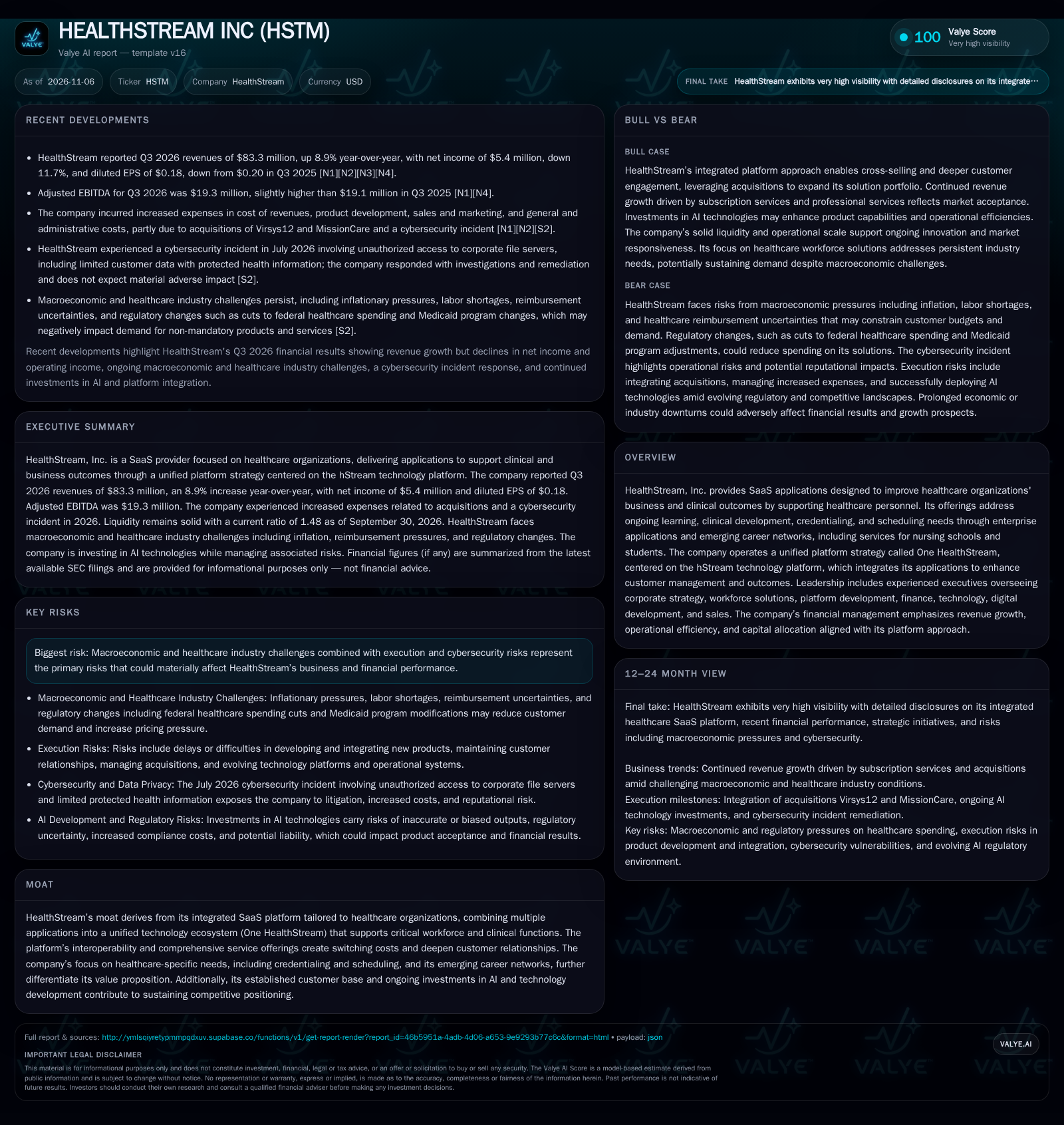
HealthStream grew Q3 2026 revenues by 8.9%, with 96% of revenue from subscriptions, but operating income fell due to higher expenses linked to acquisitions and cybersecurity remediation. The company’s platform strategy and AI investment offer upside, but margin pressure, execution complexity, and persistent healthcare industry uncertainties remain material challenges. Watch for acquisition integration, expense control, and evidence of sustainable margin expansion as key inflection points. [S2] [N1]
HealthStream’s latest quarter underscores the company’s evolving challenge: sustaining strong top-line growth through its integrated healthcare SaaS platform while managing the rising costs and operational complexities of expansion. With 96% of revenues now subscription-based, HealthStream’s model promises visibility and potential operating leverage. However, a 13% drop in operating income—driven by acquisition-related expenses and cybersecurity remediation—raises questions about the near-term path to margin recovery. As HealthStream pushes further into AI and platform integration, its ability to deliver scalable, profitable growth amid sector-wide economic and regulatory pressures will determine its strategic trajectory.
Recent Results Reveal Strong Subscription Growth but Margin Compression
HealthStream reported Q3 2026 revenues of $83.3 million, up 8.9% year-over-year, with subscription services accounting for 96% of total revenue [S2] [N1]. While top-line momentum remains robust, operating income declined 13% to $6.6 million due to elevated costs in product development, sales and marketing, and general and administrative expenses. These cost increases were linked to the integration of acquired businesses (Virsys12 and MissionCare) and remediation following a cybersecurity incident in July 2026 [S2] [N1]. Adjusted EBITDA was stable at $19.3 million, marginally above the prior year [N1] [N4]. Liquidity remained solid, with $58.96 million in cash and equivalents and a current ratio of 1.48 at quarter end [S2]. HealthStream continues to invest in AI technologies and platform integration, positioning itself for long-term differentiation but increasing near-term complexity and execution risk.
Subscription-Centric Model Drives Predictability, but Cost Structure Faces Pressure
HealthStream’s business model is anchored in SaaS subscriptions, providing recurring revenue streams from healthcare organizations seeking workforce development, credentialing, scheduling, and compliance solutions. With 96% of revenue derived from subscriptions, the company enjoys high revenue visibility and a degree of insulation from one-time project volatility [S2]. The One HealthStream platform strategy—centered on the hStream technology stack—aims to deepen integration and enable cross-selling, which could further increase average revenue per customer and retention if executed well.
However, recent financial results highlight the challenge of translating revenue growth into operating leverage. Elevated spending on acquisitions, cybersecurity remediation, and ongoing product development contributed to margin compression in Q3 2026, with operating income falling even as adjusted EBITDA was essentially flat [S2] [N1]. As HealthStream expands its solution set and invests in AI, fixed costs and integration expenses may remain elevated. Over time, the scalability of the SaaS model could allow incremental subscription revenue to drop through to margins, but this depends on the company’s ability to control costs and achieve platform efficiencies. Capital needs for ongoing product innovation and acquisition integration may also limit near-term free cash flow expansion.
Integrated Platform and Healthcare Focus Create Differentiation, but Switching Frictions Are Not Absolute
HealthStream’s core advantage lies in its tightly integrated, healthcare-specific SaaS platform that addresses credentialing, learning, and workforce management—critical functions for hospitals, nursing schools, and related organizations. The One HealthStream approach, built on the hStream platform, creates value by centralizing data, workflows, and analytics, potentially embedding HealthStream deeply within customer operations. This integration can generate switching costs, as migration to alternative solutions would involve data transfer, retraining, and regulatory compliance risks.
However, the healthcare SaaS space remains competitive, with both specialized vendors and larger enterprise HR and learning platform providers targeting overlapping needs. While HealthStream’s healthcare focus and emerging career network features offer differentiation, the company must continue to justify its value proposition amid cost-sensitive customer budgets and evolving technology standards. Ongoing investments in AI and interoperability may augment its moat, but rapid technological change and the risk of commoditization in core modules remain plausible counterforces.
If Integration and AI Investments Drive Efficiency, Margin Expansion and Cross-Sell Acceleration Become Plausible
The most favorable outcome for HealthStream would stem from successful integration of recent acquisitions (Virsys12 and MissionCare) and effective deployment of AI technologies across its product suite. If the company leverages its unified platform to cross-sell new modules, drive up-sell within its installed base, and automate internal workflows using generative and agentic AI, incremental revenue could accrue at higher marginal profitability. In this scenario, customer retention rates could rise, average contract values may increase, and operating leverage would improve as fixed platform costs are spread over a larger revenue base.
Confirmation would come from a reversal of recent margin compression—evidenced by a rising operating margin and adjusted EBITDA margin even as R&D and integration spending stabilize. Additional signs would include new customer wins, expansion within existing accounts, and a demonstrable reduction in churn. Falsification of this scenario would occur if integration drags on, AI investments fail to translate to tangible cost savings or product enhancements, or if margin pressure persists despite revenue growth.
Sustained Growth Meets Margin Volatility as HealthStream Navigates Industry Headwinds
The most plausible outcome is that HealthStream maintains solid top-line growth in the high single-digit to low double-digit range, primarily through ongoing subscription expansion and incremental product uptake. However, the company is likely to encounter intermittent margin volatility as it absorbs acquisition-related costs, invests in AI, and addresses cybersecurity and compliance demands. Macroeconomic pressures—including healthcare labor shortages, inflation, and reimbursement uncertainty—may continue to weigh on customer budgets, limiting the pace of discretionary IT and SaaS spending.
In this scenario, HealthStream could deliver modest improvements in adjusted EBITDA as integration efficiencies and automation efforts gradually offset near-term expense growth. Evidence would include stabilization of operating margins after the current dip, continued subscription growth, and successful onboarding of acquired businesses onto the core platform. Falsification would be indicated by persistent margin erosion, stalled cross-sell momentum, or significant customer attrition driven by industry cutbacks or competitive displacement.
Prolonged Margin Compression and Industry Contraction Threaten Growth Thesis
A less favorable scenario is one in which HealthStream’s elevated cost base persists or worsens, with integration challenges and cybersecurity costs draining resources while industry headwinds intensify. Should regulatory changes, reimbursement cuts, or macroeconomic shocks further constrain healthcare provider budgets, customers may defer purchases, reduce seat counts, or downgrade to lower-cost solutions. This would disproportionately affect non-mandatory modules and professional services, eroding revenue growth and pressuring margins.
Downside confirmation would include further declines in operating income, negative free cash flow, or a need to cut back on R&D and platform investment to preserve liquidity. Rising customer churn, missed sales targets, and inability to realize synergies from acquisitions would further validate this scenario. Falsification would be seen if expense growth moderates, margin trends recover, and industry demand proves more resilient than expected.
Benchmarks for Testing HealthStream’s Platform Profitability and Competitive Durability
Sustained improvement or stabilization in operating margin and adjusted EBITDA margin, particularly as integration costs and AI investments normalize, would be a key indicator of scalable profitability.
Subscription revenue growth rate relative to healthcare industry IT spending trends and peer SaaS providers would help gauge HealthStream’s market share trajectory and demand resilience.
Customer retention and net revenue retention rates (if disclosed) would provide insight into switching frictions, platform stickiness, and the success of cross-sell or up-sell initiatives.
Progress and milestones in integrating Virsys12 and MissionCare—such as unified product rollout, customer migrations, or synergy realization—would help test HealthStream’s acquisition execution.
Updates on AI-enabled product launches, automation of internal workflows, or quantifiable cost savings from AI adoption would clarify the ROI of current technology investments.
Incidence of further cybersecurity events, regulatory investigations, or material litigation related to data breaches would serve as a stress test for operational risk management.
Changes in healthcare policy, reimbursement rates, or significant shifts in Medicaid/federal healthcare funding would directly impact customer purchasing power and solution adoption.
Evidence of pricing power—such as successful price increases, premium module adoption, or resilience of contract values in the face of industry budget constraints—would signal the strength of HealthStream’s value proposition.
Disclaimer: This is research-only, informational analysis and not investment advice. It may include AI-generated interpretation and general industry context. Always verify important details using primary sources.

Comments