
ICF International: Diversified Backlog and Sector Shifts Shape the Next Phase of Growth
ICF International enters late 2026 with a record backlog, sector-tailored technology offerings, and a strategic push into energy, AI, and federal modernization. The challenge is to convert its project pipeline and multidisciplinary expertise into durable margin expansion while navigating government budget cycles and competitive pressures.
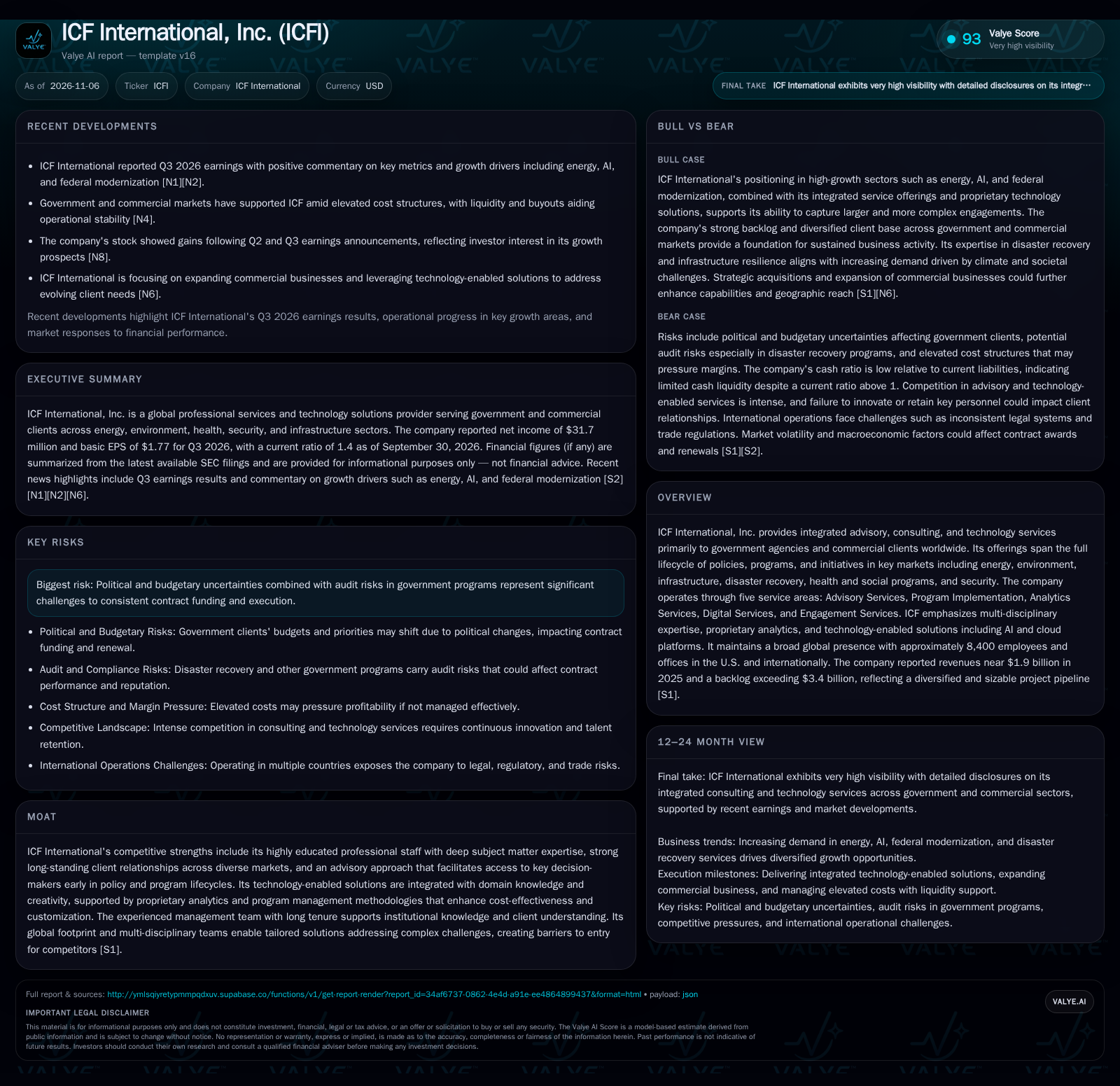
ICF International reported a $3.4 billion backlog at year-end 2025, with 2025 revenue at $1.87 billion and Q3 2026 net income of $31.7 million [S1] [S2].Recent growth is attributed to momentum in energy, AI, and federal modernization, while elevated costs and a reported cash ratio highlight the need for careful margin management [S2] [N1] [N2] [N4] [N6]. The company's integrated advisory and technology model, supported by proprietary analytics and long-tenured teams, underpins its ability to compete for large, complex projects but leaves it exposed to budgetary swings and compliance risks in its government-heavy portfolio.
ICF International stands at a pivotal juncture as 2026 draws to a close, leveraging a record backlog and sector-specific expertise to pursue growth in energy, AI, and federal modernization services. With revenues near $1.9 billion in 2025 and robust Q3 2026 earnings, ICF’s challenge is to transform its strong pipeline into sustained profitability while managing margin pressures and navigating the complexities of government and commercial client demands. The company’s integrated approach—combining advisory, analytics, and technology—offers both opportunity and risk as the consulting landscape evolves.
Backlog Strength and Sector Momentum Define ICF’s 2026 Position
ICF International reported a year-end 2025 backlog of $3.4 billion, supporting revenue visibility well above its 2025 revenue of $1.87 billion [S1]. This backlog, spanning government and commercial clients, reflects the company’s ability to secure multi-year, complex projects across energy, environment, health, and infrastructure. Q3 2026 net income was $31.7 million with basic EPS of $1.77, indicating continued earnings generation [S2]. [S2] Recent commentary emphasized growth in energy, AI, and federal modernization as key business drivers [N1] [N2] [N6]. These facts matter because they frame ICF’s near-term stability, its ability to win and execute large projects, and the financial balancing act required to sustain profitability amid sector shifts and cost pressures.
How ICF Converts Backlog into Earnings: Revenue Mix and Margin Dynamics
ICF’s economics depend on converting its sizable backlog into revenue streams that blend consulting fees, technology-enabled project work, and program implementation. Pricing is often set by government procurement rules for federal contracts, which can limit margin expansion but provide volume stability. Commercial contracts, especially in energy and air transport, may offer more pricing flexibility and upside potential if ICF can differentiate with proprietary analytics or integrated digital services.
ICF’s operating cost base is heavily weighted toward labor—its 8,400 employees are multidisciplinary and often highly credentialed, supporting premium rates but also driving elevated SG&A. Technology investments, including AI and cloud platforms, are increasingly capitalized or expensed based on project structure; these investments could yield operating leverage if software-enabled solutions are reused across clients. [S2]
The company’s business model, which emphasizes long-term client relationships and repeat engagements, creates a degree of revenue stickiness but is also exposed to changes in government budgeting cycles and regulatory priorities. Fixed costs in management and technology infrastructure provide leverage on incremental revenue, but margin expansion depends on controlling labor costs and winning higher-margin digital or analytics projects.
A critical factor influencing ICF’s margin trajectory is the balance between fixed and variable cost structures within its project portfolio. While labor costs represent a significant variable expense, investments in scalable technology platforms can introduce semi-fixed costs that, if efficiently leveraged, reduce incremental costs per project. However, the realization of operating leverage hinges on the company’s ability to standardize and modularize solutions across diverse client engagements, which may be challenging given the bespoke nature of many government contracts. Additionally, the timing mismatch between upfront technology development costs and downstream revenue recognition could create short-term margin pressure, necessitating careful financial planning and capital allocation.
Proprietary Analytics and Institutional Knowledge as Differentiators—But for How Long?
ICF’s competitive edge is built on proprietary analytics, deep subject matter expertise, and long-standing relationships with government and commercial clients [S1]. Early engagement in policy and program lifecycles allows the company to influence project design and embed itself in mission-critical work, raising switching costs for clients. Its integrated portfolio—advisory, analytics, digital, and engagement services—lets ICF address complex, multidisciplinary problems that pure-play IT or management consultancies might struggle to solve.
However, the consulting and technology-enabled services market is intensely competitive, with global strategy firms, specialized IT integrators, and boutique analytics providers all vying for similar contracts. Technology substitution is a real threat: the rise of AI-driven automation and self-service analytics platforms could erode the value of traditional consulting and analytics engagements unless ICF continues to invest and differentiate. The company’s institutional knowledge and management tenure are strengths, but talent retention and continual innovation are essential to sustaining its moat.
The sustainability of ICF’s competitive moat is also contingent on its capacity to adapt to evolving client expectations around data security, privacy, and regulatory compliance. As government agencies and commercial clients increasingly prioritize these factors, firms that integrate robust governance frameworks and transparent analytics methodologies may gain preferential access to contracts. ICF’s longstanding client relationships provide a foundation for trust, but maintaining this advantage requires continuous investment in compliance capabilities and proactive risk management. Failure to keep pace with regulatory changes or to effectively communicate the value and security of its proprietary analytics could erode client confidence and open opportunities for competitors.
Moreover, talent dynamics present a dual-edged challenge for ICF’s differentiation strategy. While long-tenured teams contribute to deep institutional knowledge and client intimacy, they may also risk complacency or resistance to adopting innovative technologies and methodologies. Conversely, aggressive recruitment of new talent with cutting-edge technical skills is essential to sustain innovation but can increase compensation costs and cultural integration challenges. The company’s ability to blend experienced professionals with emerging talent, foster continuous learning, and incentivize innovation will be pivotal in preserving its consultative relevance and technological edge over time.
If Sector Tailwinds and Tech Integration Drive Margin Expansion
The bullish scenario unfolds if ICF capitalizes on robust demand in energy, AI, and federal modernization by winning higher-margin, technology-intensive projects and driving operating leverage through reuse of proprietary software and analytics platforms. Expansion into commercial energy and air transport markets could diversify revenue and reduce reliance on government budgets, especially if regulatory and climate-driven spending accelerates. Successful integration of AI and cloud solutions into client offerings would support premium pricing and help offset labor cost inflation.
Confirmation would come from sustained double-digit backlog growth in commercial sectors, rising gross margins in digital and analytics service lines (if disclosed), and evidence of multi-year contract wins with embedded technology components. Accelerating revenue from new markets or geographies and a trend of improving cash conversion cycles would further support the upside thesis.
Sustained Execution Amid Cost Pressures and Policy Shifts
The most plausible trajectory is steady revenue growth with modest margin improvement, as ICF executes its existing backlog and wins incremental business in both government and commercial markets. Revenue visibility remains high due to the project pipeline, but margin expansion is limited by persistent labor cost pressures and the need to invest in technology and compliance. Government spending on infrastructure, environment, and modernization continues but may be uneven depending on political cycles and budgetary constraints.
The base case is confirmed if ICF reported liquidity-ratio trends above 1, keeps net income positive, and shows stable or slightly improving operating margins. Evidence of contract renewal rates and repeat business (if disclosed) would further validate this scenario. A reversal—such as declining backlog, margin compression, or missed project milestones—would challenge the base case.
Adverse Policy Shocks or Margin Squeeze Threaten the Model
Downside risk emerges if government budget cuts, regulatory delays, or audit findings disrupt major contracts, leading to project deferrals or cancellations. Elevated cost structures could compress margins if wage inflation persists or if ICF fails to secure enough high-margin digital work to offset labor-intensive contracts. [S2]
Confirmation would come from declining or stagnant backlog, negative net income, or a current ratio falling toward 1 or below. Deterioration in client relationships, contract disputes, or negative audit outcomes (if publicized) would further support a downside thesis.
What Will Confirm ICF’s Ability to Convert Pipeline into Profitable Growth?
Quarterly and annual backlog growth by sector—especially in commercial energy and AI-driven projects—would help test the sustainability of ICF’s pipeline.
Gross margin trends by service line (advisory, analytics, digital, implementation) if disclosed, to assess the impact of technology integration and cost management.
Contract renewal and repeat business rates, particularly in government segments, would clarify client stickiness and revenue visibility.
Disclosure of multi-year or recurring revenue contracts, especially those embedding proprietary software or platforms.
Talent turnover rates and management retention, as institutional knowledge is a key differentiator.
New contract wins or expansions in international markets, which would signal successful geographic diversification.
Any commentary or disclosure on audit outcomes and compliance issues in large government or disaster recovery programs.
Disclaimer: This is research-only, informational analysis and not investment advice. It may include AI-generated interpretation and general industry context. Always verify important details using primary sources.

Comments