
Lionsgate Studios: Content Volatility, Capital Structure, and the Search for Sustainable Profitability
Lionsgate Studios reported a sharp increase in motion picture revenue and segment profit for the six months ending September 30, 2026, driven by strong theatrical performance.
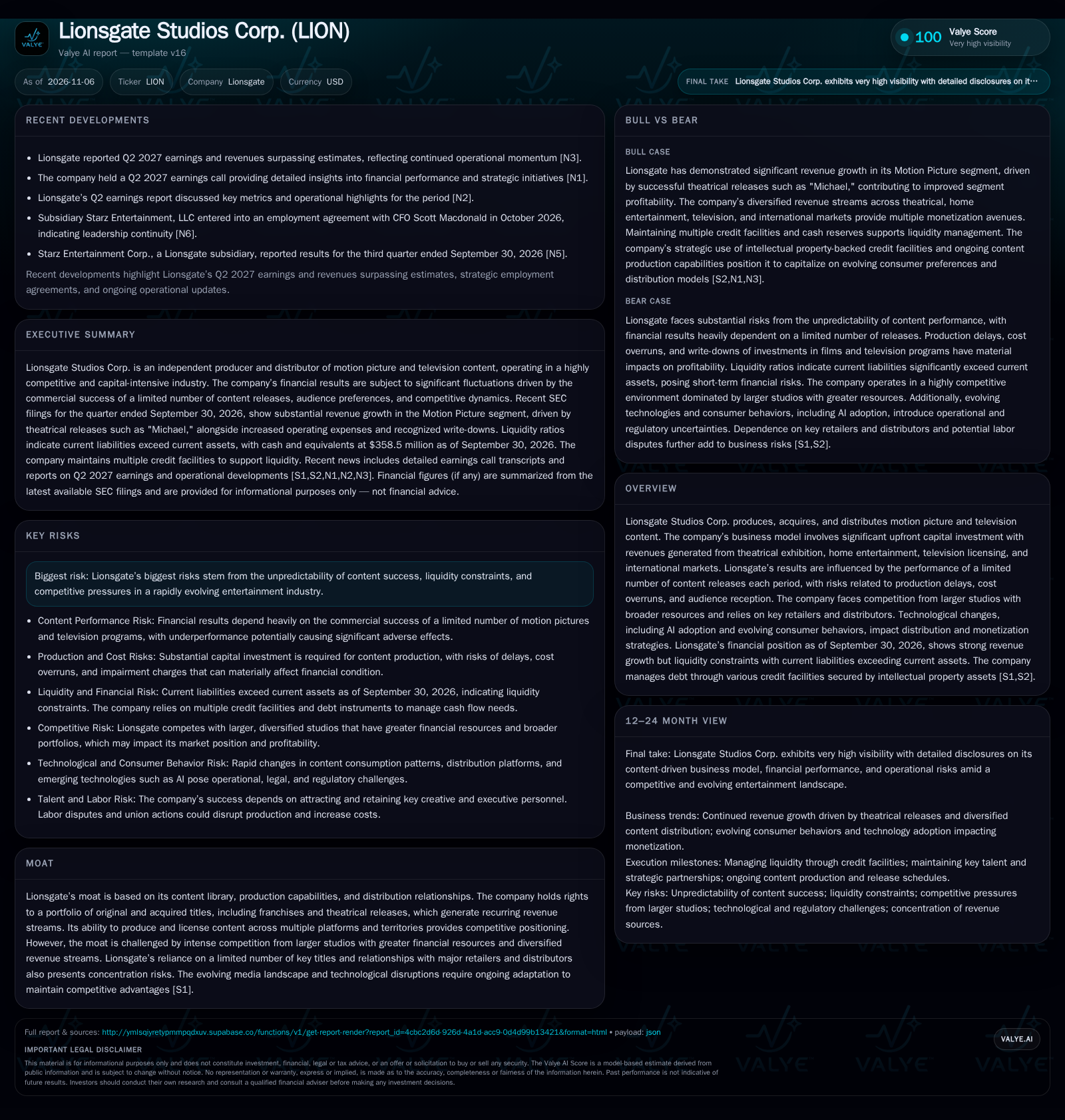
Lionsgate Studios reported a sharp increase in motion picture revenue and segment profit for the six months ending September 30, 2026, driven by strong theatrical performance. Its business model remains highly exposed to the unpredictable success of a few key releases, intensifying both upside potential and downside risks in a rapidly shifting entertainment landscape. [S2]
Lionsgate Studios’ latest results showcase both the promise and the peril of the independent content production model. A standout performance by its Motion Picture segment—propelled by successful theatrical releases—delivered robust top-line and profit growth. As the entertainment industry’s structure evolves with new technologies and shifting audience habits, Lionsgate’s ability to smooth out volatility and maintain access to capital will be critical to its long-term competitiveness.
Recent Results Reveal Sharp Gains—But Also Heightened Dependence
For the six months ended September 30, 2026, Lionsgate Studios reported total revenue of $1,445.4 million, a 44.4% increase over the prior-year period. The Motion Picture segment was the clear standout, with revenue jumping 74.1% to $946.6 million and segment profit ballooning 488.4% to $193.6 million, largely on the strength of theatrical releases such as "Michael." However, the company’s Television Production segment saw only modest revenue growth and a drop in segment profit, reflecting the unpredictable mix and performance of titles. Direct operating expenses also climbed, with $14.3 million in write-downs in Motion Pictures and $7.6 million in Television Production. While Lionsgate maintains multiple IP-backed credit facilities with available borrowing capacity, these results underscore the binary nature of content bets and the thin margin for error in financing [S2].
Hit-Driven Economics and Capital-Intensive Content Cycles
Lionsgate’s core business is built around heavy upfront investment in content—both original and acquired—which is then monetized across theatrical, home entertainment, television licensing, and international distribution windows. The economics are highly leveraged to a small number of titles each period: a blockbuster can drive segment profits and cover fixed costs, while a flop can force write-downs and impairments. The company amortizes production costs against expected revenue streams, but these estimates are at constant risk of revision as audience preferences shift. The need to continually develop and market new content creates ongoing capital requirements, which Lionsgate finances through a mix of cash, operating cash flows, and secured credit facilities. Operating leverage can be significant when releases outperform, but the inverse is also true—cost overruns, delays, or underperformance drive rapid margin compression and sometimes require additional borrowing. The lack of long-term production or co-financing arrangements may allow flexibility but also limits future revenue visibility and derivative rights [S1] [S2].
The cyclical nature of content production also imposes timing challenges on capital allocation. Lionsgate must balance the urgency of investing in new projects to maintain a relevant slate against the risk of overextending financial resources before revenue from prior releases is fully realized. This timing mismatch can strain liquidity, especially if anticipated hits fail to materialize or if distribution windows shift due to changing consumer consumption patterns. Moreover, the amortization schedules used to expense production costs depend heavily on forecasted revenue streams, which are inherently uncertain in a rapidly evolving market. Consequently, the company’s financial performance is not only sensitive to box office and licensing outcomes but also to the accuracy and conservatism of its accounting assumptions.
Surviving in the Shadow of Larger Studios and Platform Shifts
Lionsgate competes against global, vertically integrated giants with far deeper pockets, larger content libraries, and direct-to-consumer streaming infrastructure. Its advantage lies in a nimble approach and a library of original and acquired titles, but this moat is challenged by the scale and marketing muscle of diversified peers. The company’s revenue is further concentrated among a few key retailers and distributors—Amazon accounted for 18% of revenue in fiscal 2026—creating exposure to distributor leverage and platform algorithm changes. Technological shifts such as AI-powered content creation, new distribution platforms, and streaming bundling could further erode Lionsgate’s negotiating power and fragment audience attention. Retaining top creative talent is another persistent challenge, as larger studios and tech platforms can often outbid independents for marquee projects. The company’s content library does provide recurring revenue potential, but the value of that library is itself subject to changing consumption patterns and competitive output [S1].
The competitive landscape further complicates Lionsgate’s strategic positioning. Larger studios benefit from economies of scale in content production and marketing, enabling them to spread risks across a broader portfolio of projects and leverage cross-promotion across franchises and platforms. In contrast, Lionsgate’s relatively smaller scale means that individual project outcomes disproportionately impact overall results. Additionally, the rise of direct-to-consumer streaming platforms owned by major studios and tech companies reduces the bargaining power of independent content producers by limiting their access to premium distribution channels. This dynamic pressures Lionsgate to innovate in content creation and distribution partnerships, seeking niche markets or underserved audience segments to differentiate its offerings and mitigate competitive disadvantages.
Technological advancements also introduce operational complexities and opportunities. The integration of AI and data analytics into content development and audience targeting could improve Lionsgate’s ability to predict consumer preferences and optimize marketing spend, potentially reducing the hit-or-miss nature of its slate. However, adopting such technologies requires upfront investment and organizational agility, which might be constrained by current capital limitations. Furthermore, the proliferation of streaming platforms and changing consumption habits fragment audiences, making it more challenging to achieve scale and consistent monetization from any single title. Lionsgate’s success will depend on its capacity to adapt to these technological shifts while maintaining creative distinctiveness and operational efficiency.
Blockbuster Successes Compound and Liquidity Is Managed
In a favorable scenario, Lionsgate strings together multiple box office and streaming hits, amplifying the strong performance seen in the recent Motion Picture segment. This success generates cash flow that not only covers production outlays but also allows the company to pay down short-term liabilities, reducing reliance on credit facilities. The company leverages its library for additional licensing deals, potentially capitalizing on international markets or new digital platforms. If Lionsgate can also retain key creative talent and secure more co-financing or distribution partnerships, it could diversify revenue sources and reduce volatility. Evidence that would confirm this scenario includes continued outperformance in theatrical and streaming releases, visible improvement in the current ratio or net debt position, new multi-title content deals, and growing library monetization across geographies and platforms.
Volatility Persists: Strong Titles Offset by Ongoing Risks
The most plausible forward path is one of persistent volatility: Lionsgate continues to see periodic success with individual titles, but aggregate results remain highly sensitive to the mix and performance of a limited slate. The company manages liquidity through judicious use of credit facilities and occasional asset sales or licensing agreements, but does not achieve a structural balance that meaningfully reduces risk. Production costs, write-downs, and talent retention challenges remain ongoing headwinds, with general and administrative expenses trending higher in tandem with incentive-based compensation. Confirming evidence would be continued fluctuations in segment profit and write-downs, limited improvement in liquidity ratios, ongoing reliance on a small number of revenue sources, and the absence of long-term distribution or co-production deals that would stabilize revenue.
Content Misses and Liquidity Squeeze Escalate Financial Stress
If a string of releases underperform or if a major distributor relationship sours, Lionsgate’s already tight liquidity could become acute. The company may be forced to take larger write-downs on unamortized production costs, triggering covenant pressure on its credit facilities and raising the specter of distressed asset sales or expensive refinancing. A labor dispute or production halt could exacerbate the situation, especially if fixed costs remain high during downtime. Evidence of this downside would include a spike in impairment charges, a rapid drawdown of available credit, renegotiation of debt terms under duress, or public signals of cash conservation measures such as delayed releases, layoffs, or paused productions.
Factors That Will Determine Lionsgate’s Resilience in a Hit-Driven Industry
Performance of upcoming major theatrical and streaming releases, especially relative to budget and prior-year benchmarks.
Trend in the current ratio and net debt, particularly any material improvement or deterioration over the next two reporting periods.
Utilization and availability of credit facilities, including any new draws or changes in borrowing terms.
Magnitude and frequency of write-downs or impairment charges on content assets.
Renewal, expansion, or loss of key distributor and retailer relationships—especially Amazon’s share of revenue in future periods.
Disclosure of new co-financing, production, or long-term licensing agreements that could stabilize cash flows.
Evolving composition and monetization of the content library, including international and digital licensing trends.
Retention and recruitment of creative and executive talent, as measured by new employment agreements or departures (if disclosed).
Disclaimer: This is research-only, informational analysis and not investment advice. It may include AI-generated interpretation and general industry context. Always verify important details using primary sources.

Comments