
VSE Corp’s Aviation Pivot: Acquisition Ambitions, Customer Concentration, and the Economics of Scale
VSE Corp has doubled down on the aviation aftermarket by divesting non-core segments and moving to acquire Precision Aviation Group for $2.025 billion. The company now faces the integration challenge of scaling its specialized MRO and distribution platform while managing customer concentration and competitive pressure from OEMs and larger service providers.
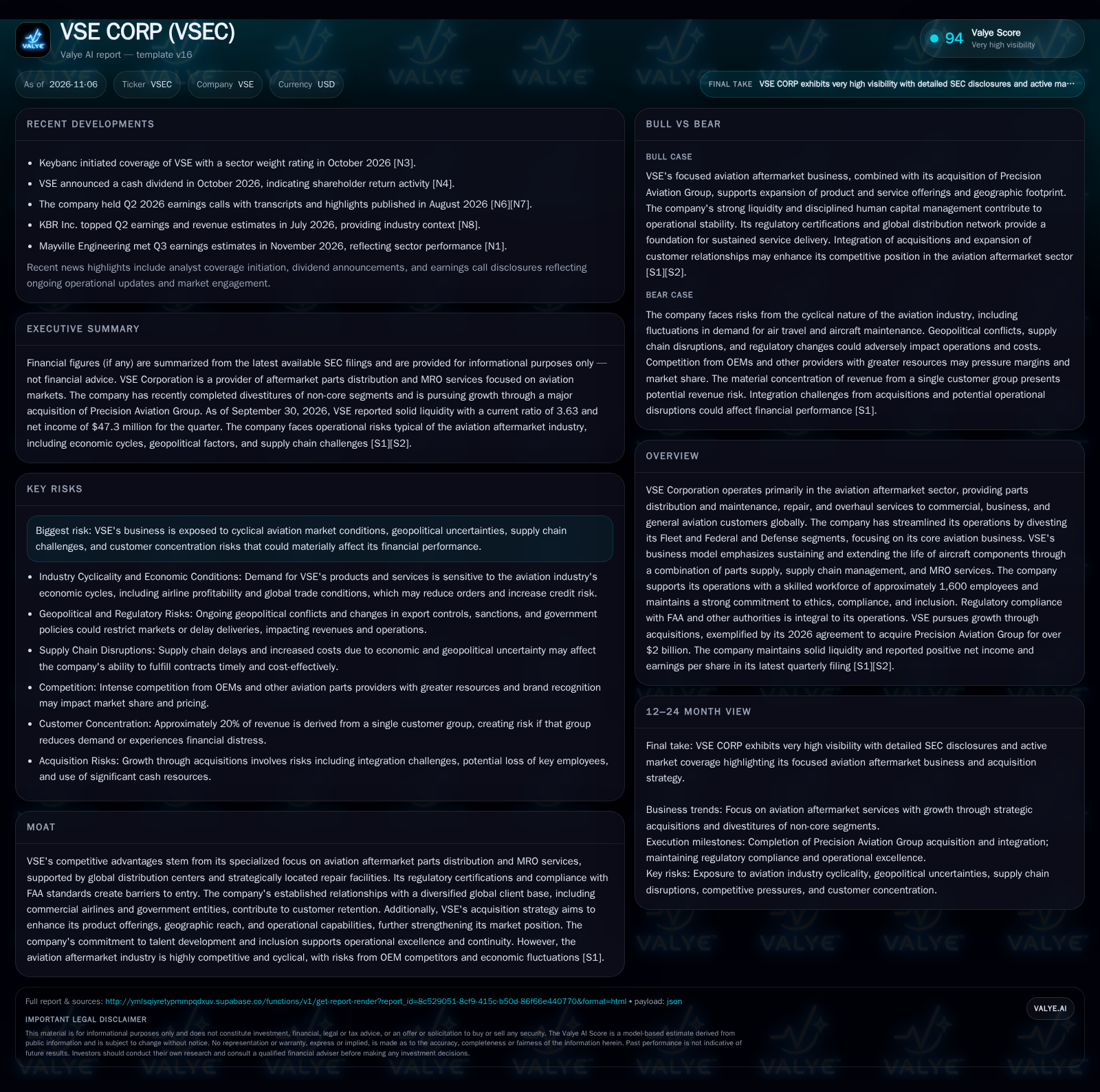
VSE Corp is now a pure-play aviation aftermarket provider, having sold its Fleet and Federal/Defense segments and agreed to acquire Precision Aviation Group for over $2 billion. This strategic shift increases operational focus, but leaves the company exposed to industry cyclicality, major-customer risk, and the hurdles of integrating a large acquisition. The company’s latest quarterly results show positive net income and a reported current ratio, but the sustainability of these metrics will hinge on successful execution and market conditions. [S1] [S2]
VSE Corp is reshaping itself into a pure-play aviation aftermarket powerhouse, having exited its Fleet and Federal/Defense operations to focus entirely on parts distribution and MRO services. The company’s ability to manage these dynamics will determine whether its strategic pivot translates into durable value creation. [S1] [S2]
Strategic Refocus and Acquisition: A Defining Moment for VSE
VSE Corp has completed a multi-year transformation by divesting its Fleet segment in April 2025 and its Federal and Defense segment in February 2024, narrowing its business to aviation aftermarket services. This refocus was capped by the January 2026 agreement to acquire Precision Aviation Group for approximately $2.025 billion, with the transaction expected to close in Q2 2026. The deal includes contingent earn-outs tied to 2026 adjusted EBITDA, signaling a performance-based approach to the integration. [S1]
Financially, as of September 30, 2026, VSE reported $65.8 million in cash, $1.356 billion in current assets, and $373 million in current liabilities, producing a current ratio of 3.63 but a cash ratio of only 0.18. Net income for the quarter was $47.3 million, with basic EPS of $1.50. [S2]
A single customer group accounted for 20% of 2025 revenue, underscoring the company’s exposure to revenue concentration risk. [S1] [N4]
How Scale and Mix Could Reshape VSE’s Profit Economics
VSE’s core revenue drivers are aftermarket parts distribution and MRO (maintenance, repair, overhaul) services for commercial, business, and general aviation. These businesses typically generate revenue through a combination of one-off parts sales, repair fees, and longer-term supply chain management contracts. Margins in the aviation aftermarket tend to be higher for specialized repairs and proprietary parts, but pricing power is limited by competition from OEMs and other independent providers.
With the Precision Aviation Group acquisition, VSE is betting on scale: a larger combined distribution network, broader inventory, and expanded MRO capabilities could yield procurement efficiencies and better asset utilization. If the integration succeeds, fixed costs—such as distribution center infrastructure and regulatory compliance—could be leveraged over a larger revenue base, improving operating margins.
However, the acquisition’s size means that capital allocation and funding costs become more material. The mix of cash and equity, plus contingent earn-outs, suggests a need for careful balance-sheet management post-close, especially with a reported cash ratio. The economics of the combined entity will also depend on the ability to cross-sell and retain customers as post-merger integration proceeds.
Defining the Moat: Regulatory Hurdles, OEM Pressure, and Aftermarket Fragmentation
VSE’s competitive position is built on regulatory certifications (notably FAA compliance), a global distribution footprint, and specialized repair capabilities. These factors create moderate barriers to entry, as new entrants must secure regulatory approvals and establish both supply chains and customer trust.
However, the aviation aftermarket is structurally fragmented, with competition from both OEMs—who are increasingly moving downstream into parts and service—and independent MRO providers. OEMs have inherent advantages in proprietary parts and data, allowing them to bundle services or exert pricing pressure. Large global distributors can also compete on breadth and logistics.
The Precision acquisition may help VSE address these challenges by expanding its geographic reach and product/service breadth, but integration risk and the potential for customer attrition remain. The company’s ability to maintain service quality and regulatory compliance at scale will be critical for defending its position.
If Integration Delivers: The Pathway to Margin Expansion and Market Share Gains
The most favorable scenario for VSE is that the Precision Aviation Group acquisition closes on schedule and is integrated smoothly, unlocking procurement synergies, broader customer relationships, and improved utilization of distribution and repair infrastructure. In this case, VSE could realize operating leverage, with fixed costs spread over a larger revenue base and incremental margin expansion from cross-selling new products and services.
Confirmation would come from sequential improvement in gross and operating margins, evidence of customer retention or expansion, and successful new contract wins in geographies or verticals previously underpenetrated. If VSE can demonstrate declining integration costs, increasing EBITDA, and stable or reduced customer concentration, it would support the thesis that scale and scope are translating into durable economic advantage.
Falsification would come from significant integration delays, customer loss, or margin compression due to higher-than-expected costs or pricing concessions.
Post-Acquisition Steady State: Integration Friction and Cyclical Headwinds
The most plausible outcome is that VSE closes the Precision acquisition and spends several quarters working through integration challenges—ranging from IT and process harmonization to cultural alignment and customer communication. Revenue growth may be offset by one-time integration costs and potential operational friction.
In this scenario, VSE maintains profitability but sees muted margin expansion as synergies are realized gradually and some customer or employee attrition occurs. The company remains exposed to aviation aftermarket demand cycles and the risk of revenue volatility from its largest customer group.
Confirmation would be steady but unspectacular progress on margin, stable customer concentration, and no major operational disruptions. Falsification would be a spike in integration costs, negative surprises in customer retention, or regulatory compliance lapses.
What If Integration Falters or the Cycle Turns Down?
In the adverse scenario, VSE faces significant integration setbacks post-Precision acquisition, such as IT failures, loss of key talent, or operational disruptions that erode service levels. Combined with the inherent cyclicality of aviation MRO demand and a potential pullback from its largest customer group, this could lead to revenue and margin contraction.
Additional risks include regulatory compliance failures, supply chain disruptions, and increased competition from OEMs or well-capitalized independents. If integration costs exceed expectations, or if the company is forced to make price concessions to retain customers, profitability could deteriorate sharply.
Confirmation would be negative earnings surprises, customer loss, rising integration or compliance costs, and any signs of liquidity stress (such as increased borrowings or emergency asset sales).
Milestones That Will Shape VSE’s Acquisition Thesis and Market Standing
Progress and timing of the Precision Aviation Group acquisition closing, including any regulatory or antitrust hurdles.
Quarterly trends in gross and operating margins post-acquisition, as a measure of synergy realization and integration effectiveness.
Customer concentration metrics—specifically, whether revenue exposure to the top customer group declines or increases (if disclosed).
Cash flow from operations and free cash flow generation post-acquisition, to assess balance-sheet resilience and integration funding.
Employee retention and turnover rates, especially among key technical and management staff from both VSE and Precision (if disclosed).
Any changes in supply chain reliability or inventory turnover, as an indicator of operational health during and after integration.
Frequency and magnitude of regulatory or compliance issues reported, given the importance of FAA and other certifications to the business.
Revenue growth or new contract announcements in previously underpenetrated regions or customer segments, as evidence of expanded market reach.
Disclaimer: This is research-only, informational analysis and not investment advice. It may include AI-generated interpretation and general industry context. Always verify important details using primary sources.

Comments