
Cogent Biosciences: Navigating the Regulatory Gauntlet with Bezuclastinib and a Deep reported cash balance
Cogent Biosciences stands at a pivotal moment, with its lead asset Bezuclastinib advancing through late-stage regulatory review for systemic mastocytosis and gaining breakthrough designation in GIST.
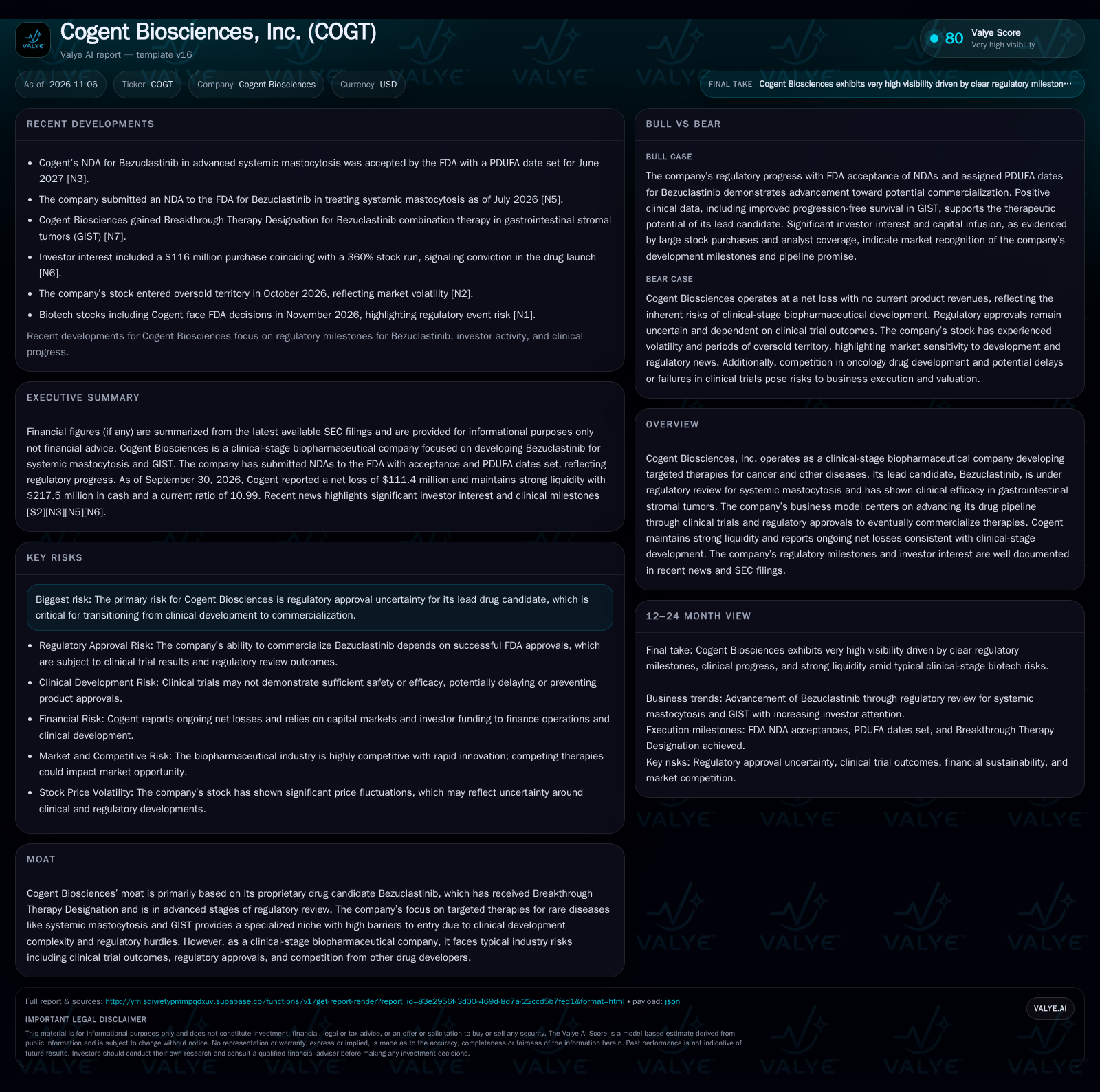
Cogent Biosciences is a clinical-stage biotech focused on targeted cancer therapies, most notably Bezuclastinib for systemic mastocytosis and GIST. With an NDA submitted and accepted for review, strong cash reserves, and investor interest, the company is well-capitalized for its next phase. However, the absence of current revenues, ongoing net losses, and dependency on regulatory success create a high-risk, high-reward profile. Competition in oncology and the uncertainty of clinical outcomes remain key watchpoints. [S2] [N3] [N5] [N7]
Cogent Biosciences is at a turning point as its lead drug Bezuclastinib advances through critical regulatory milestones in systemic mastocytosis and gastrointestinal stromal tumors (GIST). The company’s substantial liquidity and clinical progress have attracted significant investor interest, but the lack of commercialized products and dependence on successful trial outcomes leave the business model unproven. As the FDA reviews its NDA and breakthrough therapy designation supports its GIST program, Cogent must navigate industry competition, regulatory risk, and the challenge of converting scientific promise into sustainable revenue streams. [S2] [N3] [N5] [N7]
Recent Milestones and Financial Footing Define Cogent’s Risk-Reward Equation
Cogent Biosciences has recently submitted a New Drug Application (NDA) to the FDA for Bezuclastinib in systemic mastocytosis, with acceptance for review and a PDUFA date set for June 2027. This regulatory milestone is pivotal, as it marks the transition from clinical development to the possibility of commercial launch. In parallel, Bezuclastinib has received Breakthrough Therapy Designation for its combination use in gastrointestinal stromal tumors (GIST), underscoring the asset’s perceived clinical potential and providing a potential pathway for expedited development and review. [N3] [N5] [N7]
Financially, as of September 30, 2026, Cogent reports $217.5 million in cash and equivalents, total current assets of $803.6 million, and a current ratio of 10.99. This liquidity provides the company with resources to fund ongoing trials, regulatory submissions, and initial commercial preparations, but it does not eliminate the intrinsic risks of regulatory and clinical uncertainty. The company’s net loss of $111.4 million in the latest quarter reflects the capital-intensive nature of its business and the absence of product revenues at this stage. [S2]
While the reported cash balance appears substantial, the capital-intensive nature of late-stage clinical development, including manufacturing scale-up and commercial infrastructure build-out, can rapidly deplete resources. Additionally, the timing of potential milestone payments or licensing revenues, if any, will influence near-term capital needs. Understanding the cadence of these cash flows and expense commitments is critical to evaluating whether the current liquidity sufficiently buffers against unforeseen regulatory delays or trial extensions.
From Pipeline to Profit: The Economics of Cogent’s Clinical-Stage Model
Cogent’s business model is typical of clinical-stage biotechs: invest heavily in R&D to advance drug candidates through clinical trials, secure regulatory approval, and then transition to commercialization—ideally unlocking significant revenue and margin expansion if successful. The company’s primary value driver is Bezuclastinib, targeting rare diseases such as systemic mastocytosis and oncology indications like GIST. The economics hinge on the eventual pricing and market adoption of Bezuclastinib, which, if approved, could command premium pricing due to high unmet need and orphan drug status in systemic mastocytosis.
Until approval, expenses are dominated by R&D and clinical operations, with no offsetting revenue. Cogent’s ability to access capital markets remains a critical variable for long-term sustainability.
The transition from clinical-stage to commercial operations introduces a variety of economic challenges that could affect Cogent’s profitability trajectory. Commercialization demands significant upfront investment in sales force deployment, marketing, and distribution channels, which may compress margins in initial years even if revenues ramp as expected. Pricing power, especially in orphan and oncology indications, depends not only on clinical efficacy but also on payer negotiations and health technology assessments that vary by geography. If reimbursement hurdles arise, the anticipated premium pricing may be constrained, impacting revenue forecasts. Furthermore, the durability of market exclusivity and potential biosimilar or generic competition post-patent expiry will shape long-term revenue sustainability.
Therapeutic Differentiation and the Challenge of Oncology Competition
Cogent operates in the highly competitive oncology and rare disease drug development arena, where both large pharmaceutical incumbents and other biotech firms pursue similar targets. The competitive landscape for systemic mastocytosis includes both existing therapies and emerging pipeline candidates. Breakthrough Therapy Designation for Bezuclastinib in GIST suggests a differentiated clinical profile, at least in preliminary data, but sustained advantage depends on demonstrating superior efficacy, safety, or dosing convenience relative to competitors.
Switching costs in oncology and rare disease markets are generally high if a therapy demonstrates clear clinical benefit, due to physician inertia and patient need, but payers and clinicians will scrutinize incremental value. The threat of new entrants, rapid innovation, and evolving standard of care are persistent counterforces. Cogent’s position will depend on continued clinical differentiation, successful regulatory navigation, and the ability to build commercial infrastructure or secure strong partnerships for launch.
In addition to clinical differentiation, Cogent’s competitive positioning will hinge on its ability to anticipate and respond to evolving treatment paradigms. For instance, emerging combination therapies or novel modalities such as cell therapies could alter standard of care, potentially relegating small molecule inhibitors to niche roles or second-line use. The company’s strategic agility in adapting clinical development plans or pursuing label expansions will be essential to maintaining relevance. Moreover, intellectual property protection and freedom to operate are critical in oncology, where patent challenges and litigation can delay or restrict market entry. Effective management of these legal and regulatory aspects complements clinical advantages in securing a sustainable market position.
Regulatory Success Unlocks Revenue and Bolsters Pipeline Credibility
The most favorable scenario for Cogent is regulatory approval of Bezuclastinib in systemic mastocytosis and, subsequently, in GIST. Approval would allow for commercial launch into markets with high unmet need and could validate the company’s clinical platform, increasing its credibility with investors, partners, and potential acquirers. Early sales traction, positive reimbursement decisions, and rapid adoption in the initial indications would signal the transition from R&D-centric to revenue-generating operations.
This scenario could be confirmed by FDA approval in or ahead of the June 2027 PDUFA window, strong initial sales (if disclosed), new licensing or partnership deals, and positive updates on label expansion or pipeline progression. Conversely, delayed approval, tepid launch metrics, or negative post-market safety signals would undermine this pathway.
Clinical Progress Continues, but Commercial Uncertainty Lingers
The most plausible path is that Cogent continues to advance Bezuclastinib through regulatory review, with potential for approval but also the possibility of additional data requests or post-marketing requirements. The competitive environment may intensify, and payers could exert pressure on pricing or require additional value demonstration.
Evidence supporting this scenario would include continued regulatory engagement, completion of ongoing trials, and incremental data releases. Lack of new safety signals and progress toward commercial readiness would reinforce the base case. However, extended regulatory timelines, increased R&D spend, or clinical setbacks would be warning signs.
Clinical or Regulatory Setbacks Force Strategic Pivot or Capital Raise
In an adverse outcome, Bezuclastinib encounters regulatory hurdles—such as a complete response letter, unexpected safety issues, or failure to meet efficacy endpoints—that delay or derail approval.
Negative confirming evidence would include FDA requests for additional pivotal trials, new safety warnings, declining investor interest, or sharp stock declines following adverse regulatory news. Failure to secure partnerships or licensing deals would also indicate stress and reduced optionality.
Milestones and Data That Will Shape Cogent’s Value Realization
Regulatory progress for Bezuclastinib in systemic mastocytosis, including FDA communications and the outcome of the June 2027 PDUFA review.
Clinical trial updates for Bezuclastinib in GIST, including interim efficacy and safety data releases.
Cash burn rate and R&D expense trends, which will determine the company’s operational runway and need for future capital raises.
Commercial readiness indicators, such as hiring for commercialization roles, partnership announcements, or market access planning (if disclosed).
Competitor pipeline developments or new drug approvals in systemic mastocytosis or GIST, which could affect Cogent’s addressable market and pricing power.
Stock price volatility in response to clinical, regulatory, or financing news, as a proxy for market confidence and sentiment.
Any new licensing, co-development, or acquisition activity involving Cogent or its lead asset, which could alter value realization pathways.
Disclaimer: This is research-only, informational analysis and not investment advice. It may include AI-generated interpretation and general industry context. Always verify important details using primary sources.

Comments