
NewHold Investment Corp IV: SPAC Liquidity, Search Phase Dynamics, and the Road to Value Creation
The core question is whether management can leverage its capital base and SPAC structure to identify and consummate a value-creating business combination amid evolving market sentiment and regulatory scrutiny.
Its value hinges entirely on management’s ability to complete a successful merger or acquisition. Execution risk, opaque near-term plans, and shifting SPAC market conditions will determine whether this capital pool becomes a platform for value creation or a stranded asset.
NewHold Investment Corp IV stands at the classic SPAC crossroads: flush with capital from its April 2026 IPO but yet to announce or engage in substantive discussions with a merger target. Its most recent financials show reported liquidity position and positive net income—driven by interest income on its capital pool rather than business operations. With the clock ticking on regulatory and market windows for SPACs, the company’s future will be defined by its ability to source, negotiate, and close a business combination that justifies its capital base. Until then, investors face the binary risk-reward calculus that defines the SPAC asset class.
Recent IPO, Reported Liquidity Position, and Net Income—But Still Pre-Deal
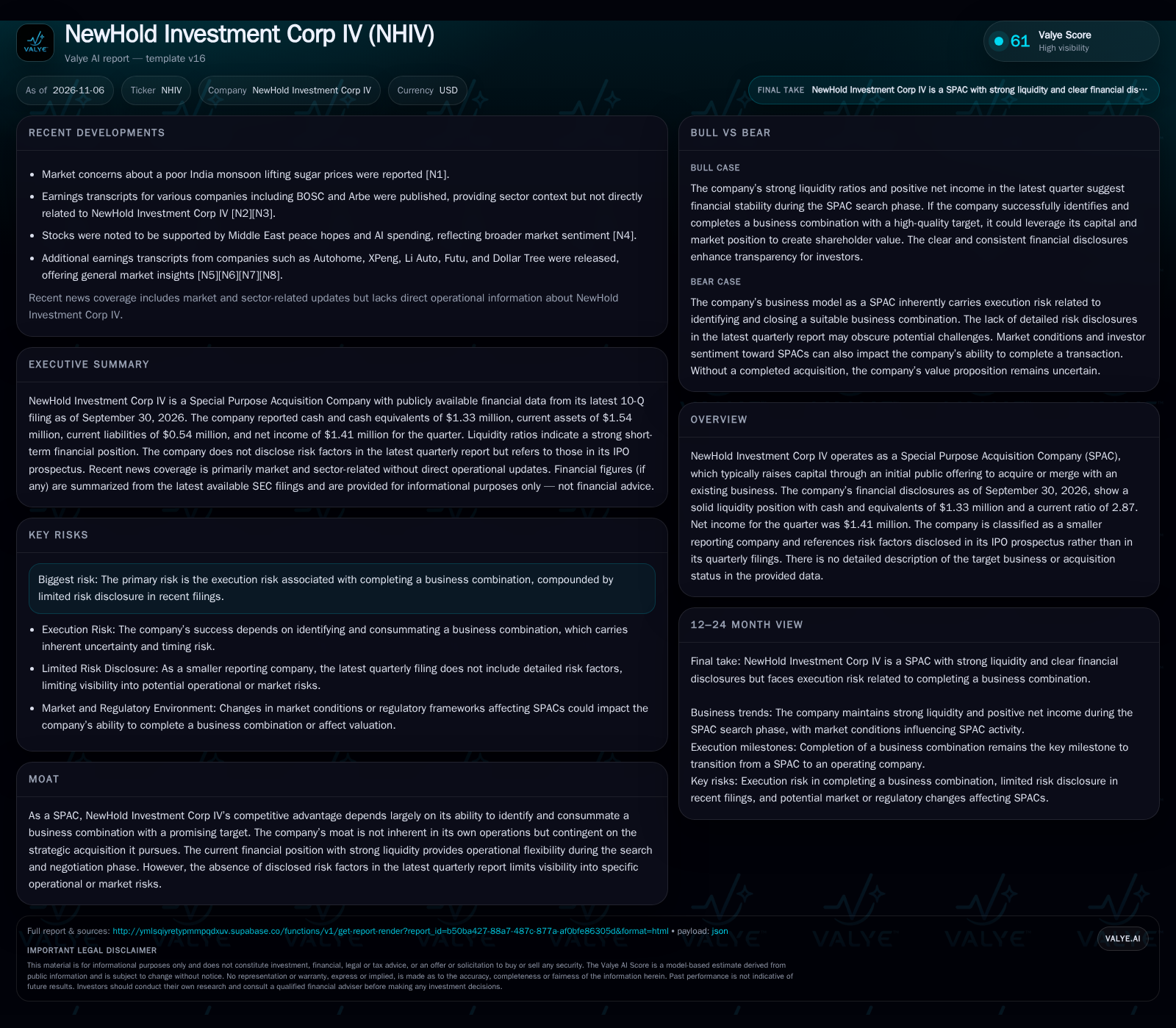
NewHold Investment Corp IV completed its IPO in April 2026, raising $201.25 million through the sale of 20,125,000 units, each comprising one Class A ordinary share and one-third of a redeemable warrant. As of September 30, 2026, the company reported $1.33 million in cash and cash equivalents, $1.54 million in current assets, $0.54 million in current liabilities, and net income of $1.41 million for the quarter. The company’s current and cash ratios (2.87 and 2.49, respectively) reflect a reported liquidity position. The company reported cash and liquidity metrics for the period; these figures do not by themselves establish operating runway, investment capacity, financial flexibility, or financing capacity. Importantly, no business combination target has been announced, nor has management reported substantive discussions with potential targets. The company remains in the SPAC search phase, with execution risk and a finite window to deploy its capital before regulatory or market pressures force a resolution [S1].
SPAC Economics: Capital Pool, Interest Income, and the Binary Nature of Value Creation
As a SPAC, NewHold Investment Corp IV’s core economics center on the stewardship and deployment of its IPO capital. Until a business combination is completed, the company generates non-operating income from interest on its trust account—reflected in the recent net income figures. There are no revenues from operations, and costs are limited to SPAC administration, due diligence, and potential deal structuring. The fundamental economics are highly binary: if a business combination is completed, the SPAC’s capital and public listing are exchanged for equity in a new operating entity, potentially creating value for public shareholders if the target outperforms the acquisition price. If no deal is consummated within the regulatory timeline, funds (minus expenses) are returned to shareholders, often resulting in minimal returns for public investors and the loss of sponsor capital. The capital needs are front-loaded—primarily the IPO itself and associated fees—while ongoing expenses are modest unless a transaction process accelerates. Operating leverage and cash burn remain low pre-deal, but post-merger economics depend entirely on the acquired business’s profile, which remains unknown.
SPAC Competition: Deal Sourcing, Sponsor Reputation, and Market Saturation
NewHold Investment Corp IV competes not through traditional products or services, but in the market for attractive private companies seeking a public listing or growth capital. SPACs differentiate themselves by sponsor track record, sector focus, and the ability to offer certainty, speed, and flexible deal structures. However, the broader SPAC market has become increasingly crowded, with many blank-check companies competing for a finite pool of high-quality targets. Regulatory scrutiny has increased, and investor enthusiasm has cooled compared to prior cycles, raising the bar for deal quality and sponsor credibility. NewHold’s management references prior experience with earlier NewHold SPACs, which may confer some reputational edge in deal sourcing. Still, with no target identified and no active negotiations disclosed, the company’s competitive position is theoretical until a specific transaction emerges. The absence of a sector focus may provide flexibility, but it also risks a lack of differentiation versus sector-specialist SPACs.
Unlocking Value: What a High-Quality Business Combination Would Require
The pathway to material upside is clear but narrow: NewHold Investment Corp IV must identify, negotiate, and close a business combination with a high-quality private company whose growth prospects and valuation justify public market entry. A successful deal would likely require: (1) a target with strong fundamentals and clear growth catalysts; (2) favorable transaction terms that align incentives between sponsor, target, and public shareholders; and (3) timely execution before the SPAC’s regulatory deadline or a deterioration in market sentiment. Confirmation would come from a deal announcement with explicit details on the target business, financial projections, valuation, and deal structure. Additional evidence of upside would be a positive market reaction, PIPE (private investment in public equity) participation, or third-party validation of the target’s prospects. Upside is amplified if the acquired business demonstrates rapid revenue and earnings growth post-merger, driving appreciation in the combined entity’s share price.
Most Probable Trajectory: Prolonged Search and Eventual Deal or Wind-Down
Given current disclosures and market context, the most plausible scenario is that NewHold Investment Corp IV continues its search for an acquisition target into 2027. However, persistent market headwinds and increased SPAC competition may prolong the search phase. If a deal is identified, it may involve a mid-sized private company willing to accept current market terms, with the sponsor negotiating to preserve value for public shareholders. Alternatively, if no suitable target is found within the regulatory window, the company will be forced to return funds to shareholders and wind down operations. Confirmation of this middle path would be continued quarterly disclosures of interest income, incremental search expenses, and, eventually, either a deal announcement or a formal wind-down notice.
Failure to De-SPAC: Erosion of Capital and Sponsor Value
The primary downside risk is failure to complete a business combination before the regulatory deadline. In this case, NewHold Investment Corp IV would be required to liquidate, returning the bulk of IPO proceeds to public shareholders, typically at or near trust value, but sponsor capital would be forfeited. Downside is exacerbated if search costs, legal fees, or adverse market conditions erode the trust account, reducing returns to public investors. Additional risks include the potential for adverse changes in SPAC regulations, further deterioration in target-company valuations, or an inability to secure PIPE or debt financing for a deal—each of which could scuttle negotiations or make deals economically unattractive. Confirmation of the downside would be a lack of deal announcements as the deadline approaches, declining trust value, or explicit disclosures of wind-down preparations.
What Will Determine NewHold Investment Corp IV’s Outcome
Announcement of a letter of intent (LOI) or definitive agreement with a specific business combination target.
Quarterly changes in trust account value and interest income, which indicate capital preservation during the search phase.
Incremental disclosure of search, legal, and due diligence expenses, as these can erode capital available to shareholders if a deal is not reached.
Any PIPE financing or third-party investment commitments secured alongside a business combination announcement.
Regulatory or market developments that materially impact the SPAC sector—such as changes to SEC rules or shifts in investor sentiment.
Sponsor willingness to add capital, extend deadlines, or cover additional expenses to facilitate a deal (if disclosed).
Evidence of target-company quality: sector, growth profile, management team, and valuation at deal announcement would help test the value-creation thesis.
Disclaimer: This is research-only, informational analysis and not investment advice. It may include AI-generated interpretation and general industry context. Always verify important details using primary sources.

Comments