
Bed Bath & Beyond’s Transformation Gamble: Integration, Liquidity, and the Uncertain Path to a Digital Retail Platform
The company’s ability to navigate integration, retain customers, and stabilize its platform will determine if it can transition from legacy retail to a viable internet-first model.
Bed Bath & Beyond’s recent merger-driven transformation, name change, and ongoing losses leave it in a precarious position. Successful integration and brand repositioning may unlock new growth, but failure risks further erosion of value.
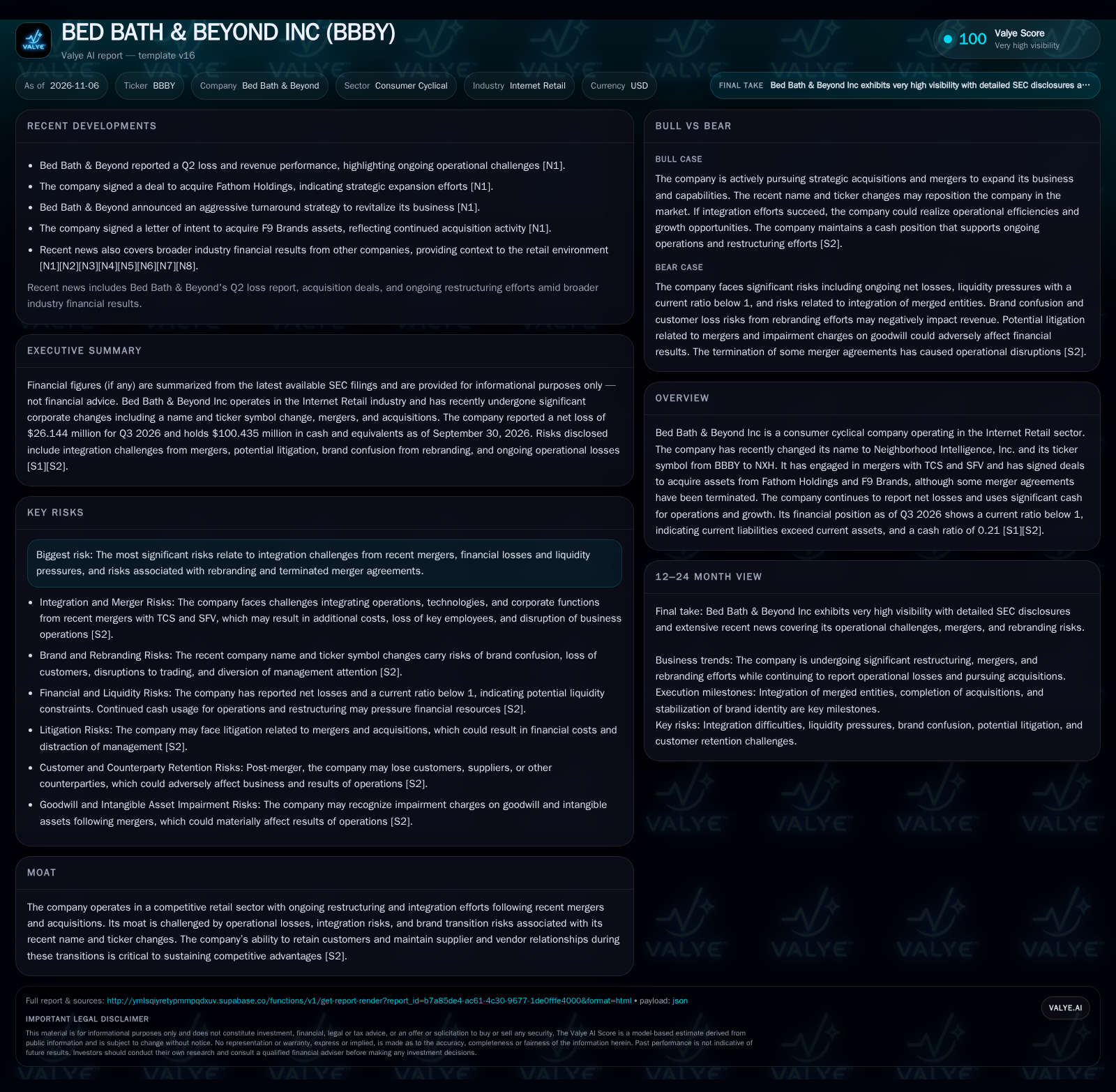
Bed Bath & Beyond’s high-profile pivot—marked by its rebranding as Neighborhood Intelligence, Inc. and a flurry of mergers—lands the company at a critical crossroads. The latest filings reveal deepening losses, a subpar liquidity profile, and a complex integration agenda. As management races to knit together disparate acquisitions and redefine its market presence, the company must overcome both structural and perception hurdles. The next phase will test whether its transformation can reverse cash burn, deliver operational leverage, and establish a durable niche amid fierce digital retail competition.
Recent Results Spotlight Liquidity Strain and Strategic Overhaul
As of September 30, 2026, Bed Bath & Beyond (now Neighborhood Intelligence, Inc. The company reported cash and liquidity metrics for the period; these figures do not by themselves establish operating runway, investment capacity, financial flexibility, or financing capacity. [S2] The company posted a net loss of $26.1 million for the most recent quarter, continuing a multi-year trend of operational losses [S2]. These financial challenges are set against the backdrop of a sweeping corporate rebranding and ticker change, as well as the integration of recent mergers with TCS and SFV. Management has flagged significant risks related to customer retention, litigation from merger activity, and the potential for impairment charges on newly acquired goodwill and intangibles [S2]. In sum, the company is attempting a high-stakes turnaround while managing acute financial and operational headwinds.
Economics of a Digital Retail Pivot: Margin Pressures and Integration Costs
Internet retail relies on high volume, thin margins, and efficient logistics. Historically, Bed Bath & Beyond’s legacy business model was burdened by high fixed costs—large store footprints, inventory, and labor. The shift to an internet-first model could theoretically improve variable cost flexibility and enable broader reach, but also intensifies exposure to price competition and logistical complexity.
The company’s ongoing net losses and continued cash outflows suggest that its current economics remain unfavorable [S2]. Integration of TCS and SFV introduces both potential cost synergies (eliminating redundancies, leveraging technology) and near-term restructuring expenses. If integration unlocks operational efficiencies—such as shared fulfillment infrastructure or consolidated digital platforms—operating leverage could improve. However, these gains are not automatic; failed integrations often result in higher costs, lost revenue from customer churn, and write-downs of overvalued intangible assets.
In internet retail, revenue predictability is heavily influenced by customer loyalty, repeat purchase dynamics, and the ability to cross-sell or upsell across a broader digital platform. Without clear evidence of successful integration or a differentiated customer value proposition, the company’s economics may continue to be challenged by high customer acquisition costs and low pricing power, especially during the disruptive rebranding phase.
Brand Uncertainty and Integration Risks Undermine Competitive Defenses
The company’s competitive position is in flux. The rebranding to Neighborhood Intelligence, Inc. introduces substantial risk of customer confusion and potential loss of legacy brand equity [S2]. In a sector dominated by established digital-native players and scaled logistics operators, customer trust and familiarity are critical. The risk of losing customers or counterparties during the transition is explicitly cited by management [S2].
Recent mergers could, in theory, broaden the company’s product offering or technological capabilities, but also expose it to integration pitfalls. Competitors in internet retail—ranging from global e-commerce giants to niche specialty platforms—have significant scale advantages, established fulfillment networks, and robust digital ecosystems. Unless the company can achieve real differentiation or leverage new synergies post-merger, it risks being trapped in a low-margin, undifferentiated position.
The threat of substitutes remains high, as switching costs for online retail customers are typically low. Any operational missteps, fulfillment delays, or poor digital experience could quickly erode market share.
If Integration Yields Synergies and Brand Repositioning Succeeds
A favorable outcome may arise if the company executes on integration, realizes cost and technology synergies, and manages to re-engage its customer base under the new brand. In this scenario, operational redundancies are eliminated, digital platforms are unified, and fulfillment efficiency improves, leading to margin stabilization or expansion. Successful rebranding could attract new customer segments or recapture lapsed shoppers, while the combined capabilities from TCS and SFV mergers might enable cross-selling or new service offerings.
Evidence that would confirm this scenario includes: a return to top-line growth, narrowing operating losses, improved operating margin, customer retention rates stabilizing or improving after the rebranding, and clear progress on integration milestones (such as unified digital platforms or logistics enhancements). Early signs of goodwill impairment reversal or avoidance, and a halt to significant cash burn, would also support the case.
Transitional Turbulence: Integration and Brand Risks Prolong Losses
The most plausible near-term trajectory is continued operational turbulence. The company may face persistent integration challenges, with restructuring costs offsetting any initial synergies. Customer confusion and churn may weigh on revenue, especially if the new brand identity fails to resonate or the transition disrupts fulfillment and service quality.
Financially, ongoing cash burn and a current ratio below 1 suggest that liquidity pressures will remain acute unless the company can materially improve its economics or secure additional capital [S2]. Impairment charges and litigation risk could further erode shareholder value. Stabilization is possible if integration challenges are managed and the brand transition does not lead to significant customer attrition, but the burden of proof remains high. Evidence for this scenario would include persistent net losses, continued use of cash for operations, and only incremental progress on integration and customer retention.
Failure to Integrate and Rebrand Accelerates Erosion of Value
In the adverse scenario, integration falters—leading to operational fragmentation, duplicated costs, and loss of key employees. The rebranding fails, resulting in accelerated customer and counterparty defections. Litigation from merger activity and impairment of goodwill or intangible assets could trigger further financial distress.
Liquidity constraints could force the company to seek emergency financing, divest assets at unfavorable terms, or face restructuring. Evidence confirming this downside would include a sharp increase in customer churn, successive impairment charges, further deterioration in the current ratio, additional net losses, and disclosures of covenant breaches or emergency capital raises.
Milestones That Will Define Neighborhood Intelligence’s Transformation
Progress in integrating TCS and SFV platforms, with explicit disclosures of cost savings or operational enhancements, would help validate synergy realization.
Customer retention rates and engagement metrics post-rebranding (if disclosed) will be critical for assessing brand transition success.
Sequential changes in net cash used in operations and operating margin trends will indicate whether the company is gaining economic traction.
Any recognition of goodwill or intangible asset impairments will signal the extent of integration or rebranding challenges.
Litigation disclosures related to merger activity or restructuring could materially impact financial and management bandwidth.
New capital raises, credit facility amendments, or asset sales would highlight the company’s ability—or struggle—to manage liquidity.
Vendor and supplier continuity during the transition, as reflected in disclosed counterparty relationships, will be important for operational stability.
Evidence of improved customer acquisition cost, average order value, or repeat purchase rates (if disclosed) would provide insight into the viability of the digital retail model.
Disclaimer: This is research-only, informational analysis and not investment advice. It may include AI-generated interpretation and general industry context. Always verify important details using primary sources.

Comments