
Eagle Bancorp’s Risk Management Playbook: Hedging Strategy and Credit Modeling in a Shifting Rate Landscape
Eagle Bancorp’s latest results show solid earnings and ongoing dividends, but its long-term trajectory hinges on the effectiveness of its interest rate hedging and credit risk methodologies as monetary conditions evolve. The bank’s ability to sustain margins and asset quality amid external shocks will likely define its competitive standing.
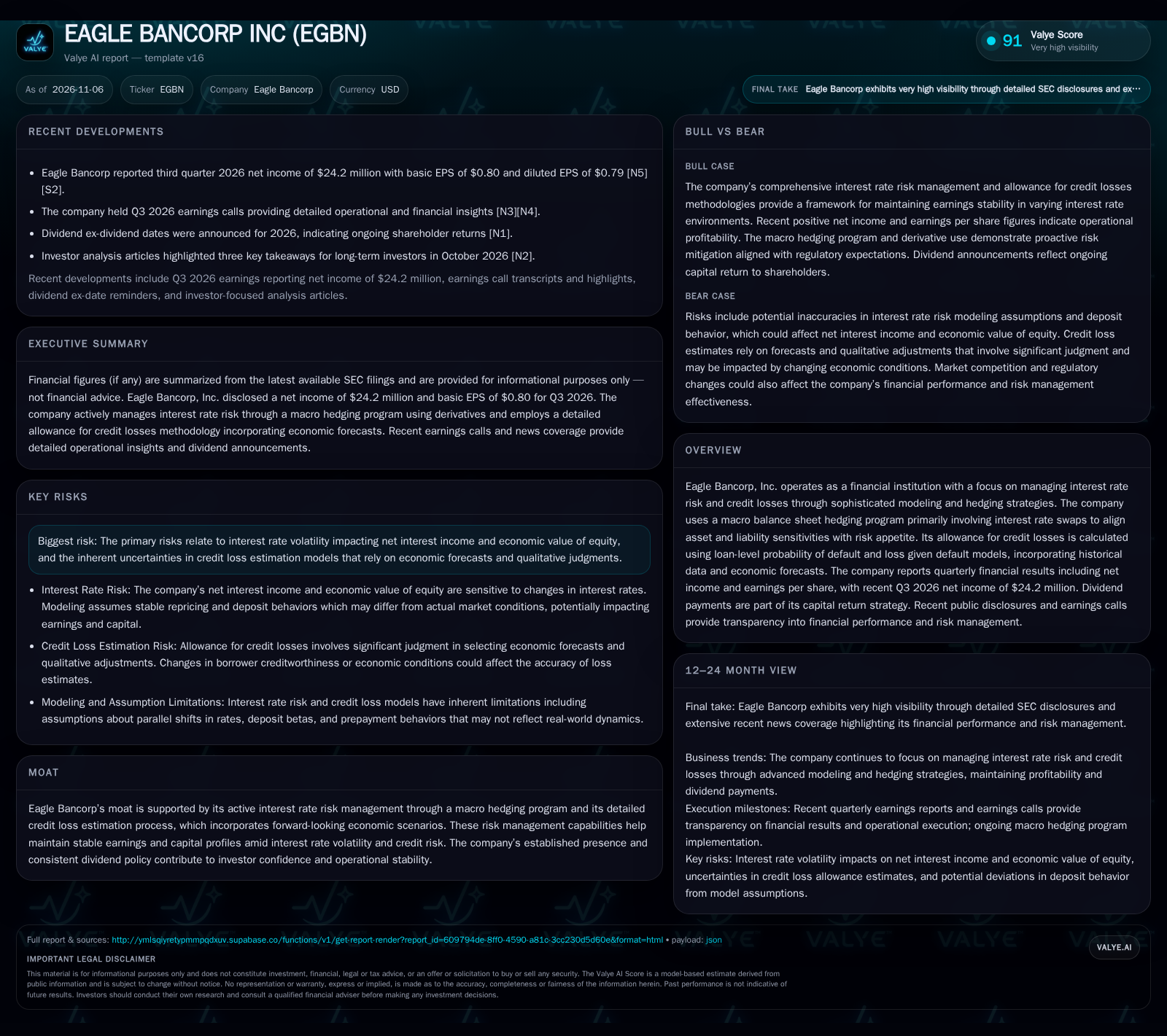
Eagle Bancorp reported Q3 2026 net income of $24.2 million and continues to return capital via dividends. Its macro hedging program and credit loss modeling are central to risk management, supporting stable earnings but exposing the bank to potential modeling limitations if market conditions diverge from assumptions [S2] [N1].
Eagle Bancorp’s third-quarter 2026 performance underscores the growing importance of advanced risk management in regional banking. With $24.2 million in net income and a continued commitment to dividends, the company demonstrates operational resilience. Its business model is increasingly defined by sophisticated interest rate hedging and dynamic credit loss modeling—tools that can help stabilize earnings, but that also introduce new sensitivities if economic or behavioral assumptions prove inaccurate. The next phase for Eagle Bancorp will likely be shaped by how these risk frameworks perform as the rate and credit environment evolves [S2] [N1].
Q3 2026 Results Highlight Profitability and Risk Management Focus
Eagle Bancorp reported net income of $24.2 million for Q3 2026, translating to basic earnings per share of $0.80 and diluted EPS of $0.79 [S2] [N5]. This profitability reflects continued operational execution and prudent risk management. The cited source reports dividend-related activity; that disclosure alone does not establish dividend-policy continuity, management confidence, or a material constraint on capital flexibility. [N1]
The bank’s disclosures emphasize the centrality of interest rate risk management and allowance for credit losses. It employs a macro balance sheet hedging program, primarily using interest rate swaps, to align asset and liability repricing sensitivities. Its credit loss allowance leverages loan-level probability of default and loss given default models, incorporating historical data and forward-looking economic forecasts [S1].
Eagle Bancorp’s risk models currently project moderate net interest margin (NIM) expansion in rising rate environments, with compression if rates decline, but within policy limits [S1]. These facts set the stage for understanding both near-term stability and the longer-term dependencies embedded in the bank’s strategy.
Earnings Drivers: Margin Management, Asset Quality, and Operating Leverage
Eagle Bancorp’s core earnings engine is its net interest margin—the spread between interest earned on loans and securities and the cost of funding those assets, primarily through deposits. The company’s interest rate hedging program is designed to mitigate volatility in NIM by using swaps to manage the duration and repricing mismatch between its assets and liabilities [S1]. When rates rise, the bank’s models suggest modest margin expansion; if rates fall, margins could compress, but the company expects these effects to remain within its risk appetite.
Credit costs represent the second major lever of profitability. By using a loan-level, probability-of-default model that folds in both historical performance and 18-month economic forecasts, Eagle Bancorp aims to set a credit loss allowance that is both forward-looking and responsive to deteriorating credit conditions [S1]. This approach can smooth earnings volatility but also introduces model risk if actual credit trends diverge from projections.
Operating leverage in this context is primarily realized through scale efficiencies in risk management and compliance, rather than dramatic fixed-cost leverage. The bank’s ability to grow its asset base without proportionally increasing overhead can support incremental margin improvement, but capital requirements and regulatory scrutiny typically cap the upside for regional banks.
How Eagle Bancorp’s Approach Stacks Up: Risk Controls as a Differentiator
Eagle Bancorp’s competitive position is shaped by its proactive risk management, which may provide an advantage versus peers that rely more heavily on static balance sheet exposures. The use of macro hedging and sophisticated credit modeling could allow Eagle Bancorp to maintain more stable earnings through rate cycles and credit downturns, especially if competitors are slower to adapt or face larger shocks from deposit flight or credit losses.
However, these advantages are not absolute. Larger regional and national banks often have even more advanced hedging infrastructure, greater diversification, and more granular data for credit modeling. Community banks, by contrast, may have simpler portfolios and lower cost structures, but face greater risk from local economic downturns and deposit competition.
A key counterforce is the potential for model and execution risk—if Eagle Bancorp’s assumptions about deposit beta, prepayment rates, or borrower creditworthiness prove wrong, its hedging and credit reserves could prove inadequate. The competitive landscape is also shaped by technology-driven entrants, non-bank lenders, and evolving customer preferences, all of which could pressure both margins and fee income over time.
What Sustained Margin Expansion Could Look Like for Eagle Bancorp
The most favorable scenario for Eagle Bancorp is one in which its balance sheet positioning and hedging program enable it to capture incremental NIM as rates rise, while its credit modeling keeps loss provisions low and responsive to actual portfolio performance. This would likely require a stable or gradually rising rate environment, steady or improving local economic conditions, and continued deposit stability.
Confirmation of this upside would come from sequential improvement in net interest margin, below-peer credit loss rates, and steady or increasing dividends. Additional evidence would include management commentary pointing to successful hedging outcomes, as well as regulatory filings showing allowance coverage ratios that remain robust even as credit conditions evolve.
Falsification of this scenario would include rising credit losses, NIM compression despite higher rates, or evidence that deposit outflows are forcing the bank to reprice liabilities upward more quickly than assets, eroding profitability.
Earnings Stability Anchored by Risk Model Effectiveness
The most plausible outcome is that Eagle Bancorp continues to deliver stable, modestly growing earnings, with some quarter-to-quarter volatility driven by rate moves and localized credit events. Its risk models and hedging program are likely to remain broadly effective, but not immune to external shocks or model errors.
The bank’s operating leverage is limited by regulatory capital requirements and the need to invest continually in risk management and compliance infrastructure. Confirmation would include consistent quarterly earnings, stable NIM, and allowance coverage ratios that track peer averages.
Falsification would emerge if the company’s models are persistently wrong—if, for example, a rapid shift in deposit behavior or unforeseen credit deterioration leads to outsized provision expenses, dividend cuts, or regulatory scrutiny.
When Models Go Awry: Exposure to Interest Rate or Credit Shocks
The most adverse scenario for Eagle Bancorp is a sharp mismatch between modeled and actual market realities. If interest rates fall quickly or depositors become more rate-sensitive than anticipated, the bank could experience NIM compression outside its policy limits, with hedges unable to fully offset the impact. On the credit side, a sudden economic downturn or sector-specific stress could cause actual default and loss rates to exceed modeled expectations, forcing the bank to increase its allowance for credit losses and eroding earnings.
Evidence of this downside would include negative operating leverage (expenses rising faster than revenues), a spike in credit provision costs, dividend reduction or suspension, and management commentary highlighting challenges in forecasting or model calibration. External triggers could range from Fed policy surprises to regional economic shocks or shifts in competitive deposit pricing.
Signals That Will Define Eagle Bancorp’s Long-Term Trajectory
Quarterly trends in net interest margin, especially relative to peer banks and as rates fluctuate.
Allowance for credit losses as a percentage of total loans, and its sensitivity to changes in economic forecasts.
Deposit growth or attrition rates—if disclosed—that could indicate shifting customer behavior or competitive pressure.
Management commentary on the effectiveness and outcomes of the macro hedging program, particularly in volatile rate environments.
Nonperforming asset ratios and trends in charge-offs or recoveries, as reported in SEC filings.
Regulatory filings or disclosures regarding stress test outcomes, capital adequacy, or model risk reviews.
A useful metric would be customer-level data on deposit betas or repricing lag, to test the bank’s rate sensitivity assumptions.
Disclaimer: This is research-only, informational analysis and not investment advice. It may include AI-generated interpretation and general industry context. Always verify important details using primary sources.

Comments