
Friedman Industries: Margin Volatility, Concentration Risks, and the Economics of Steel Distribution
The company’s business model, built on broad geographic reach and rapid delivery, faces fundamental questions around margin sustainability and risk management in a cyclical, commoditized market.
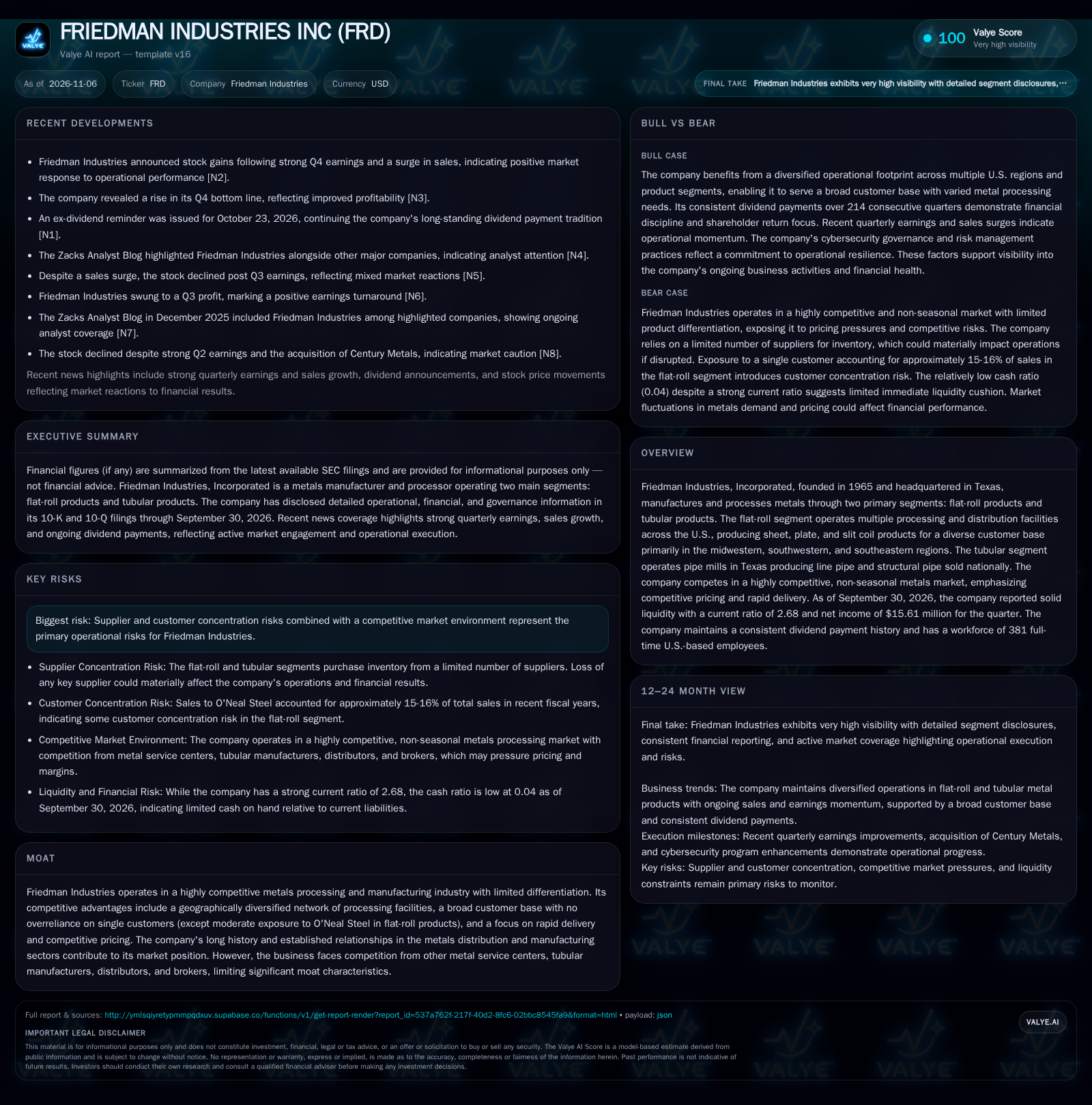
Friedman Industries reported strong Q4 earnings, with $15.61 million in net income and its 214th consecutive dividend. However, significant customer concentration, a reported cash ratio, and reliance on a small supplier base expose the company to volatility. Its performance hinges on managing margin cycles and maintaining competitive delivery and pricing amid intense industry pressure. Watch for shifts in customer mix, supplier stability, and inventory management to test the durability of recent momentum. [S2] [N2] [N3]
Yet beneath these headline results, the company’s exposure to a handful of key customers and suppliers, combined with a reported cash balance and heavy reliance on price competitiveness, underscore the fragility of its earnings base. The central question is whether Friedman’s diversified footprint and operational discipline can offset the cyclical pressures and concentration risks that define its business.
Earnings Upswing and Concentration Risks Define 2026 Snapshot
Friedman Industries reported net income of $15.61 million for the quarter ended September 30, 2026, with basic and diluted EPS of $2.19. This performance followed a period of strong sales momentum and positive market response, as evidenced by recent stock gains post-Q4 earnings. However, the company’s flat-roll segment remains exposed to customer concentration, with sales to O’Neal Steel comprising approximately 15-16% of total sales in fiscal years 2025 and 2026.On the balance sheet, Friedman reported cash and cash equivalents of $5.64 million, current assets of $340.88 million, and current liabilities of $127.38 million, resulting in a current ratio of 2.68 but a reported cash ratio of 0.04. The company’s 214th consecutive quarterly dividend highlights its shareholder return focus. [S2] [N2] [N3] [N1]
How Friedman Makes Money: Volume-Driven Margins in a Commoditized Market
Friedman’s revenue model is split between flat-roll products—sheet, plate, and slit coil processed and distributed from multiple U.S. facilities—and tubular products produced at two Texas pipe mills. The flat-roll segment derives income from both inventory sales and fee-based processing/storage of customer-owned materials, while the tubular segment relies solely on company-owned inventory sales. Pricing is largely dictated by prevailing steel and pipe market rates, with margins subject to input cost volatility and cyclical swings in end-market demand.
The business is inherently high-volume and low-margin, with operating leverage stemming from fixed facility and labor costs spread across large throughput. However, margin upside is limited by intense competition and the undifferentiated nature of the products. Working capital requirements are significant, as the company must finance large inventory positions to support rapid delivery and customer responsiveness. [S2] [S1]
Dividend continuity and the maintenance of processing/distribution infrastructure require steady cash flows, making effective inventory management and disciplined capital allocation critical to sustaining returns through the cycle.
Given the low-margin nature of the steel distribution business, Friedman’s profitability is highly sensitive to operational efficiency and cost control. Fixed costs such as labor, facility maintenance, and logistics infrastructure create a leverage effect where small changes in volume can disproportionately affect margins. Therefore, sustaining or growing volume is critical, but volume growth must be balanced against inventory carrying costs and potential obsolescence risks. Additionally, the fee-based processing component introduces a layer of revenue stability, though it may also compress margins if pricing pressure intensifies or if customer-owned inventory volumes fluctuate unpredictably.
Competitive Pressures and the Limits of Differentiation in Metals Processing
Friedman operates in a highly competitive, non-seasonal market, contending with metal service centers, other tubular manufacturers, distributors, and brokers. Its main levers for customer retention are competitive pricing and rapid delivery, which are necessary but not sufficient for sustainable differentiation in a commoditized space. While the company’s geographic reach, broad customer base, and established relationships provide some buffer against regional demand swings, true pricing power is elusive.
Customer concentration in the flat-roll segment—particularly the reliance on O’Neal Steel—raises the stakes for customer retention and negotiation, as the loss or renegotiation of a major account could materially impact revenue. On the supply side, dependence on a limited number of suppliers for inventory introduces further operational risk, as any disruption could constrain production or erode margins through higher input costs. The competitive intensity and lack of proprietary technology or unique product features mean that Friedman’s moat, if any, is built primarily on operational discipline, logistics efficiency, and longstanding industry relationships. [S1]
The lack of product differentiation in steel distribution means that Friedman’s competitive positioning relies heavily on non-price factors such as delivery speed, geographic coverage, and customer service quality. However, these attributes are costly to maintain and can erode returns if competitors match service levels or if technological advancements reduce the value of rapid delivery. Moreover, the company’s dependence on a narrow supplier base limits its ability to negotiate favorable input prices, making it vulnerable to supplier power shifts. Effective risk mitigation would require strategic supplier diversification or vertical integration, though these options entail capital investment and operational complexity.
Margin Expansion via Volume Growth and Operational Discipline
A favorable scenario for Friedman Industries would see continued strength in end-market demand for both flat-roll and tubular products, allowing the company to maintain high capacity utilization and spread fixed costs across greater throughput. If steel prices remain stable or rise, and input costs are well-managed, margins could expand modestly even in a competitive environment. Diversification of the customer base—reducing reliance on O’Neal Steel—and improved supplier terms could further enhance resilience.
Confirmation of this scenario would come from sustained sales growth, rising gross margins despite input cost volatility, and reduced customer concentration in flat-roll products. Evidence of improved cash conversion cycles and inventory turnover would support the case for better working capital efficiency. [N2] [N3] [N4]
Cyclical Stability with Persistent Margin and Concentration Pressures
The most plausible path for Friedman is continued cyclical performance, with revenues and profits fluctuating in line with steel demand and pricing. Competitive forces and the commoditized nature of the metals market will likely constrain significant margin expansion, though broad geographic reach and operational execution may allow the company to defend its market share. Customer and supplier concentration risks remain live, with the potential for periodic disruptions or renegotiations impacting quarterly results.
Falsification would occur if Friedman consistently outperforms on gross margin or rapidly diversifies its customer and supplier base, suggesting a structural shift rather than cyclical stability. [S1] [S2]
In this scenario, Friedman’s ability to maintain operational discipline will be crucial to managing working capital and preserving cash flow amid cyclical demand swings. However, persistent customer concentration risks mean that any adverse change in a key account’s purchasing behavior could disproportionately impact results, underscoring the importance of proactive customer relationship management and diversification efforts. Capital allocation decisions will also need to prioritize flexibility to navigate potential market downturns.
Earnings Volatility from Concentration Shocks and Steel Price Swings
In an adverse scenario, a downturn in steel demand or a sharp drop in steel prices could compress margins and reduce throughput, straining Friedman’s fixed-cost structure. If O’Neal Steel, the largest flat-roll customer, were to materially reduce orders or switch suppliers, the revenue impact could be immediate and severe. Similarly, a disruption in supply—whether from price hikes, shortages, or logistical issues—could erode gross margins or even halt production in affected segments.
This scenario would be confirmed by declining sales and net income, margin compression, and possible dividend cuts or suspensions. A rising proportion of slow-moving inventory, deteriorating current or cash ratios, or negative working capital trends would further validate the downside. News of supply chain disruptions, customer losses, or competitive encroachment would be additional warning signs. [S2] [S1]
Benchmarks for Testing Friedman’s Margin Durability and Risk Exposure
Quarterly gross margin trends, as these reflect both pricing power and input cost management in a volatile steel market.
Customer concentration in the flat-roll segment—specifically, the percentage of sales to O’Neal Steel and any announcements regarding contract renewals or terminations.
Inventory turnover ratio and days sales outstanding, which would reveal working capital discipline and the company’s ability to respond to demand fluctuations.
Supplier base diversification and any disclosed changes in supply chain relationships or input cost structures.
Dividend continuity and payout ratio, as an indicator of underlying cash flow stability and capital allocation discipline.
Disclosures of new customer wins, geographic expansion, or entry into higher-margin product lines, which could signal a shift in business mix or competitive position.
If disclosed, backlog levels or forward order commitments that would offer visibility into revenue stability for upcoming quarters.
Disclaimer: This is research-only, informational analysis and not investment advice. It may include AI-generated interpretation and general industry context. Always verify important details using primary sources.

Comments