
Orion Properties: Tenant Concentration and Specialized Asset Strategy Shape Market Response
With a suburban office and dedicated-use property focus, Orion Properties faces the dual challenge of evolving workspace demand and tenant concentration risk. Active capital recycling, a strategic review, and a shift toward specialized assets may buffer against sector headwinds, but execution and market conditions remain pivotal.
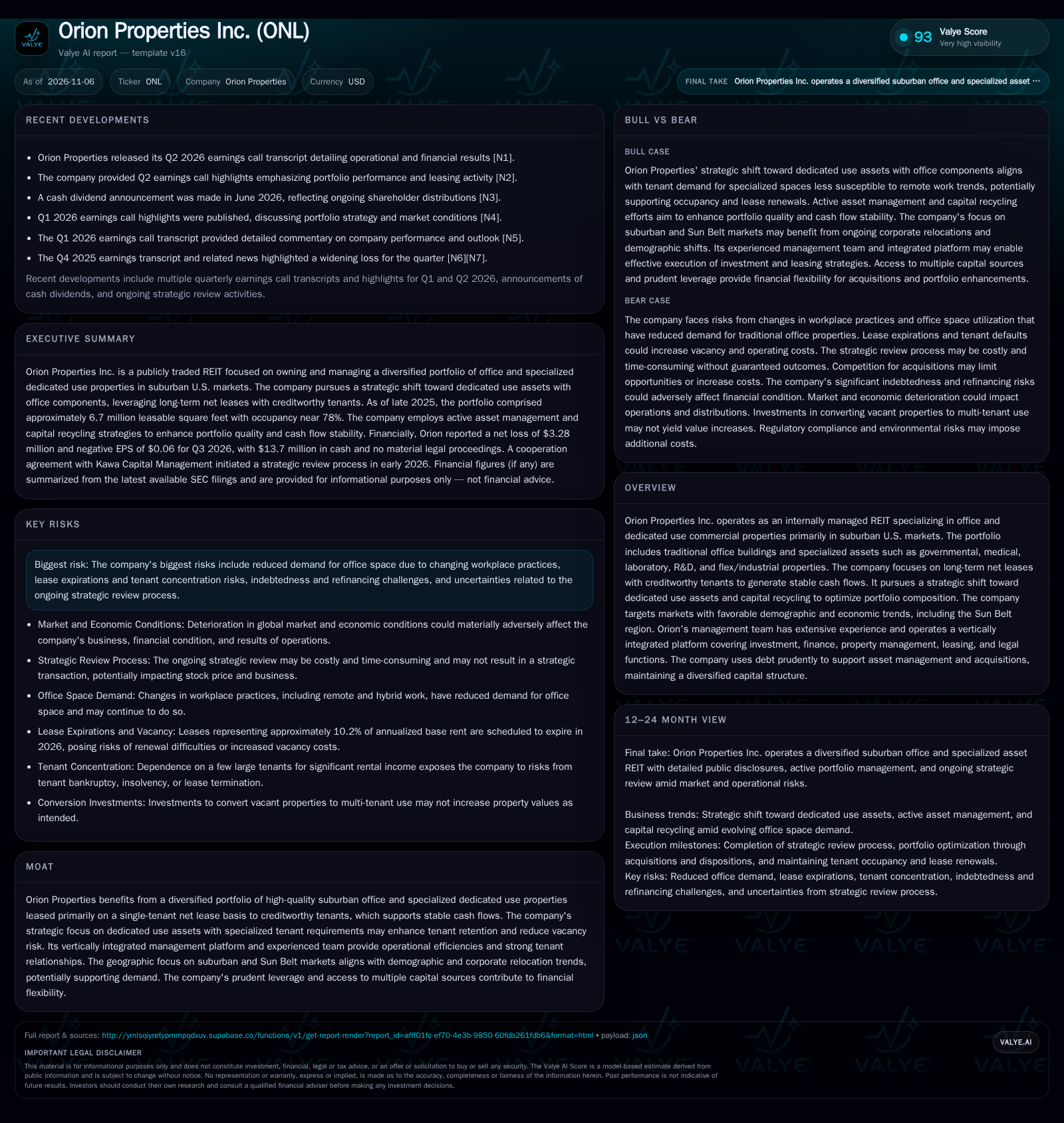
Orion Properties Inc. is a REIT with a 6.7 million square foot portfolio of office and dedicated-use properties, a 78% occupancy rate, and material tenant concentration. The company is actively cycling capital and shifting toward specialized assets while reviewing strategic options. Market headwinds persist as traditional office demand weakens and tenant concentration exposes Orion to renewal and default risk. Execution on asset conversion and lease retention will be critical to outcomes over the next 12-24 months. [S1] [S2]
Orion Properties Inc. stands at a crossroads as it manages a portfolio of suburban office and dedicated-use assets under mounting pressure from shifting workplace trends and tenant concentration risk. With a significant portion of rent tied to just two tenants and an occupancy rate hovering around 78%, Orion is actively repositioning its portfolio toward specialized properties and recycling capital to enhance stability. The company's ongoing strategic review could reshape its trajectory, but results will depend on success in lease retention, asset conversion, and navigating broader office sector challenges. [S1] [S2]
Portfolio Overview: Occupancy Levels, Lease Terms, and Strategic Assessment
Orion Properties’ portfolio as of December 31, 2025 comprised 58 operating properties totaling 6.5 million square feet (6.7 million including its joint venture), with a 78.7% occupancy rate and a weighted average remaining lease term near 5.7 years [S1]. The company’s revenue base is highly concentrated: the General Services Administration and Merrill Lynch represent 17.8% and 10.0% of annualized base rent, respectively [S1].
Geographically, Texas, New Jersey, and New York each contribute at least 10% of annualized base rent. Tenant industries with significant exposure include Government & Public Services (18.3%), Health Care Equipment & Services (13.7%), and Capital Goods (10.8%) [S1].
Orion reported a net loss of $3.28 million and negative EPS for Q3 2026, with $13.7 million in cash as of September 30, 2026 [S2]. The company entered into a cooperation agreement with Kawa Capital Management in January 2026 to evaluate strategic alternatives, including a potential sale, but is not obligated to pursue any transaction [S1].
Balancing Revenue Consistency with Vacancy Exposure in Net Lease REITs
Orion’s business model is anchored in long-term single-tenant net leases, which typically shift property-level expenses (taxes, insurance, maintenance) to tenants, providing a more predictable cash flow profile and partial inflation protection. Embedded rent escalators in these leases can support organic revenue growth if tenants remain solvent and in place.
However, Orion’s 78% occupancy rate suggests underutilized capacity and lost rent opportunities, especially given the high fixed costs associated with property ownership and management. The relatively long weighted average lease term (5.7 years) provides some revenue visibility, but upcoming lease expirations—especially the 10.2% of base rent rolling in 2026—could pressure cash flows if not renewed.
Tenant concentration amplifies both risk and potential operating leverage: positive lease renewals with major tenants can stabilize or grow cash flow, while a default or non-renewal could create material revenue holes and increase re-leasing and capital expenditures. The company’s capital recycling strategy—selling non-core assets and reinvesting in specialized or higher-yielding properties—may help offset vacancy pressures, but execution risk is high if market conditions deteriorate.
Access to $465 million in consolidated debt, including a $215 million revolver and $355 million fixed-rate CMBS loan, provides capital for acquisitions and asset repositioning, but also raises refinancing and covenant compliance risks if property values or cash flows decline [S1].
Leveraging Specialized Assets to Offset Broader Office Market Challenges
The U.S. office REIT sector remains structurally challenged by remote and hybrid work trends, reducing overall demand for traditional office space. Orion’s strategy to increase exposure to specialized dedicated-use assets—such as government-leased, medical office, lab/flex, and R&D properties—seeks to mitigate these headwinds by targeting tenants with more mission-critical, less fungible space needs.
This approach may improve retention and pricing power in subsegments less exposed to work-from-home risk, particularly if such assets are difficult to replicate or relocate. However, competition for high-quality, specialized properties is intense, with institutional investors, private equity, and larger REITs seeking similar diversification. Acquisition pricing could be bid up, compressing yields and making it harder for Orion to achieve above-market returns.
Orion’s vertically integrated management platform and its leadership team’s experience in single-tenant net leases may offer operational efficiencies and relationship advantages. Yet, the company’s relative scale, tenant concentration, and regional focus (notably Texas, New Jersey, and Sun Belt markets) mean that local market cycles and individual tenant credit events can have outsized impacts.
Alternative asset classes (industrial, life sciences, data centers) and landlords with greater balance sheet strength may exert competitive pressure, especially in acquisition and re-leasing situations.
Recovery Potential Through Portfolio Adjustment and Targeted Leasing
A favorable outcome for Orion would see successful execution of its strategic shift: disposing of lower-performing traditional office assets, redeploying capital into high-demand specialized properties, and maintaining or increasing occupancy through new long-term net leases with creditworthy tenants.
If the company can renew a substantial portion of leases rolling in 2026—particularly with major tenants—and attract new tenants to currently vacant or converted multi-tenant space, cash flow stability would improve. This, combined with successful asset recycling at attractive cap rates, could enable Orion to grow FFO (funds from operations), resume or increase dividends, and possibly command a higher valuation multiple.
Confirmation of this scenario would require sustained or rising occupancy rates, evidence of lease renewals or new signings with strong tenants, successful asset sales at or above book value, and progress in the strategic review (such as a value-creating M&A transaction or favorable portfolio optimization announcement). Conversely, failure to execute on asset sales or lease renewals would falsify the upside scenario.
Sector Volatility Limits but Does Not Halt Incremental Gains
The most plausible medium-term scenario is one of slow, uneven progress. Orion may succeed in recycling some capital and growing its dedicated-use asset base, but occupancy rates are likely to remain pressured as traditional office demand continues to soften. Lease renewals with major tenants could be mixed, with some success but also some non-renewals or rent concessions required to maintain occupancy.
Operationally, the company may achieve modest improvements in cash flow stability if asset management and leasing initiatives offset vacancy and expense growth. Dividends may be maintained at current levels but are unlikely to grow meaningfully absent a sustained recovery in office demand or a transformative strategic transaction.
Confirmation would come from steady occupancy (remaining in the high 70% range), stable or slightly improving rental income, and limited asset impairments. Evidence against this scenario would include a step-change drop in occupancy, major tenant defaults, or an inability to execute planned dispositions.
Extended Weakness from Tenant Departures and Unsuccessful Asset Turnover
A negative outcome would be triggered by a combination of major lease non-renewals or tenant defaults—particularly involving the General Services Administration or Merrill Lynch—and continued difficulty re-leasing vacant space. This would drive occupancy and cash flow lower, potentially forcing asset sales at distressed prices and triggering asset impairments.
If the market for suburban office and even some specialized assets weakens further, Orion could struggle to recycle capital or refinance debt on acceptable terms. Breaching financial covenants or facing higher borrowing costs could restrict operating flexibility and threaten dividend sustainability.
This scenario would be confirmed by a sharp drop in occupancy (well below current levels), material rent roll-downs, distressed asset sales, debt covenant breaches, or a dividend cut or suspension. A failed or inconclusive strategic review could amplify downside risk by prolonging uncertainty.
Key Developments Influencing Orion’s Shift from Office to Specialized Assets
Occupancy rates by property type and region—especially any improvement or further decline in traditional office versus dedicated-use asset occupancy (if disclosed).
Lease renewal rates and rent spreads on expiring leases, with particular attention to the General Services Administration and Merrill Lynch lease outcomes.
Progress and pricing on asset sales and acquisitions, including realized cap rates and gain/loss versus book value (if disclosed).
Updates on the scope, direction, or outcome of the strategic review process, including any announced transactions or portfolio reconfigurations.
Changes in the company’s debt profile, refinancing activity, and compliance with financial covenants (if disclosed).
Reported asset impairments or significant writedowns, especially on properties with elevated vacancy.
Expense trends relative to revenue, as high fixed costs may pressure margins if vacancy remains elevated.
Disclaimer: This is research-only, informational analysis and not investment advice. It may include AI-generated interpretation and general industry context. Always verify important details using primary sources.

Comments