
PJT Partners at a Crossroads: Advisory Fluctuations, Talent Investments, and Technology Opportunities
PJT Partners’ 2026 results highlight both the resilience and cyclicality of its advisory-driven business model, with Q3 softness amid macro headwinds but year-to-date gains. The firm’s future hinges on its integrated platform, talent strategy, and ability to harness technology and restructuring trends while managing cost discipline and competitive pressures.
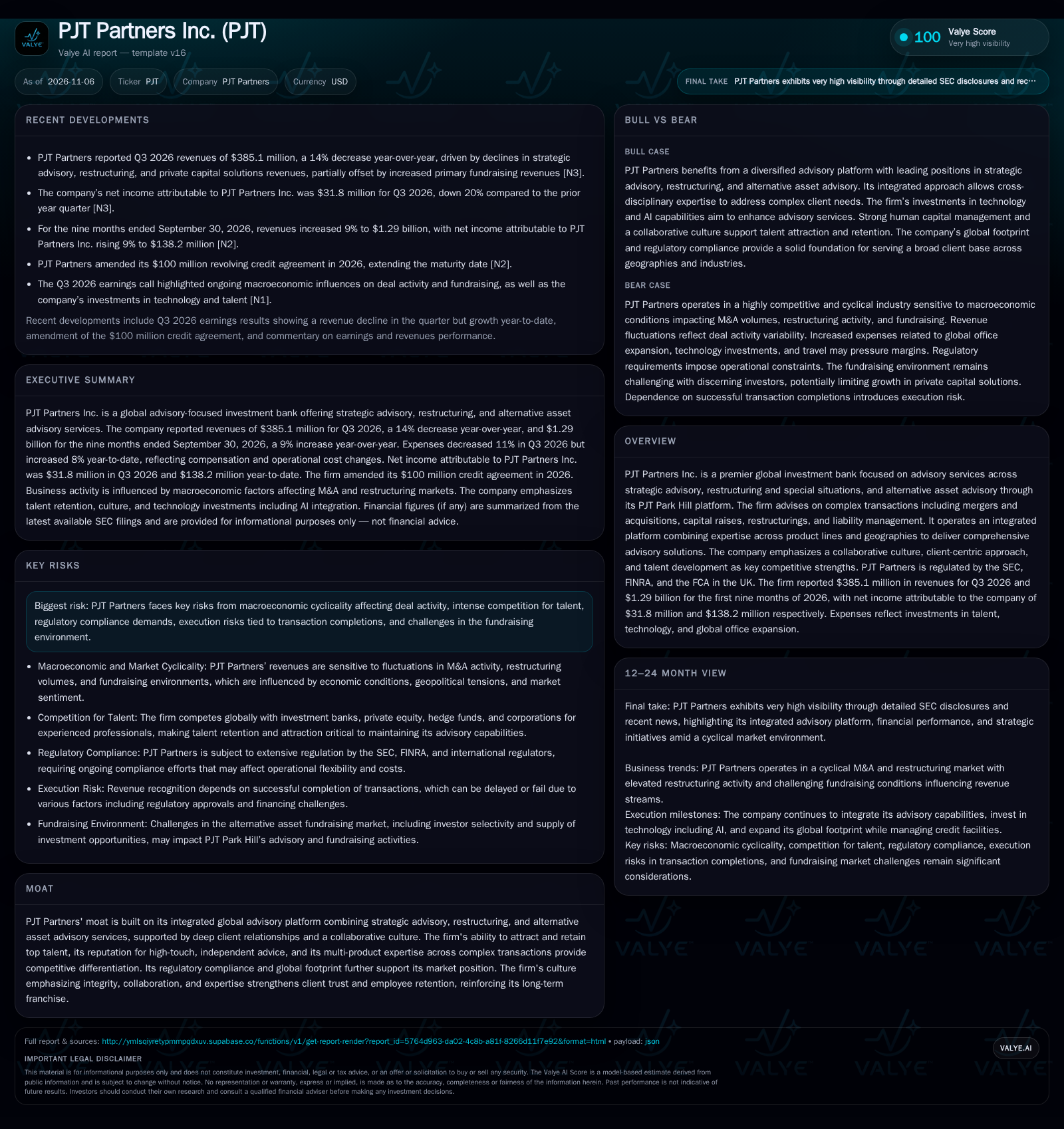
PJT Partners reported a 14% revenue decline in Q3 2026 but grew year-to-date revenues and net income, reflecting the cyclical nature of advisory demand. The firm is investing in technology and talent while amending its credit facility. The outlook depends on deal flow recovery, restructuring needs, and the impact of AI and cost controls on margins and competitive positioning. [S2] [N2]
PJT Partners Inc. stands at a crossroads in late 2026, with its Q3 results reflecting the inherent volatility of advisory-focused investment banks. While the firm posted a 14% year-over-year revenue decline for the quarter, its nine-month performance remained positive on both revenue and net income. This split underscores the cyclical exposure embedded in its business lines—strategic advisory, restructuring, and private capital solutions—amid a challenging deal environment. Strategic investments in technology and talent, combined with a recently extended credit facility, are intended to position PJT for renewed momentum. The question for investors is whether these initiatives can offset economic headwinds and intensifying competition, or if further margin pressure and revenue variability will define the next phase.
Revenue Trends Highlight Distinct Phases in Performance
For the three months ended September 30, 2026, PJT Partners reported revenues of $385.1 million—a 14% decrease compared to the same quarter in 2025. This shortfall was attributed to declines in strategic advisory, restructuring, and private capital solutions revenues, only partially offset by an uptick in primary fundraising activity. Net income for the quarter fell 20% year-over-year to $31.8 million. However, on a nine-month basis, revenues climbed 9% to $1.29 billion, with net income up 9%, reflecting gains earlier in the year. Expenses declined 11% in Q3 but rose 8% year-to-date, primarily due to higher compensation, office expansion, and technology investments. The company also amended its $100 million revolving credit facility, extending its maturity but not materially altering liquidity capacity. Together, these facts highlight a business that remains sensitive to the timing and mix of deal activity, with expenses and profitability fluctuating alongside revenue. [S2] [N2] [N3]
Human Capital Costs Shape Advisory Revenue Patterns
PJT Partners’ economics are driven by transaction-based advisory fees across M&A, restructuring, and fundraising. Revenue is episodic, depending on the successful completion of deals, and subject to macroeconomic swings. The firm’s integrated model may allow for some smoothing—restructuring demand can rise as M&A slows—but all segments are ultimately cyclical. Pricing power is largely a function of reputation, senior banker relationships, and the complexity of assignments, rather than product differentiation. Compensation is the dominant expense, reflecting the war for top talent: when revenue surges, so do bonuses, but in slower periods, fixed salaries and ongoing investments in technology and office space can pressure margins. Recent investments in AI and infrastructure could drive future operating leverage, but these costs are upfront and their ultimate impact on productivity and revenue per employee remains to be proven. Capital needs are modest compared to balance-sheet-intensive banks, but talent retention and technology upgrades create a persistent demand for reinvestment. [S2] [S1]
Platform Integration Offers Edge Amid Fierce Competition
PJT’s integrated advisory platform—spanning M&A, restructuring, and private capital solutions—offers clients a one-stop shop for complex transactions. This breadth can foster deeper client relationships and cross-sell opportunities, especially when market conditions shift between growth and distress cycles. The firm’s reputation for independent, high-touch advice and its focus on senior talent retention are potential advantages in a crowded field. However, PJT competes directly with global investment banks, boutique advisory shops, and increasingly, alternative asset managers and consulting firms. Switching costs for clients are generally low, and mandates are won and lost based on expertise, trust, and prior deal execution. Technology and data analytics, including AI, could become differentiators, but only if they enhance client outcomes or improve productivity meaningfully. Regulatory compliance is necessary but not unique. Ultimately, the ability to maintain a pipeline of high-profile mandates and retain elite talent will shape PJT’s competitive standing.
Tech Leverage and Restructuring Could Drive Margin Gains
A favorable scenario would see PJT benefit from a pronounced uptick in restructuring and special situations activity—typically triggered by economic downturns, credit tightening, or sector-specific disruptions. If M&A activity also rebounds, the firm’s diversified platform could capture a disproportionate share of complex mandates. Investments in AI and technology could yield higher productivity, enabling more revenue per banker and reducing the marginal cost of service delivery. If compensation costs are managed as a percentage of revenue, operating leverage could drive margin expansion. Confirmation would come from successive quarters of rising revenue across all major segments, an improving compensation-to-revenue ratio, and evidence that technology investments are translating into higher win rates or client retention. A falsification would be persistently flat or declining revenue, or if tech investments fail to move the needle on margins or client acquisition.
Ongoing Cyclical Variations Challenge but Don’t Overwhelm
The most probable outcome is a continuation of cyclical swings in deal activity, with PJT’s diversified platform offering partial but not full insulation. M&A volumes may recover gradually, while restructuring and fundraising remain mixed, reflecting ongoing macroeconomic uncertainty. Expenses are likely to track revenue trends, with compensation remaining variable and fixed investments in technology and office expansion moderating as prior projects are absorbed. Margins may remain steady but not expand meaningfully unless revenue growth accelerates or cost discipline sharpens. Evidence for this scenario would be moderate, single-digit annualized revenue growth, stable headcount, and compensation ratios, and incremental improvements in client win rates. A deviation—either a sharp surge in deal flow or a prolonged drought—would challenge this base case.
Extended Deal Slowdown Risks Margin and Revenue Pressure
The adverse scenario envisions a sustained slowdown in both M&A and restructuring activity, driven by macroeconomic stagnation, geopolitical risk, or a prolonged risk-off environment. Under these conditions, PJT’s revenue base would shrink, but fixed costs related to talent, technology, and office leases would remain elevated, compressing margins. If fundraising markets remain challenging, the Park Hill platform may not provide the intended counter-cyclical buffer. Failure of recent technology investments to produce meaningful efficiency gains would exacerbate the pain, as would any uptick in talent attrition or loss of senior rainmakers. Confirmation of this downside would be sequential revenue declines, rising compensation ratios, and negative operating leverage. A falsification would require a clear rebound in deal volumes or visible cost containment.
Execution Quality and Market Cycles Define PJT’s Outlook
Quarterly revenue by segment—strategic advisory, restructuring, and private capital solutions—to gauge business mix and cyclical exposure.
Compensation and benefits as a percentage of revenue, since this is the fulcrum of margin swings in both upturns and downturns.
Headcount and partner turnover, as stability or attrition among senior professionals signals franchise strength or vulnerability.
Incremental revenue from technology-enabled services or explicit client wins attributed to AI or analytics (if disclosed).
Deal pipeline visibility and announced mandates to assess near-term revenue potential (would help test the thesis if disclosed).
Fundraising volumes and close rates within the Park Hill platform, especially as a counter-cyclical buffer.
Expense growth in technology and office expansion relative to revenue, to measure whether investments are scaling effectively.
Amendments or draws on credit facilities, which could indicate stress or flexibility depending on context.
Disclaimer: This is research-only, informational analysis and not investment advice. It may include AI-generated interpretation and general industry context. Always verify important details using primary sources.

Comments