
Agenus’s Immuno-Oncology Pivot: Phase 3 Ambitions, Outsourced Manufacturing, and the Next Commercial Hurdle
With a $340 million financing boost and a bold pivot to Phase 3 trials in colon cancer, Agenus is betting its future on late-stage immuno-oncology assets.
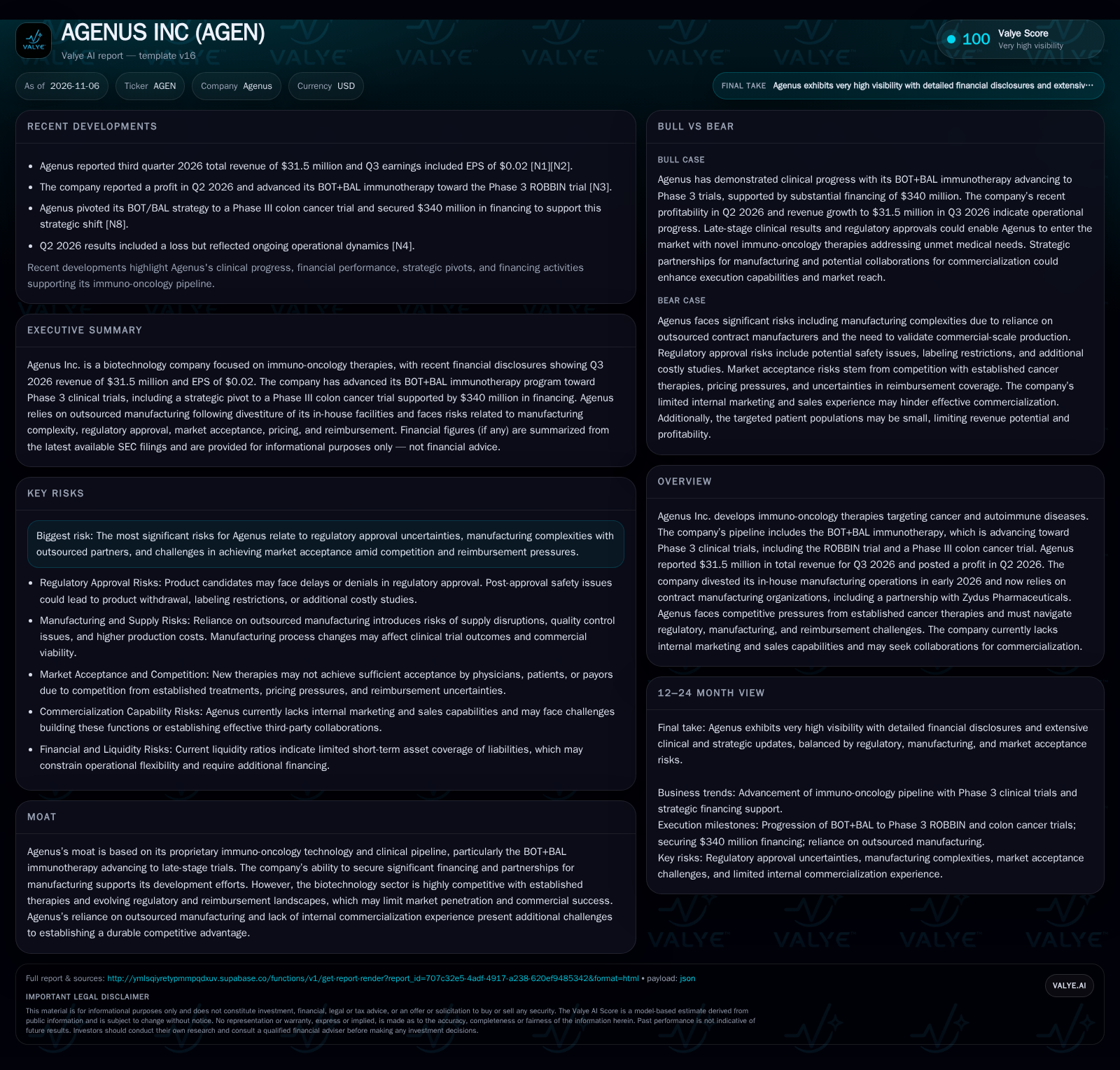
Agenus has advanced its BOT+BAL immunotherapy to Phase 3 trials, including a strategic shift to colon cancer, backed by $340 million in new financing. Agenus lacks internal commercialization capabilities, raising questions about its ability to transition from clinical success to market impact in a highly competitive oncology landscape. [S2] [N3] [N8]
Agenus is at a pivotal juncture, having raised $340 million to propel its BOT+BAL immunotherapy into Phase 3 clinical trials, including a newly prioritized colon cancer indication. This strategic pivot, paired with the divestiture of in-house manufacturing and a reliance on contract partners, signals a leaner but riskier operating model. However, the company’s reported liquidity position cushion and lack of commercial infrastructure mean that even clinical breakthroughs may not easily translate into market success. As the immuno-oncology field grows ever more competitive and capital-intensive, Agenus’s ability to navigate regulatory, manufacturing, and commercialization hurdles will determine whether its late-stage ambitions can yield lasting value. [S2] [N3] [N8]
Phase 3 Colon Cancer Trial and Financial Realignment Mark Agenus’s Latest Strategic Moves
Agenus has made a significant strategic pivot by advancing its BOT+BAL immunotherapy program into a Phase 3 clinical trial for colon cancer, supported by a $340 million financing package. This represents a major bet on late-stage clinical validation as the company seeks to carve a position in the crowded immuno-oncology space. As of September 30, 2026, Agenus reported $66.9 million in cash and cash equivalents, $20 million in short-term investments, and a current ratio of 0.73, illustrating a relatively tight liquidity profile. The company has also exited in-house manufacturing, now relying on contract manufacturing organizations like Zydus Pharmaceuticals, signaling a shift toward a more asset-light development model. These moves collectively raise the stakes on clinical, operational, and commercial execution in the coming quarters. [S2] [N8]
How Agenus’s Asset-Light Model Alters Its Cost Structure and Commercial Prospects
Agenus’s economics hinge on the successful transition from R&D-driven outflows to commercial inflows—an inflection that, in biotech, typically depends on late-stage trial success, regulatory approval, and effective market entry. Divesting in-house manufacturing reduces fixed costs and capital intensity, but increases variable costs and exposes the company to supply-chain and quality risks inherent in outsourced production. If BOT+BAL secures approval, commercial revenues would likely depend on pricing power in oncology, which is often constrained by established competitors and payer negotiations.
The company’s lack of internal marketing and sales infrastructure means it will face a choice: build commercial teams from scratch (entailing heavy upfront investment and slow ramp), or partner with larger pharmaceutical firms (likely at the cost of sharing economics). The size of the initial addressable market may be limited, as new oncology therapies are often first approved for later-line, smaller patient populations. This dynamic puts a premium on demonstrating superior efficacy or safety to gain rapid adoption and premium pricing—otherwise, payor pushback and competition could cap margins and slow uptake.
Ongoing clinical trials and regulatory submissions remain significant cash drains, and with a current ratio below 1, Agenus may need to secure additional financing before reaching commercial self-sufficiency. Thus, while the asset-light approach can streamline development, it does not eliminate the need for substantial capital to bridge to revenue generation.
Facing Entrenched Oncology Rivals and the Barriers to Displacement
Agenus competes in a sector dominated by established immuno-oncology therapies, especially checkpoint inhibitors and combination regimens from large pharmaceutical companies. The company’s proprietary BOT+BAL combination may offer differentiated mechanisms, but the real test will be in demonstrating superior clinical outcomes in Phase 3 trials. Even with positive data, market entry is complicated by physician inertia, established treatment guidelines, and the need for robust real-world evidence.
Outsourced manufacturing may speed scale-up if demand materializes, but it also increases vulnerability to supply disruptions—a critical risk in oncology, where therapy interruptions can have severe implications for patient outcomes and prescriber trust. The absence of commercial infrastructure puts Agenus at a disadvantage relative to larger peers that can leverage existing salesforces, payer relationships, and global reach. Unless Agenus secures a strong commercialization partner or builds capabilities rapidly, it risks being outmaneuvered on both access and uptake.
Finally, payer and reimbursement dynamics are increasingly challenging in oncology, with cost-effectiveness scrutiny intensifying. Without clear evidence of substantial benefit over existing standards of care, new entrants may face price pressures or restricted formulary access, further complicating the path to meaningful market share.
Breakthrough Data and Strategic Partnerships Could Accelerate Agenus’s Ascent
A favorable outcome would see BOT+BAL deliver compelling Phase 3 efficacy and safety results, particularly in colon cancer, enabling rapid regulatory approval. This could attract a major commercial partnership or acquisition offer, allowing Agenus to leverage a partner’s salesforce, market access infrastructure, and payer relationships while reducing the burden of building these capabilities independently.
The $340 million financing would then provide sufficient runway through regulatory milestones, avoiding dilutive capital raises. If the therapy secures a premium price due to clear clinical differentiation and addresses a significant unmet need, initial uptake could be robust—even with a limited label—setting the stage for label expansions into broader indications.
Evidence confirming this scenario would include: positive Phase 3 top-line data, rapid regulatory submissions and approvals, a disclosed commercialization partnership with a large biopharma, and early signals of favorable payer coverage and physician adoption. Conversely, failure to secure a partner or lackluster trial results would quickly challenge this trajectory.
Clinical Progress with Execution Bottlenecks and Incremental Market Entry
The most plausible near-term path is that Agenus advances BOT+BAL through late-stage trials with mixed but generally positive results, leading to a regulatory submission. Approval is possible but may come with a narrow label (e.g., later-line colon cancer), limiting initial revenue potential. Without internal commercial capabilities, Agenus may enter into a regional or indication-specific partnership, capturing only a portion of the economics.
Manufacturing scale-up proceeds with manageable disruptions, but cost of goods remains higher than in-house production would allow, compressing gross margins. Reimbursement negotiations prove challenging, with payers demanding discounts or step-edit requirements given the crowded treatment landscape. Uptake is steady but gradual, as physicians and patients await more real-world data.
Confirmation of this scenario would be visible in regulatory filings, a disclosed commercial partnership or field force build-out, and initial revenue contributions that are meaningful but not transformative. Delays in manufacturing or regulatory review, or tepid payer responses, would suggest downside risk.
Clinical Setbacks or Commercial Stumbles Threaten Agenus’s Solvency and Independence
Adverse outcomes could arise if BOT+BAL fails to show significant benefit in Phase 3, encounters unexpected safety signals, or faces regulatory setbacks. In this case, Agenus would be left with a depleted cash position, limited pipeline visibility, and no near-term revenue prospects. Reliance on outsourced manufacturing could exacerbate the situation if supply chain or quality issues are implicated in trial failures or regulatory delays.
Without positive data or a commercial partner, the company would likely need to raise additional capital under unfavorable terms, risking shareholder dilution or even insolvency. The lack of commercial infrastructure would make pivoting to other indications or assets slower and more expensive. Competitive pressure from established therapies would further erode any residual market opportunity.
Evidence supporting this scenario would include negative or equivocal Phase 3 data, regulatory rejections, significant manufacturing disruptions, and urgent financing actions such as deep-discounted equity raises or asset sales.
Milestones That Will Clarify Agenus’s Transition from Pipeline to Product
Top-line results and detailed data readouts from the Phase 3 colon cancer trial will be the most immediate and material catalyst for the Agenus thesis.
Announcements of commercial partnerships, licensing deals, or acquisition interest would indicate external validation and address go-to-market execution risk.
Updates on regulatory submissions and feedback, including timelines for FDA or EMA review, will clarify the path to potential product launch.
Disclosures regarding manufacturing ramp-up, supply chain stability, and any quality or cost challenges will be critical, especially given the company’s reliance on contract manufacturers.
Quarterly cash burn and updated liquidity projections, including any new financing arrangements or equity raises, would help test the sustainability of operations through the next major milestones.
If disclosed, metrics on payer coverage decisions, formulary placements, and reimbursement rates for BOT+BAL following approval would help gauge market acceptance and pricing power.
Tracking the company’s progress in building or accessing commercial infrastructure—whether through hiring, partnerships, or acquisition—will be essential to assess launch readiness.
Disclaimer: This is research-only, informational analysis and not investment advice. It may include AI-generated interpretation and general industry context. Always verify important details using primary sources.

Comments