
IMAQ’s Merger Gamble: Deadline Pressure, Dilution Mechanics, and the Economics of a SPAC’s Last Act
IMAQ, a blank check SPAC, has until January 2027 to complete its merger with VCI Holdings Limited and Vietnam Biofuels Development Joint Stock Company.
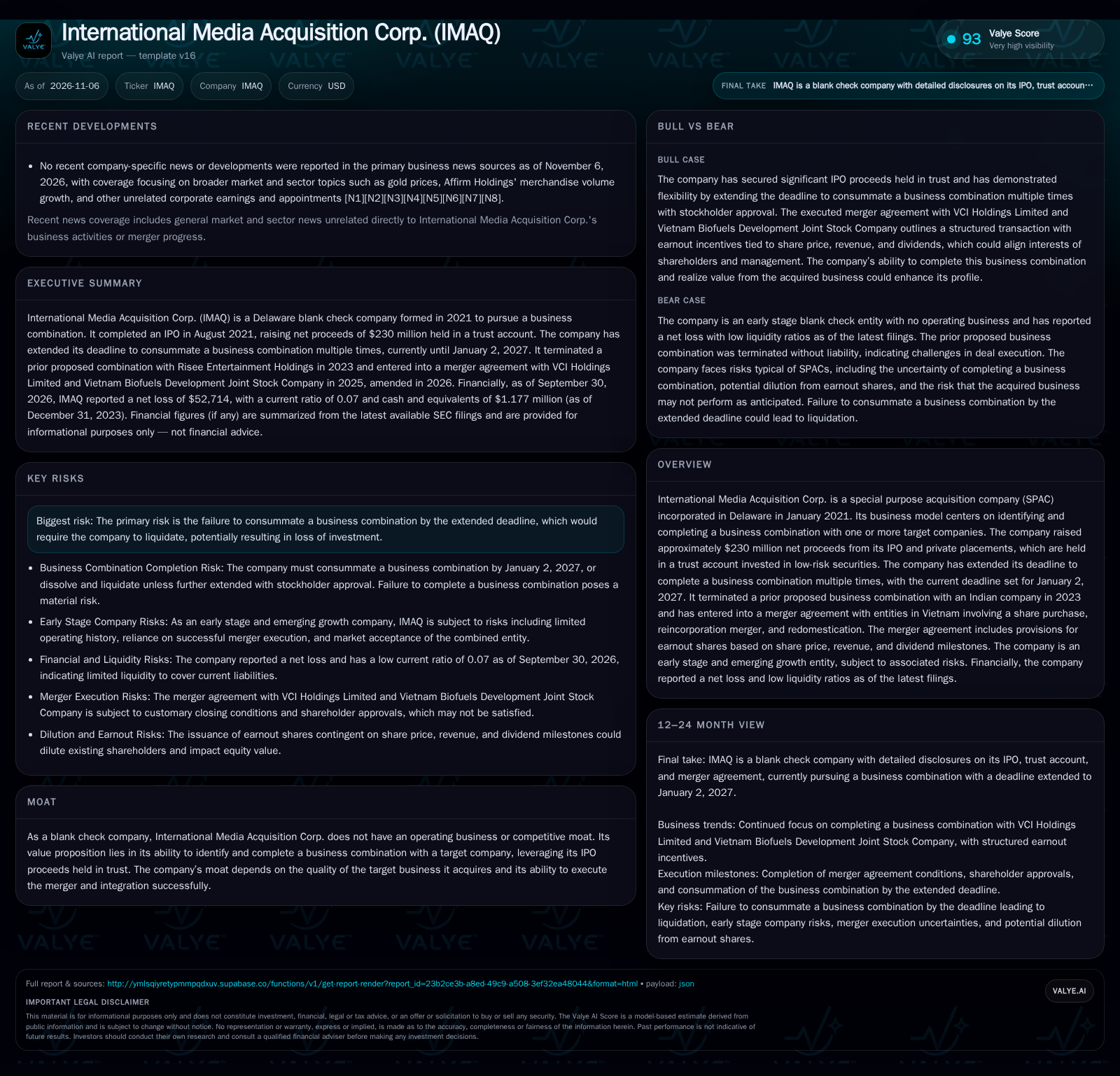
IMAQ, a blank check SPAC, has until January 2027 to complete its merger with VCI Holdings Limited and Vietnam Biofuels Development Joint Stock Company. The next twelve months will be defined by the ability to close the merger, manage dilution, and transition from a trust-fund vehicle to an operating business—or face liquidation if deadlines slip further. [S2]
International Media Acquisition Corp. (IMAQ) stands at a critical inflection point: its future now hinges on the successful closure of a complex, earnout-laden merger with VCI Holdings Limited and Vietnam Biofuels Development Joint Stock Company before its final January 2027 deadline. The next twelve months will determine whether IMAQ transitions to an operating entity or is forced into liquidation, with every step contingent on regulatory, financial, and market execution.
IMAQ’s Current State: Merger Deadline, Liquidity Pinch, and Earnout Uncertainty
As of November 2026, International Media Acquisition Corp. has secured shareholder approval to extend its business combination deadline multiple times, with the current cut-off set for January 2, 2027. The company has entered into a definitive merger agreement, amended in April 2026, with VCI Holdings Limited and Vietnam Biofuels Development Joint Stock Company. This agreement involves a share purchase, reincorporation merger, and redomestication, with earnout shares tied to future financial and market milestones. The company reported cash and liquidity metrics for the period; these figures do not by themselves establish operating runway, investment capacity, financial flexibility, or financing capacity. The company’s prior attempt at a business combination was terminated without liability in 2023, suggesting substantial execution risk. These facts highlight that IMAQ’s future is now almost entirely dependent on closing the complex merger within the required timeframe and securing shareholder approval. [S2]
SPAC Economics: Trust Account, Dilution, and the Path to Operating Revenues
IMAQ’s business model, like all SPACs, is predicated on transforming trust-held IPO proceeds into an operating business through a merger. Until a deal closes, the company earns only nominal returns from its trust account investments in government securities or money market funds. The economics shift dramatically post-merger: the trust account is released, and the combined entity must generate operating revenues to service any new or assumed debt and justify the value of newly issued shares.
A critical economic lever is the earnout structure embedded in the merger agreement. Earnouts, contingent on achieving share price, revenue, and dividend milestones, are designed to align management and shareholder interests but also introduce the risk of significant dilution if performance targets are met. The merger could also require additional financing—through debt or equity—to fund the operations of the combined business, further impacting dilution and leverage. Given the current lack of operating income and the company’s minimal cash outside the trust, the economics of the post-merger business will hinge on rapid revenue generation, cost discipline, and careful capital structure management. If the merger fails, the SPAC will liquidate and distribute trust proceeds to shareholders, typically resulting in a loss of sponsor capital and warrants.
No Moat Until Merger: Deal Quality and Integration Shape Future Prospects
As a pre-combination SPAC, IMAQ does not possess an operating moat or competitive advantage. Its only current asset of value is the cash in its trust account and the potential of its merger target. The ultimate competitive position of IMAQ will be determined entirely by the quality and market positioning of VCI Holdings Limited and Vietnam Biofuels Development Joint Stock Company post-merger.
If the merger closes, IMAQ’s future moat would derive from the acquired entities’ industry dynamics—such as barriers to entry, regulatory protection, technology, and customer relationships. Until then, IMAQ’s competitive standing is defined by its ability to execute a deal under terms favorable enough to attract and retain shareholder support. The presence of earnout triggers could be a double-edged sword: they may incentivize high performance, but if targets are set too low or too high, they could either dilute existing shareholders unnecessarily or fail to motivate management. In the current SPAC market, competition for attractive targets remains intense, and failed deals or poor post-merger performance can quickly erode any perceived advantage.
A Successful Merger and Earnout Alignment Could Unlock Shareholder Value
The optimistic scenario for IMAQ rests on the timely and successful completion of its merger with VCI Holdings and Vietnam Biofuels. If the deal closes as structured, and the acquired business performs well—achieving the earnout milestones for share price, revenue, and dividends—the combined entity could quickly transition from a trust-dependent shell to a revenue-generating operating company. This would not only preserve the original SPAC capital but could also reward shareholders with upside from both business growth and well-aligned management incentives.
Evidence supporting this scenario would include regulatory approval of the merger, positive shareholder votes, disclosure of robust pro forma financials for the target entities, and early achievement of earnout milestones. Additional confirmation would come from the market’s response—such as increased share price and trading liquidity—post-deal, as well as timely disclosure of new customer wins or operational milestones by the combined company. Falsification would be signaled by delays in closing, failure to secure shareholder approval, or early signs of underperformance by the target businesses.
Deadline-Driven Execution with Dilution and Integration Hurdles
The most plausible outcome is a high-stakes, deadline-driven push to close the merger before January 2027, amid tight liquidity and the risk of shareholder dissent. In this scenario, the merger is completed but only after protracted negotiations, additional concessions, or revised terms to secure shareholder approval. The company emerges as an operating entity, but with immediate challenges: the need to integrate disparate businesses, realize revenue quickly, and manage the impact of earnout-triggered dilution.
Confirmation of this path would include incremental regulatory and shareholder approvals, regular updates on deal milestones, and transparency about post-merger financial projections and capital needs. Any slippage in the trust account balance, delays in closing, or changes to the merger structure would suggest increased risk to successful execution. The company’s ability to communicate a credible integration plan and early proof points in revenue or margin expansion would be critical to sustaining market confidence.
Deal Failure or Liquidation: SPAC-Holder Value at Risk
The adverse scenario is defined by the failure to consummate the merger before the January 2027 deadline, whether due to regulatory, shareholder, or target-company hurdles. In this case, IMAQ would be forced to liquidate, returning trust proceeds to public shareholders and effectively wiping out any value in the sponsor’s capital and warrants. Given the acute liquidity constraints outside the trust, the company would have little ability to extend its runway or pursue alternative targets.
Evidence for this scenario would include repeated delays in deal milestones, loss of shareholder support, regulatory pushback, or public withdrawal of the merger counterparties. Early warning signs would be a deteriorating trust account (from extension-related withdrawals or redemptions), increased legal or advisory expenses, and lack of communication from management regarding progress. Any further terminated deals, as occurred in 2023, would reinforce the risk of liquidation.
Milestones That Will Determine IMAQ’s Fate and Shareholder Outcomes
Shareholder vote results on the proposed merger—timing, turnout, and approval rates will be crucial in assessing deal viability.
Updates on regulatory and legal approvals for the merger, including any disclosed conditions or delays.
Monthly trust account balance disclosures, especially as they reflect extension deposits and possible redemptions.
Disclosure of pro forma financials and operating forecasts for VCI Holdings and Vietnam Biofuels, if provided.
Earnout target details—specific share price, revenue, and dividend milestones, and early progress against these benchmarks.
Any changes to the merger agreement structure, such as revised consideration, altered earnout terms, or additional financing requirements.
Updates on integration planning and post-merger management appointments or departures.
If disclosed, redemptions by public shareholders prior to deal close, which could affect the capital available for the combined entity.
Disclaimer: This is research-only, informational analysis and not investment advice. It may include AI-generated interpretation and general industry context. Always verify important details using primary sources.

Comments