
CorVel’s Managed Care Growth: Profit Expansion, Data Leverage, and the Next Chapter in Workers’ Comp Services
CorVel’s recent profit gains and expansion in health insurance services highlight the company’s operational momentum and liquidity. The central question is how much further CorVel’s technology-driven approach can scale within a competitive, regulated market for workers’ compensation and managed care.
CorVel posted rising profits and expanded its health insurance services in Q2 FY2027, supported by reported liquidity position and stable operations. The company’s technology focus in claims and managed care positions it for further growth, but future outperformance hinges on sustaining efficiency gains, navigating regulatory risk, and fending off sector competition. Watch for evidence of deeper customer penetration, margin durability, and regulatory shifts as signals of the next phase.
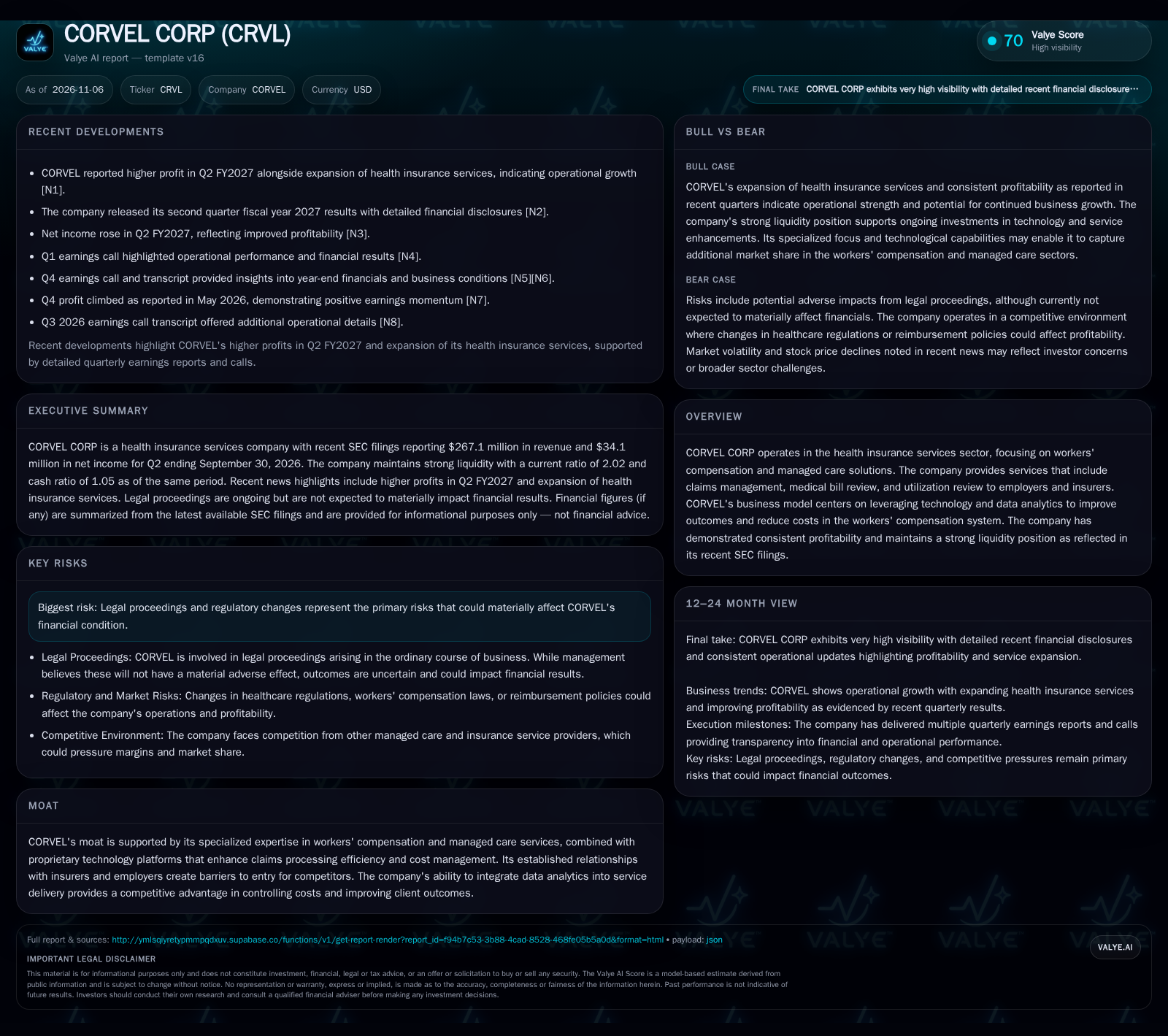
CorVel Corp’s Q2 FY2027 results underscore the company’s sustained profitability and operational expansion, particularly in its health insurance services segment. With $267.1 million in revenue and $34.1 million in net income for the quarter, CorVel demonstrates both scale and discipline in a complex, regulated sector. However, future outperformance will depend on CorVel’s ability to deepen its market position and adapt to evolving regulatory and competitive landscapes. The next phase will test whether its technology infrastructure can deliver durable margin and share gains.
Recent Profit Gains and Service Expansion Define CorVel’s 2026-2027 Trajectory
CorVel reported $267.1 million in revenue and $34.1 million in net income for the quarter ended September 30, 2026, marking a period of improved profitability and operational momentum [S2] [N1] [N3]. The company reported cash and liquidity metrics for the period; these figures do not by themselves establish operating runway, investment capacity, financial flexibility, or financing capacity. [N1] Legal proceedings persist but are not currently expected to materially impact performance. These developments collectively set the stage for CorVel’s next chapter, centered on scaling technology-enabled managed care in a competitive environment.
Beyond headline liquidity figures, a more nuanced understanding of CorVel’s potential financial flexibility would consider the composition and timing of cash flows from operations, capital expenditures, and financing activities. For instance, the conversion of accounts receivable and the predictability of claims-related cash inflows can materially affect the operating runway. Moreover, the company’s capacity to reallocate capital toward technology development or strategic initiatives hinges not only on current liquidity but also on the stability of cash generation amid potential sector cyclicality or regulatory shifts. Thus, a dynamic assessment of working capital management and free cash flow trends would deepen insight into CorVel’s investment capacity and financial resilience.
How Technology and Scale Shape CorVel’s Profit Engine
CorVel’s business model is built on providing outsourced claims management, medical bill review, and utilization review services—primarily to employers and insurers navigating the workers’ compensation system. The company’s economics hinge on processing large claim volumes efficiently, using proprietary technology platforms to reduce manual intervention and administrative costs. Revenue is typically transaction- or service-based, with margins influenced by the mix of technology-enabled versus labor-intensive activities.
The fixed-cost base includes investments in software, analytics infrastructure, and compliance, while variable costs scale with claims volume and service breadth. As the company expands technology-driven offerings, operating leverage may increase: incremental claims or new customers can be serviced at a lower marginal cost if platform utilization rises. However, the need for ongoing technology upgrades and compliance with evolving regulatory standards means capital expenditures and R&D are likely recurring features. Sustained margin expansion would require that automation and data analytics continue to offset wage inflation and regulatory compliance costs.
The scalability of CorVel’s technology platforms is a critical determinant of long-term margin sustainability. As transaction volumes increase, the incremental cost of servicing additional claims should ideally decline, reflecting economies of scale in data processing and automation. However, this benefit is conditional on maintaining system performance and data integrity, which may require periodic reinvestment in infrastructure and cybersecurity measures. Additionally, the balance between in-house technology development versus third-party software integration can influence cost structures and speed of innovation. The interplay of these factors shapes the company’s operating leverage and its ability to absorb wage inflation or regulatory compliance costs without eroding profitability.
Barriers, Counterforces, and the Race to Digitalize Claims Management
CorVel’s core advantage lies in its specialized expertise in workers’ compensation and managed care, reinforced by proprietary technology that streamlines claims processing and medical bill review. This creates switching frictions for clients, as moving to a new provider could entail process disruption, integration costs, and potential delays. Established relationships with insurers and employers further entrench CorVel’s position.
However, the sector is crowded with competitors ranging from national managed care organizations to niche technology vendors and business process outsourcers. Key counterforces include: (1) the potential commoditization of claims-processing software, (2) regulatory mandates that may open up or restrict service provision, and (3) the persistent risk of price competition as payors seek to reduce administrative expenses. Substitution risk also looms if insurers or large employers invest in their own technology or shift to alternative care management models.
The durability of CorVel’s moat depends on its ability to continuously enhance its technology stack and analytics capabilities—delivering measurable cost savings and outcomes for clients that are not easily replicated by rivals or in-house solutions.
The competitive landscape’s evolution will likely be influenced by the pace and direction of regulatory reforms, which can either raise barriers or lower entry thresholds for new providers. For example, if regulations mandate greater transparency or interoperability, this could commoditize certain software components but simultaneously create opportunities for providers who can integrate complex data streams effectively. Furthermore, client preferences for bundled versus specialized services may shift as employers and insurers reassess cost-benefit trade-offs. CorVel’s ability to anticipate these shifts and tailor its technology roadmap accordingly will be pivotal in sustaining differentiation. The company’s ongoing investment in predictive analytics and outcome-based metrics could serve as a moat if these capabilities translate into measurable improvements in claims outcomes and cost containment.
Tech-Led Efficiency Drives Share Gains and Margin Expansion
The most favorable outcome for CorVel centers on its technology investments yielding superior efficiency gains and demonstrable value for clients. If the expanded health insurance services translate into deeper customer relationships and higher wallet share, CorVel could grow faster than the underlying workers’ comp market.
Key confirming evidence would include: sustained revenue growth above sector averages; rising operating margins as technology leverages scale; and explicit disclosures of new, large client wins or multi-year contracts in managed care. A continued increase in net income, alongside flat or declining expense ratios, would also indicate that automation and analytics are driving durable margin improvement.
This scenario could be falsified if revenue growth stalls despite technology investments, if margins compress due to competitive pricing, or if customer churn rises—signaling that switching frictions and technology differentiation are weaker than anticipated.
Incremental Growth Anchored by Operational Discipline and Client Retention
The most plausible outcome is that CorVel continues to deliver steady, incremental growth through operational discipline and retention of its core client base. Expansion of health insurance services adds to the addressable market, but growth rates may moderate as the company encounters sectoral headwinds and mature client relationships.
Evidence supporting this scenario would include stable or modestly rising revenue and net income, maintenance of current margin levels, and continued investment in technology without step-changes in capital allocation. Customer retention rates (if disclosed) and renewal activity would signal that CorVel’s solutions remain valued, even as competition intensifies.
This scenario could be challenged if regulatory changes disrupt existing service lines, if cost inflation outpaces efficiency gains, or if competitors successfully undercut CorVel’s value proposition with next-generation digital platforms.
Regulatory Shifts, Legal Outcomes, and Eroding Competitive Edge
A negative trajectory would likely result if adverse regulatory changes or legal outcomes materially affect CorVel’s operations or cost structure. New state or federal mandates could increase compliance costs, restrict service fees, or require changes to claims management protocols. Unfavorable legal judgments, while not currently expected, could also impact potential financial flexibility [S2].
Competitive pressures could accelerate, particularly if major insurers insource claims management or if disruptive technology entrants commoditize key services. Margin compression would follow if CorVel is forced into price competition or if its technology differentiation erodes.
Early warning signs would include declining revenue or net income, rising legal or regulatory expenses, and explicit disclosures of lost contracts, major client churn, or adverse litigation outcomes.
Testing CorVel’s Value Proposition and Market Position: What Will Distinguish the Next Phase?
Quarterly revenue and net income growth trends, especially relative to sector benchmarks, will be crucial for gauging momentum.
Disclosure of new client wins, contract expansions, or renewal rates (if provided) would help assess the stickiness of CorVel’s relationships.
Operating margin trajectory: sustained or expanding margins would suggest successful technology leverage; compression could indicate competitive or cost pressure.
Capital expenditures and R&D investment levels will signal whether CorVel is maintaining the pace of technology innovation needed to differentiate.
Any regulatory changes or updates on legal proceedings that affect the company’s service model or cost base should be monitored.
Customer churn or retention rates, if disclosed, would clarify whether switching frictions and value delivery remain effective.
Updates on the mix and penetration of expanded health insurance services could provide insight into CorVel’s cross-selling and wallet-share gains.
Disclaimer: This is research-only, informational analysis and not investment advice. It may include AI-generated interpretation and general industry context. Always verify important details using primary sources.

Comments