
Blueport Acquisition Ltd: Merger Execution, Redemption Risk, and the Realities of SPAC Economics
Blueport Acquisition Ltd’s pending merger with SingAuto Inc moves it beyond the blank-check stage, but a tight regulatory clock and a stressed balance sheet sharpen the stakes. Success now hinges on deal closure, redemption dynamics, and the ability to transition from SPAC to viable operating company.
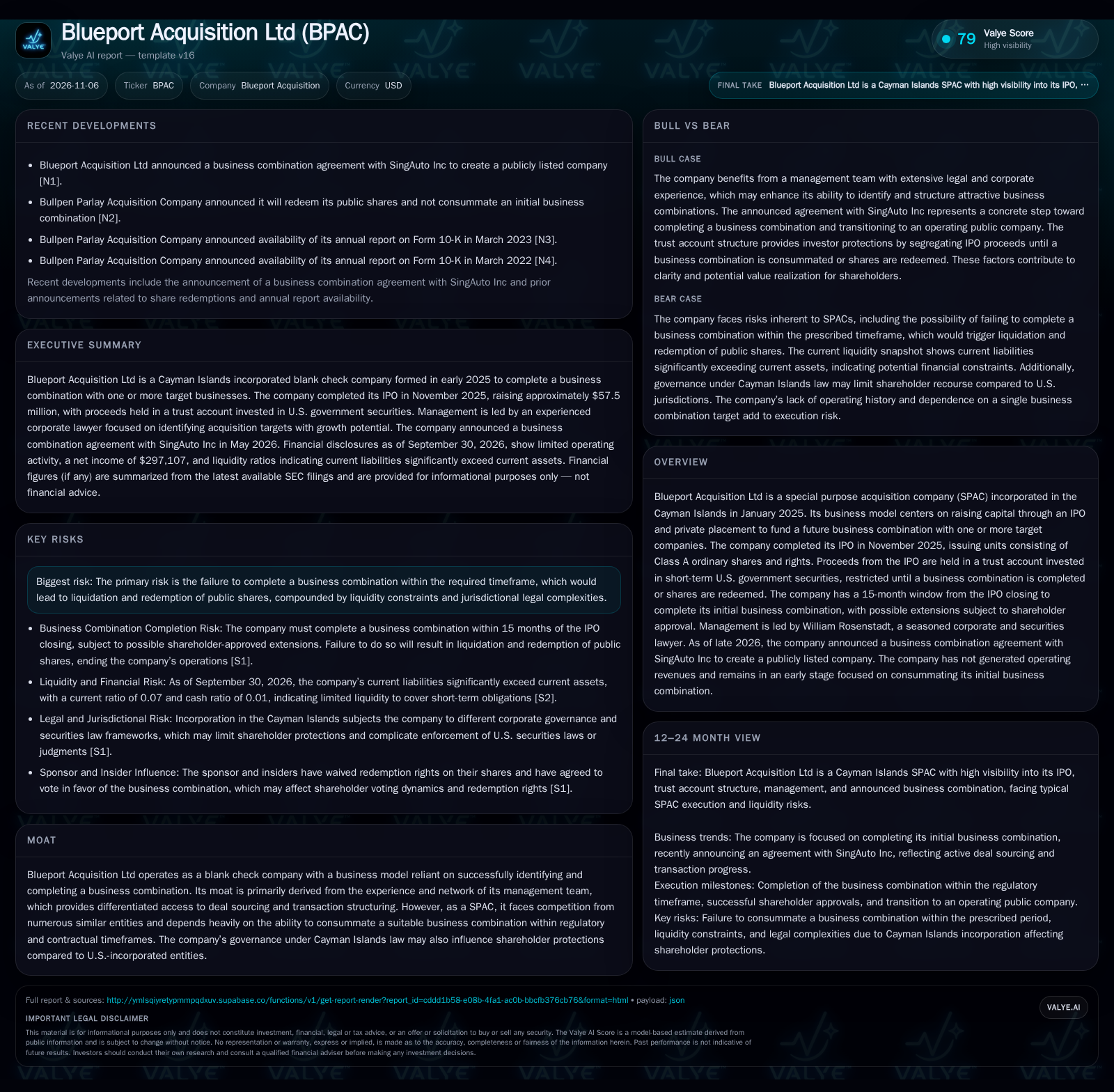
Blueport Acquisition Ltd (BPAC) is a Cayman Islands SPAC that has announced a merger with SingAuto Inc, aiming to create a publicly traded operating company. With a 15-month deadline from IPO to close the deal, BPAC faces significant execution and redemption risks, especially as its current liabilities far exceed current assets. The outcome will depend on shareholder support, redemption rates, and the viability of the SingAuto transaction in delivering long-term value.
Blueport Acquisition Ltd, a Cayman Islands-incorporated SPAC, stands at a critical juncture following its announced business combination with SingAuto Inc. With the regulatory window for closing narrowing and a balance sheet that highlights acute short-term constraints, the next several months will determine whether BPAC can successfully transition from a capital pool to an operating public company. The company’s future now depends on the smooth execution of its merger, the behavior of redeeming shareholders, and the ultimate viability of SingAuto as a public-market story.
From Capital Pool to Merger Target: Blueport’s Defining Moment
Blueport Acquisition Ltd has transitioned from SPAC formation to deal execution, announcing a business combination agreement with SingAuto Inc in May 2026 [N1]. This step is pivotal: it shifts BPAC from a capital-raising entity into the phase where value realization—and risk—are concentrated in a single transaction. As of September 30, 2026, BPAC reported $46.7 million in current assets and $4.68 million in cash, dwarfed by $664.7 million in current liabilities, resulting in a current ratio of 0.07 and a cash ratio of 0.01 [S2]. These figures do not reflect post-merger capitalization, but they do highlight the time-limited, event-driven nature of SPACs and the financial pressure to close a deal within the 15-month window following the November 2025 IPO [S1]. Public shareholders retain redemption rights, and the sponsor/insiders have waived theirs, setting up a dynamic where the ultimate net cash delivered to the merger is uncertain and contingent on redemption rates [S1].
SPAC Deal Mechanics: Economics, Leverage, and Redemption Sensitivity
The SPAC business model is defined by its capital-raising structure and the economics of the subsequent business combination. BPAC raised $57.5 million in gross IPO proceeds, with additional sponsor capital, all held in trust and invested in U.S. government securities until a deal closes or shares are redeemed [S1]. The economics hinge on the amount of cash remaining after shareholder redemptions, which can be highly variable—especially if public confidence in the target is weak or if market conditions deteriorate prior to merger close.
Fixed costs for BPAC are largely front-loaded (underwriting, legal, administrative), while operating leverage only materializes if a viable business is acquired and transitioned to a public company. In the interim, interest income on trust assets is minimal relative to potential operating costs post-combination. The company reported cash and liquidity metrics for the period; these figures do not by themselves establish operating runway, investment capacity, financial flexibility, or financing capacity. If redemption rates are significant, BPAC may need to secure additional financing—such as PIPEs, debt, or sponsor backstops—to meet minimum cash conditions or to support the operating business post-merger. This makes the economics highly sensitive to both market sentiment and deal execution.
SPAC Crowd Dynamics: Differentiation and Deal Sourcing in a Saturated Market
BPAC operates in a crowded SPAC universe, where hundreds of similar vehicles compete for attractive targets. The primary source of differentiation is management’s ability to source, negotiate, and close a high-quality business combination. BPAC’s leadership, centered on an experienced corporate and securities lawyer, may provide an edge in deal structuring and regulatory navigation [S1]. However, most SPACs offer similar financial terms and compete for the same pool of targets—especially in hot sectors like mobility, technology, or sustainability.
The announced merger with SingAuto Inc offers a path to public-market access for that company, but also exposes BPAC to the risk that the target’s business fundamentals may not meet public-market expectations. Substitutes for BPAC’s offering are abundant: other SPACs, direct listings, and traditional IPOs all vie for the same cohort of growth companies. The success of the transaction will depend on the perceived quality of SingAuto, the structure of the merger, and the ability to minimize dilution and maximize post-close capital. The SPAC’s Cayman Islands domicile may also affect investor perceptions and U.S. shareholder protections, although this is a common structure in the sector.
Unlocking Value: What a Successful SingAuto Merger Could Deliver
If BPAC closes the SingAuto merger with low redemption rates and sufficient cash delivered into the combined entity, the resulting public company could benefit from a clean capital structure and growth capital to execute its business plan. The best-case scenario would see strong market support for SingAuto’s story, leading to limited redemptions, possibly additional PIPE investment, and a smooth transition to public trading.
Confirmation of this scenario would include: robust pre-close investor communication, evidence of PIPE or other strategic capital commitments, and a post-close share price that trades at or above the $10 trust value. Falsification would be signaled by high redemption rates, failure to secure additional capital, or the inability to meet minimum cash conditions required by the merger agreement. If the merged entity trades poorly or is forced to restructure the deal, the upside thesis would be undermined.
Navigating the Middle Ground: Typical SPAC Outcomes and Execution Dependencies
The most plausible outcome for BPAC is completion of the SingAuto transaction, but with moderate to high public shareholder redemptions—reflecting typical SPAC market dynamics in periods of uncertainty or tepid investor enthusiasm. In this scenario, the merged company proceeds to public trading with reduced net cash, possibly relying on sponsor backstops or secondary capital sources to meet closing conditions.
This path would be confirmed by transaction close within the regulatory window, compliance with minimum cash conditions (even if aided by backstops), and the successful listing of the combined company. Evidence against this scenario would include failure to meet closing conditions, inability to secure extension votes if needed, or a breakdown in the merger agreement due to market or regulatory hurdles. The post-close performance would likely be muted, with valuation and liquidity reflecting both the quality of SingAuto and the realities of a drawn-down trust account.
Deal Failure, Liquidation, and Shareholder Recourse
The adverse scenario materializes if BPAC fails to close the SingAuto merger—either due to excessive redemptions, inability to secure required approvals, or unforeseen legal and regulatory obstacles. In that case, the SPAC would be forced to liquidate and redeem public shares, returning the bulk of trust proceeds to shareholders and effectively ending the company’s existence in its current form.
Confirmation of this downside would include: public announcements of failed shareholder votes, inability to meet minimum cash conditions, or expiration of the 15-month window without a completed deal (unless an extension is secured). In such a scenario, public shareholders would receive their trust value (minus any permitted deductions), while sponsors would lose their upfront investment. The company’s Cayman Islands jurisdiction may also complicate recourse for U.S. investors, particularly regarding any potential claims or disputes arising from the liquidation process.
Milestones and Metrics That Will Define BPAC’s Transition
Actual public shareholder redemption rates at the time of the SingAuto merger closing—this will determine the net cash delivered to the combined entity and is a leading indicator of deal viability.
Any PIPE investments, backstop agreements, or strategic capital raises disclosed prior to merger close—a useful metric would be the aggregate additional capital secured to offset redemptions, if disclosed.
Shareholder vote outcomes on the business combination and any required extensions—timely approval is essential given the regulatory window.
Minimum cash condition compliance at merger close—confirmation that the combined company meets its contractual funding thresholds.
Post-close trading price of the combined entity relative to the $10 trust value—persistent discounting could signal market skepticism or structural issues.
Material legal, regulatory, or tax developments relating to the Cayman Islands structure—would help test the thesis around jurisdictional risk.
Sponsor and insider actions in the run-up to close—such as additional capital commitments or waivers—would clarify alignment and risk appetite.
Disclaimer: This is research-only, informational analysis and not investment advice. It may include AI-generated interpretation and general industry context. Always verify important details using primary sources.

Comments