
Red River Bancshares: Margin Expansion, Regional Depth, and the Next Stage of Franchise Growth
Red River Bancshares has delivered record profitability and margin expansion through 2025–2026, leveraging its Louisiana-focused franchise and relationship-driven model. As it enters a new growth phase with digital upgrades and market expansion, the challenge will be sustaining earnings momentum amid regional concentration, evolving competition, and interest rate dynamics.
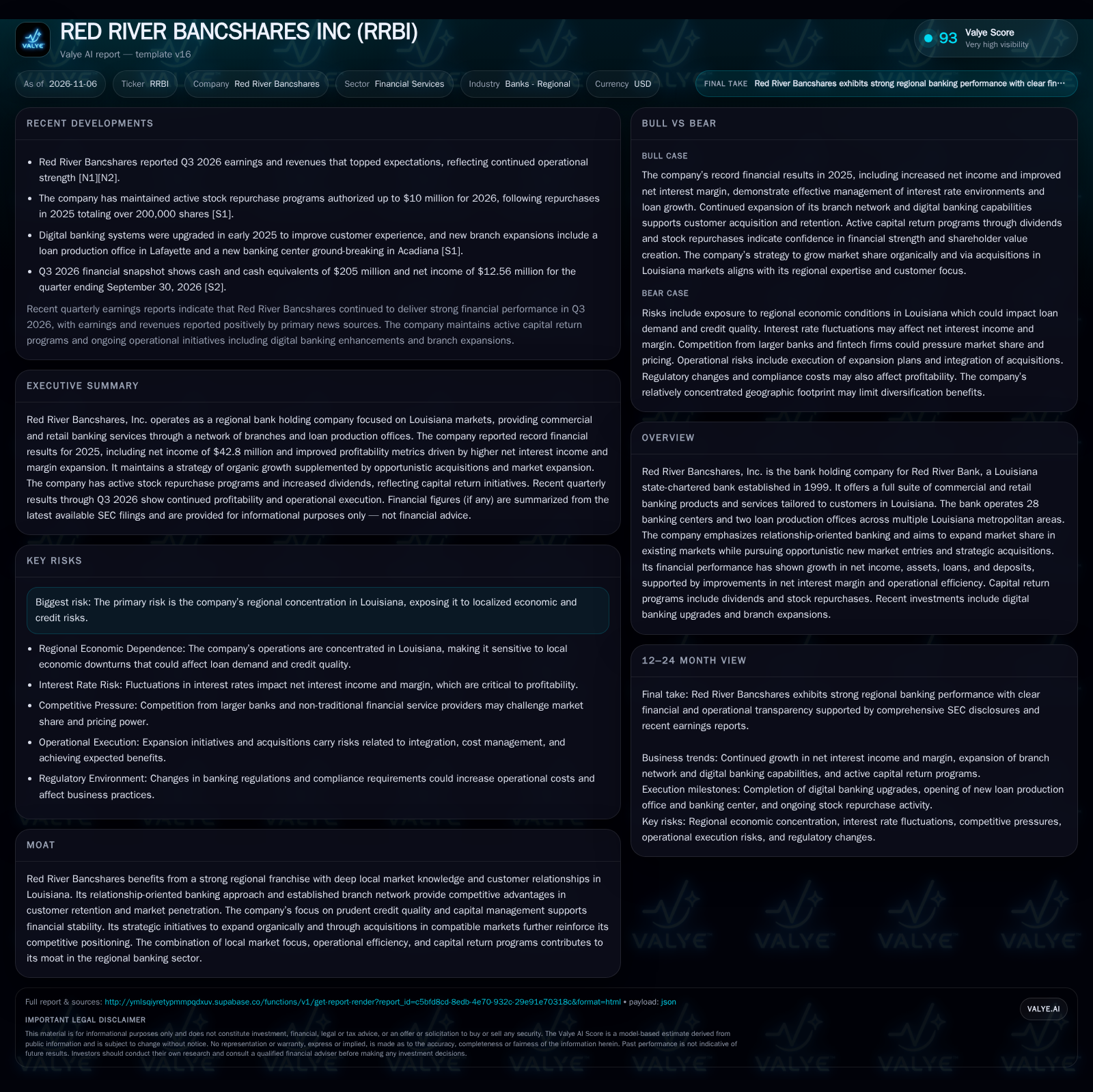
Red River Bancshares posted record net income and improved margins in 2025, driven by higher net interest income and disciplined deposit cost management. The company continues to expand its Louisiana footprint with new branches and digital banking upgrades, while returning capital via dividends and buybacks. The next phase hinges on balancing growth ambitions against regional risks and competitive pressures in a changing rate environment. [S1] [S2] [N1] [N2]
Red River Bancshares has emerged from 2025–2026 with a strengthened earnings profile and regional franchise, reporting record net income, improved asset quality, and proactive capital return. The bank’s focus on relationship-driven commercial and retail banking in Louisiana has underpinned loan and deposit growth, while digital initiatives and branch expansion point to a deliberate next phase of franchise building. However, with economic fortunes tied to a single state and the specter of rate volatility and rising competition, the question is whether Red River can sustain—and translate—recent margin gains into long-term outperformance.
Record Profitability, Margin Expansion, and Network Growth Define Recent Performance
Red River Bancshares reported record net income of $42.8 million in 2025, a 24.9% increase over the prior year. This growth was driven primarily by an 18.2% increase in net interest income, supported by a 42 basis point rise in net interest margin (to 3.38%). Asset quality remained robust, with nonperforming assets at just 0.11% of assets, and the provision for credit losses rising only modestly to $2.3 million, reflecting healthy loan growth rather than stress. The company expanded loans held for investment by 8.4% to $2.25 billion and grew total assets by 6.4% to $3.35 billion, fueled by a $158.3 million increase in deposits. On the operational front, Red River opened a new loan production office in Lafayette and broke ground on a new banking center in Acadiana, while also completing digital banking upgrades. Capital return was active, with a 50% increase in dividends and over 200,000 shares repurchased in 2025, plus a new $10 million buyback authorization for 2026 [S1] [S2] [N1] [N2].
How Relationship Banking and Deposit Discipline Drive Earnings Power
Red River’s core earnings are anchored in traditional spread banking, where profitability hinges on the difference between interest earned on loans and securities and interest paid on deposits and borrowings. The 2025 margin expansion suggests disciplined deposit pricing and a favorable loan mix, possibly reflecting a stable, loyal customer base less prone to rate-shopping than in more commoditized markets. Operating leverage is achievable if branch network expansion and digital investments yield incremental deposit and loan growth without proportionate increases in overhead.
Deposit growth remains a critical funding pillar, especially as rising rates and fintech competition could pressure deposit costs and retention. The ability to maintain a low-cost deposit base—often a function of strong local relationships and service differentiation—directly supports margin resilience and capitalizes on asset growth. The bank’s active capital return (dividends and buybacks) signals a confidence in future capital generation, but it also raises the bar for sustainable profitability and prudent risk management in the face of potential credit or funding shocks.
Digital banking upgrades may improve operating efficiency and customer acquisition, but the return on these investments will depend on the bank’s success in driving digital engagement and defending its franchise against larger regional and national banks with more advanced platforms. If expansion into new Louisiana markets proves accretive, this could provide further operating leverage and revenue diversification.
Regional Franchise Strengths and the Looming Threat from Larger Banks and Digital Entrants
Red River’s competitive edge lies in its deep local market knowledge, established relationships, and physical presence in core Louisiana markets. This relationship-driven strategy can yield stickier deposits and differentiated credit underwriting, helping insulate the bank from purely price-based competition. However, the Louisiana banking landscape is not immune to encroachment by larger super-regionals, national banks, and digitally native challengers, all of whom can compete aggressively for both commercial and retail customers.
The bank’s ability to grow organically and via selective acquisitions may depend on its reputation for reliable execution, integration skill, and cultural fit within Louisiana communities. However, geographic concentration remains a double-edged sword: while it enables regional dominance and brand loyalty, it also exposes the company to local economic shocks (such as commodity price swings or industry-specific downturns) and limits diversification benefits.
Emerging fintechs and digital-only banks, while not yet dominant in rural or relationship-driven commercial banking, could gradually erode Red River’s cost advantages or customer stickiness if digital investments lag market expectations. The company’s moat is thus predicated on continually refreshing its service model and digital infrastructure, while leveraging its local presence to fend off commoditization.
Margin Gains Compound with Successful Market Expansion and Tech Adoption
If Red River can leverage its digital banking upgrades and new branch openings to accelerate deposit and loan growth, while maintaining disciplined underwriting and deposit costs, then net interest income and margins could continue to expand. The combination of strong local relationships, enhanced customer experience, and targeted market entries may allow the bank to gain share from less nimble incumbents and defend against digital-only challengers.
Evidence for this scenario would include sustained growth in non-maturity deposits, further increases in net interest margin, and an expanding loan book without a commensurate rise in credit costs. Additional signals would be positive market response to new locations, high digital engagement metrics (if disclosed), and continued low levels of nonperforming assets. If capital return is maintained without sacrificing capital adequacy, it would reinforce the thesis that the franchise is generating durable excess returns.
Earnings Stability as Expansion Balances Out Regional Risks
The most plausible outcome is for Red River to maintain modest loan and deposit growth in its core Louisiana footprint, with net interest margins stabilizing as deposit costs gradually rise in a more competitive, higher-rate environment. Digital banking investments are likely to support retention and moderate new customer acquisition, but are unlikely to radically change the growth trajectory absent a major competitive misstep by larger banks.
In this scenario, credit quality remains strong, with nonperforming assets and charge-offs at or below regional peer averages. Capital return continues but at a measured pace, balancing growth investments and regulatory capital needs. The bank’s earnings trajectory tracks with regional economic conditions—solid but not immune to local shocks. Confirmation would come from quarterly financials showing steady margins, modestly rising noninterest income, and stable asset quality metrics.
Regional Stress or Rate Shocks Unravel Margin and Asset Quality Gains
Should Louisiana’s economy experience a downturn—be it from energy sector volatility, severe weather, or broader macro shocks—Red River’s concentrated loan book could see rising delinquencies and credit losses. This would force higher provisions, eroding earnings and potentially constraining capital return. Simultaneously, if larger banks or fintechs aggressively target deposits with higher rates or superior digital offerings, Red River could face upward pressure on funding costs, compressing net interest margin even as credit quality deteriorates.
Early warning signs for this scenario would include a meaningful uptick in nonperforming assets, a sharp increase in provision expense relative to loan growth, deposit outflows or rapid increases in deposit betas, and management commentary on competitive or economic headwinds. If digital investments fail to translate into customer growth or retention, the bank’s competitive position could weaken further, exacerbating margin and growth pressures.
Milestones and External Factors That Will Test Red River’s Franchise Durability
Sustained net interest margin above 3.3% would indicate continued pricing discipline and funding advantage in a competitive environment.
Loan growth outpacing deposit growth could point to tightening funding conditions or a need for external funding—monitor the loan-to-deposit ratio for signs of stress (if disclosed).
Nonperforming asset ratio remaining below 0.15% would confirm strong credit quality; a spike above peer averages would signal emerging credit risk.
Deposit cost trends—particularly the rate paid on interest-bearing deposits versus market benchmarks—would help assess the bank’s pricing power and retention.
Return on equity consistently above 12% would validate capital efficiency and earnings quality.
Progress on digital banking adoption and customer engagement (if disclosed) would illuminate the payback from recent tech investments.
Branch and loan production office productivity—such as deposit and loan growth per location—would clarify the ROI on expansion initiatives.
Evidence of successful integration or performance from new market entries (e.g., Lafayette, Acadiana) would support the growth thesis.
Disclaimer: This is research-only, informational analysis and not investment advice. It may include AI-generated interpretation and general industry context. Always verify important details using primary sources.

Comments