
Gran Tierra Energy’s $1.3 Billion Asset Sale: Strategic Reset or Liquidity Imperative?
The sale, which triggered a sharp stock rally, may reshape the company’s risk profile, capital structure, and future operating model, but leaves open questions about reserve replacement, ongoing cash needs, and the durability of its remaining Canadian operations.
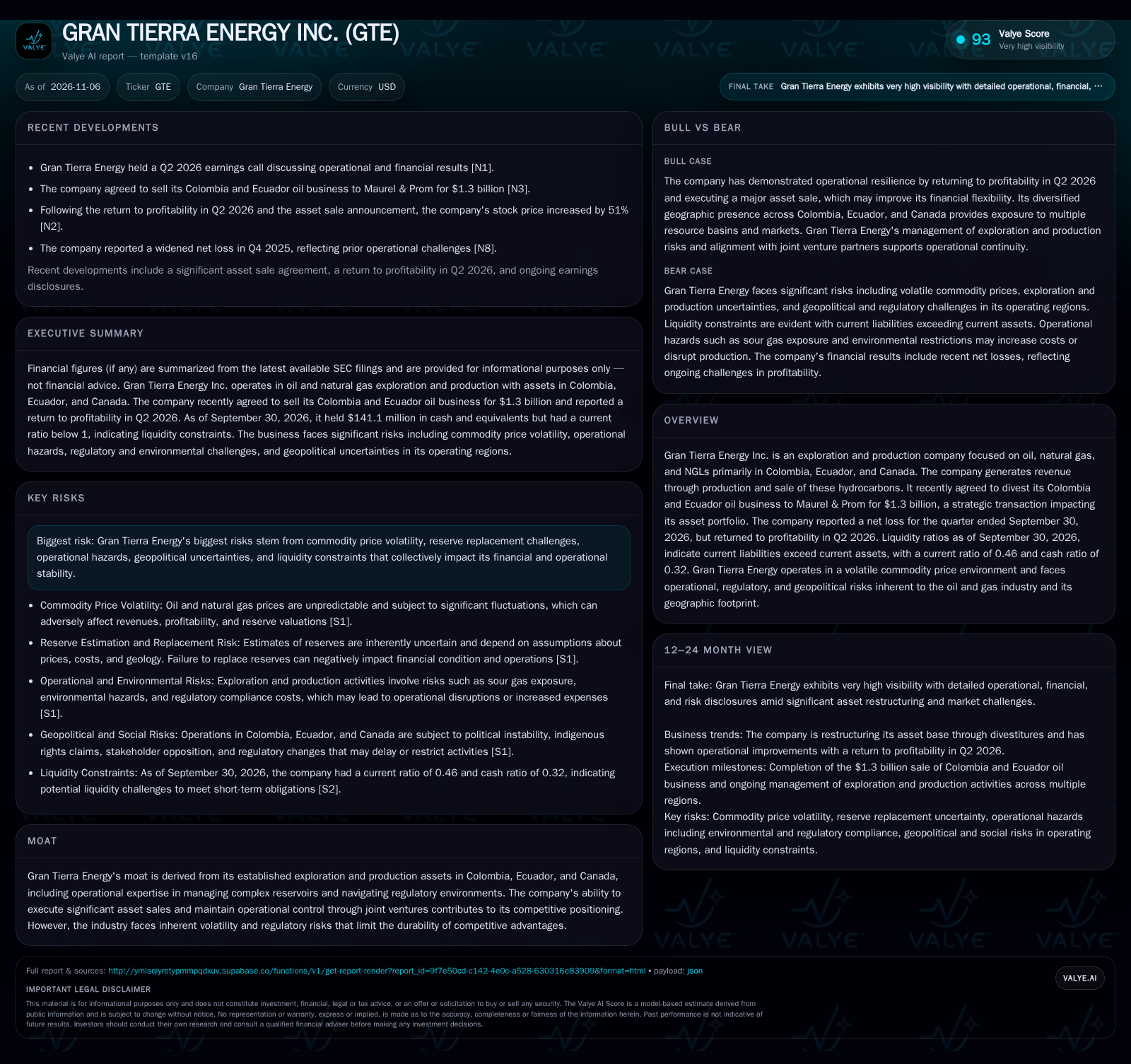
Gran Tierra Energy is selling its Colombia and Ecuador oil businesses for $1.3 billion after returning to profitability in Q2 2026, but still faces acute liquidity pressure and a challenging operating environment. The asset sale will significantly alter its production footprint and risk exposure, offering a potential cash infusion but raising new questions about strategic direction, reserve base, and sustainable earnings [N2] [N3] [S2].
Gran Tierra Energy is at a strategic crossroads after agreeing to sell its cornerstone Colombia and Ecuador oil businesses for $1.3 billion. The asset sale, which catalyzed a 51% surge in the company’s stock price, represents both a potential financial lifeline and a radical redefinition of Gran Tierra’s future—raising questions about how the company will deploy proceeds, what remains of its production base, and whether it can build a more resilient business model in the volatile oil and gas sector [N2] [N3] [S2].
Colombia and Ecuador Asset Divestiture Reshapes Gran Tierra’s Future
Gran Tierra Energy’s agreement to sell its Colombia and Ecuador oil business to Maurel & Prom for $1.3 billion is a defining event that will dramatically reshape its asset portfolio and operational footprint [N3]. The company reported cash and liquidity metrics for the period; these figures do not by themselves establish operating runway, investment capacity, financial flexibility, or financing capacity. [S2] Despite these constraints, the market responded positively: Gran Tierra’s stock price soared 51% after the sale announcement and Q2 results, implying investor optimism that the deal could address pressing liquidity and strategic challenges [N2]. The transaction will reduce the company’s exposure to Colombian and Ecuadorian regulatory and geopolitical risks but leaves uncertainty around the scale and sustainability of its ongoing operations.
Revenue Model, Cost Structure, and Post-Sale Capital Dynamics
Historically, Gran Tierra’s economics have relied on the exploration, development, and sale of crude oil, natural gas, and NGLs from a geographically diverse portfolio—primarily in Colombia and Ecuador, with additional assets in Canada. Revenue is fundamentally volume-driven, highly sensitive to fluctuations in global oil and gas prices, and exposed to local cost structures, royalty frameworks, and regulatory regimes. Fixed costs are significant due to field development, infrastructure, and compliance, but variable costs (operating expenses per barrel) can be flexed with production levels.
The $1.3 billion asset sale introduces a substantial potential cash inflow, but the company’s liquidity position—$141.1 million in cash and a current ratio of 0.46 as of September 30, 2026—signals acute short-term funding needs [S2]. The deal could enable Gran Tierra to reduce debt, fund new investments, or return capital to shareholders, but the economics of its remaining Canadian operations (including sour gas production in Alberta) may not fully offset the lost cash flow from its divested South American assets. Operating leverage could decline if the post-sale production base is smaller or less profitable, and the company’s ability to replace reserves and generate stable free cash flow becomes even more critical.
Shifting Competitive Landscape After Divestiture
By exiting Colombia and Ecuador, Gran Tierra will lose both scale and local expertise in two of its most important basins, potentially eroding its competitive advantages relative to regional and global E&P peers. The company’s historic moat—built on technical expertise, established reserves, and regulatory navigation in Latin America—will be diminished. Remaining operations, particularly in Canada, face different competitive pressures: the Canadian upstream market is mature, with larger integrated producers, high environmental standards, and cost competitiveness driven by scale, technology, and infrastructure access.
Gran Tierra’s future positioning may hinge on its ability to redeploy capital effectively, access new resource opportunities, and manage operational risks (such as sour gas, water availability, and stakeholder relations) in Canada. The loss of diversification could increase vulnerability to local shocks and commodity price swings. Without a clear growth platform or differentiated asset base, the company risks being marginalized among better-capitalized or more technologically advanced competitors.
How Strategic Reinvestment of Sale Proceeds Could Drive a Turnaround
If Gran Tierra successfully closes the $1.3 billion asset sale and strategically deploys proceeds—paying down debt, funding high-return Canadian projects, or acquiring new assets—it could engineer a financial and operational reset. A streamlined balance sheet, reduced leverage, and focused investment could position the company to capture value from niche Canadian resource plays or adjacent energy opportunities. The upside would be confirmed by evidence of debt reduction, new reserves added in Canada, and sustained positive earnings or free cash flow within the first 12-18 months post-sale.
Additional confirming signals would include a credible capital allocation plan, positive production and reserve replacement metrics in the remaining portfolio, and the establishment of new commercial partnerships or joint ventures in Canada. Falsification would occur if proceeds are consumed by legacy obligations or if post-sale operations fail to generate meaningful cash flow, leading to continued losses or further asset sales.
Post-Divestiture Restructuring and Operational Uncertainty
The most plausible outcome is that Gran Tierra closes the Colombia and Ecuador sale, uses a portion of proceeds to address immediate liquidity needs and reduce debt, and then faces a transitional period of operational and strategic uncertainty. The company will likely operate a smaller, Canada-focused portfolio with lower overall production and cash flow, requiring careful capital allocation to maintain reserve life and operational efficiency.
Support for this scenario would come from timely deal closure, reported debt paydown, and evidence that Canadian operations are at least breakeven. However, if cash burn persists or reserve replacement lags, the company may face pressure to further rationalize its asset base or consider strategic alternatives, including partnerships or additional divestitures. Confirmation would be quarterly updates showing stable or improved liquidity, neutral-to-positive margins, and concrete plans for replacing lost production.
Liquidity Strain, Reserve Attrition, and Strategic Drift
A negative scenario unfolds if the asset sale is delayed, fails to close, or proceeds are insufficient to stabilize the business. Without the Colombian and Ecuadorian cash flows, Gran Tierra’s liquidity could deteriorate further, forcing asset fire sales or dilutive financing. Operational hazards in Canada—such as sour gas incidents, water shortages, or regulatory setbacks—could exacerbate losses.
If the company cannot replace reserves or develop profitable new projects, its remaining asset base could rapidly deplete, leading to a downward spiral of shrinking production, negative cash flow, and eroding equity value. Confirmation of this scenario would include missed deal milestones, rising short-term liabilities, persistent net losses, and disclosure of asset impairments or adverse reserve revisions.
Milestones and Metrics That Will Shape Gran Tierra’s Next Chapter
Completion timeline and final terms of the Colombia/Ecuador asset sale to Maurel & Prom, including net cash proceeds received.
Use of sale proceeds: allocation between debt repayment, reinvestment in Canadian operations, and potential shareholder returns.
Quarterly production volumes, operating costs per barrel, and realized pricing from the remaining Canadian asset base—if disclosed.
Reserve replacement ratio and new reserve bookings in Canada post-divestiture—a key test of future sustainability.
Gross and net debt levels, interest expense, and overall balance sheet strength following the transaction.
Material operational or regulatory events in Canada, such as incidents, water resource developments, or new joint venture announcements.
Quarterly net income or free cash flow generation, indicating whether the new business model is self-sustaining or reliant on external funding.
Disclaimer: This is research-only, informational analysis and not investment advice. It may include AI-generated interpretation and general industry context. Always verify important details using primary sources.

Comments