
Abundia Global Impact Group: Waste-to-Fuels Ambitions Confront Funding, Execution, and Market Validation Hurdles
Abundia Global Impact Group is advancing waste-to-fuels pilot projects with notable engineering partners and has authorized a share repurchase program.
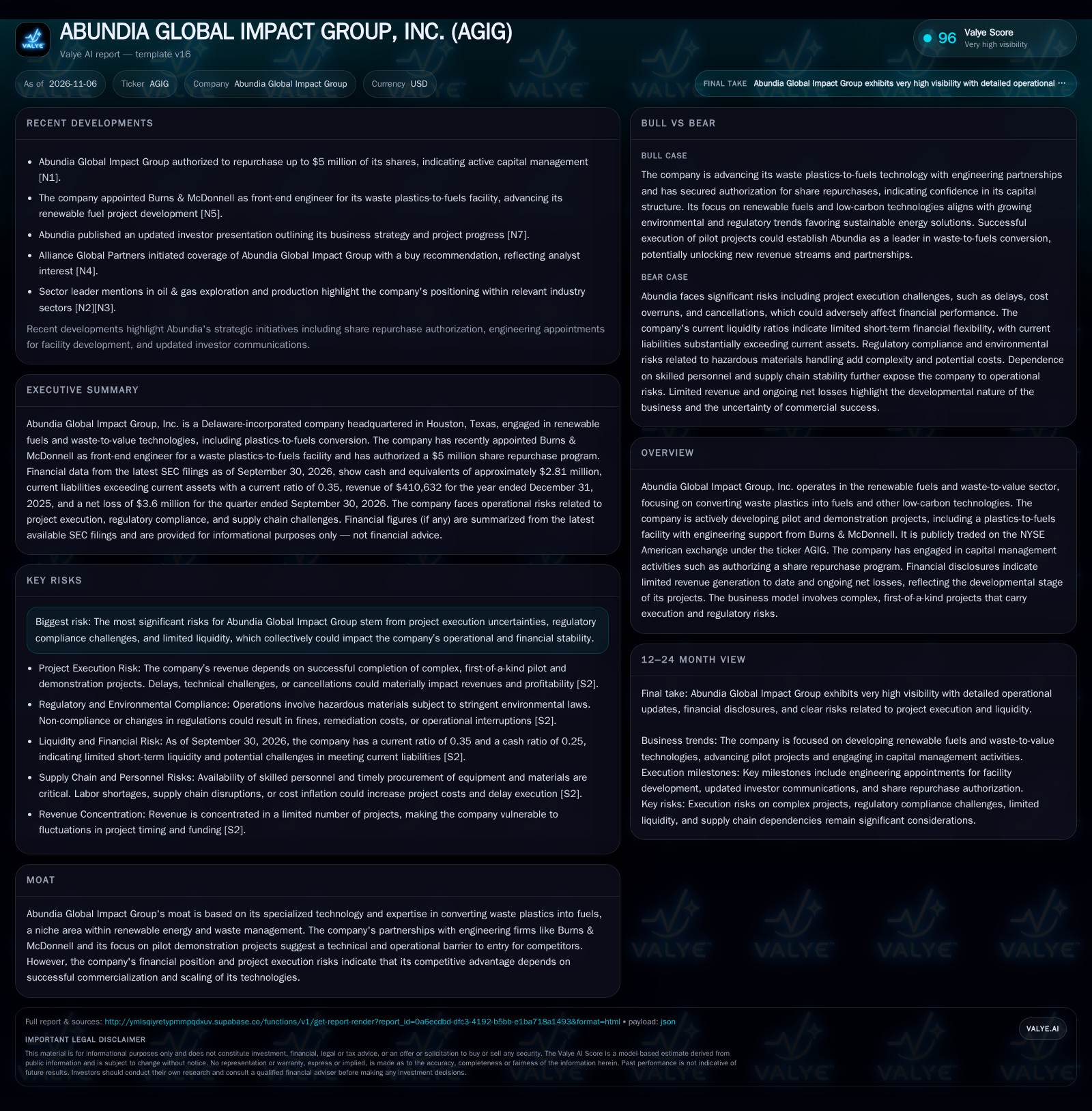
Abundia Global Impact Group is advancing waste-to-fuels pilot projects with notable engineering partners and has authorized a share repurchase program. The business model’s long-term viability hinges on successful project delivery, regulatory navigation, and the ability to scale from demonstration to commercial adoption in a competitive and capital-intensive sector. [S2] [N5] [N1]
Abundia Global Impact Group is positioning itself at the intersection of renewable fuels and waste-to-value innovation, with a particular emphasis on converting waste plastics into usable fuels. The company’s recent appointment of Burns & McDonnell as front-end engineer for its plastics-to-fuels facility signals technical progress, but its financial disclosures reveal a precarious liquidity position and persistent losses. As Abundia attempts to transition from pilot demonstrations to scalable commercial operations, its future will be shaped by its ability to navigate execution, funding, and regulatory headwinds in a capital-intensive and evolving industry landscape. [S2] [N5]
Recent Developments Highlight Technical Progress and Financial Strain
Abundia Global Impact Group has taken several notable steps in its bid to commercialize waste-to-fuels technology. The company appointed Burns & McDonnell as front-end engineer for its flagship plastics-to-fuels facility, indicating active project development and technical collaboration [N5]. On the capital management front, Abundia authorized a $5 million share repurchase program, which is an unusual move for a company with constrained liquidity [N1]. Financially, as of September 30, 2026, the company reported only $2.81 million in cash and equivalents against current liabilities of $11.24 million, resulting in a current ratio of 0.35 [S2]. Revenue for the year ended December 31, 2025, stood at $410,632, while the net loss for the most recent quarter was $3.6 million [S2]. These facts reinforce the reality that Abundia remains in a capital-intensive, pre-commercial phase, with limited revenue and high sensitivity to project timing and execution.
Project-Driven Economics and the Challenge of Scaling Waste-to-Fuels
Abundia’s business model relies on developing and eventually commercializing complex waste-to-fuels and renewable fuel projects. These projects typically require significant up-front capital for engineering, permitting, and construction, with long lead times before revenue realization. Fixed costs are high due to the need for specialized engineering, regulatory compliance, and facility buildout, while variable costs depend heavily on feedstock sourcing, labor, and operating efficiency.
The core economic opportunity lies in converting low- or negative-value waste plastics into higher-value synthetic fuels or chemical feedstocks, ideally capturing both tipping fees for waste intake and premium pricing for low-carbon fuels. However, success hinges on achieving reliable process yields, regulatory certification, and consistent product quality at scale. Until demonstration projects prove technical and economic viability, revenue is likely to remain lumpy and dependent on milestone payments or government incentives.
The company reported cash and liquidity metrics for the period; these figures do not by themselves establish operating runway, investment capacity, financial flexibility, or financing capacity. If projects face delays or overruns, additional capital raises may be necessary, potentially diluting existing shareholders or raising questions about long-term solvency.
Positioning in a Crowded and Technically Demanding Landscape
Abundia operates within a competitive ecosystem spanning traditional oil and gas, established waste management companies, and a growing cohort of renewable fuels and chemical upcyclers. Its focus on plastics-to-fuels positions it in a niche that demands both technical credibility and regulatory navigation—areas where partnerships with engineering heavyweights like Burns & McDonnell can confer some operational advantage [N5].
However, the competitive threat is multifaceted. Larger energy and chemical companies often have deeper capital reserves, established customer relationships, and vertically integrated operations that could enable them to scale similar technologies more quickly. At the same time, a wave of startups is targeting adjacent waste-to-value pathways, such as pyrolysis, gasification, and advanced recycling, often with aggressive claims of yield, cost, or carbon advantages.
Abundia’s moat, if it emerges, would likely derive from proprietary process know-how, successful demonstration of technical reliability, and the ability to secure long-term feedstock and off-take agreements. The company’s current financial position, however, limits its ability to absorb setbacks or scale aggressively, leaving it vulnerable to both execution missteps and competitive leapfrogging.
Commercial Breakthrough Could Unlock Scale and Strategic Partnerships
The most favorable scenario for Abundia would see it successfully complete its plastics-to-fuels demonstration facility on time and on budget, proving technical viability and achieving regulatory certification. If the process delivers reliable yields and product quality, the company could secure long-term feedstock supply contracts and off-take agreements for its fuels, supporting recurring revenue streams and improved margins.
A commercial breakthrough could attract strategic partners or acquirers from the energy, waste management, or specialty chemical sectors, enabling Abundia to scale through joint ventures or licensing. Confirmation of this scenario would come from public announcements of successful demonstration results, signed commercial contracts, expanded project pipelines, and positive cash flow from operations. Further evidence would include additional analyst coverage or capital raises on favorable terms, indicating growing market confidence.
Demonstration Progress, Ongoing Funding Needs, and Incremental Revenue
The most plausible medium-term path for Abundia involves incremental progress on its demonstration projects, with periodic technical milestones but continued reliance on external funding. Revenue may remain modest and concentrated in a few projects, as the company works through technical, regulatory, and supply chain hurdles inherent in scaling first-of-a-kind facilities.
The company would likely need to raise additional equity or secure grants to fund ongoing operations and capital expenditures, especially if project timelines slip or costs escalate. Confirmation would include continued financial disclosures showing negative cash flow and net losses, new capital raises or grant awards, and updates on project progress but without clear evidence of commercial scale adoption or recurring multi-year contracts.
Project Delays, Funding Shortfalls, and Erosion of Strategic Options
If external funding dries up or is only available at punitive terms, the company could be forced to curtail operations, shelve projects, or relinquish intellectual property. Confirmation of this scenario would come from announcements of project cancellations, significant layoffs, covenant breaches, or auditor going-concern warnings in financial filings. A spike in accounts payable or a deterioration in supplier relationships could also signal mounting distress.
Milestones and External Factors That Will Shape Abundia’s Next Chapter
Progress updates on the plastics-to-fuels demonstration facility, including achievement of engineering, construction, and commissioning milestones, would be critical to gauge technical and execution risk.
Disclosure of new or expanded feedstock supply agreements, off-take contracts, or strategic partnerships would help validate commercial demand and revenue visibility.
Trends in quarterly cash flow from operations, capital expenditures, and the structure and terms of any new capital raises would clarify the company’s funding trajectory and dilution risk.
Evidence of regulatory approvals, environmental certifications, or successful audits would reduce compliance overhang and support project credibility.
If disclosed, project-level economics such as process yield, cost per ton of feedstock processed, and product pricing would provide insight into margin potential and scalability.
Any changes in the composition or turnover of key technical personnel or executive leadership could signal either operational progress or emerging challenges.
Developments in relevant policy (e.g., waste management mandates, renewable fuel standards) or competitive technology breakthroughs could alter the addressable market and competitive dynamics.
Disclaimer: This is research-only, informational analysis and not investment advice. It may include AI-generated interpretation and general industry context. Always verify important details using primary sources.

Comments