
Simon Property Group: Scale, Occupancy, and Strategic Acquisitions in the Evolving Retail Landscape
Simon Property Group leverages its vast, high-occupancy retail real estate portfolio and selective acquisitions to maintain earnings power, but faces persistent headwinds from shifting consumer behavior, joint venture complexity, and the evolving nature of physical retail.
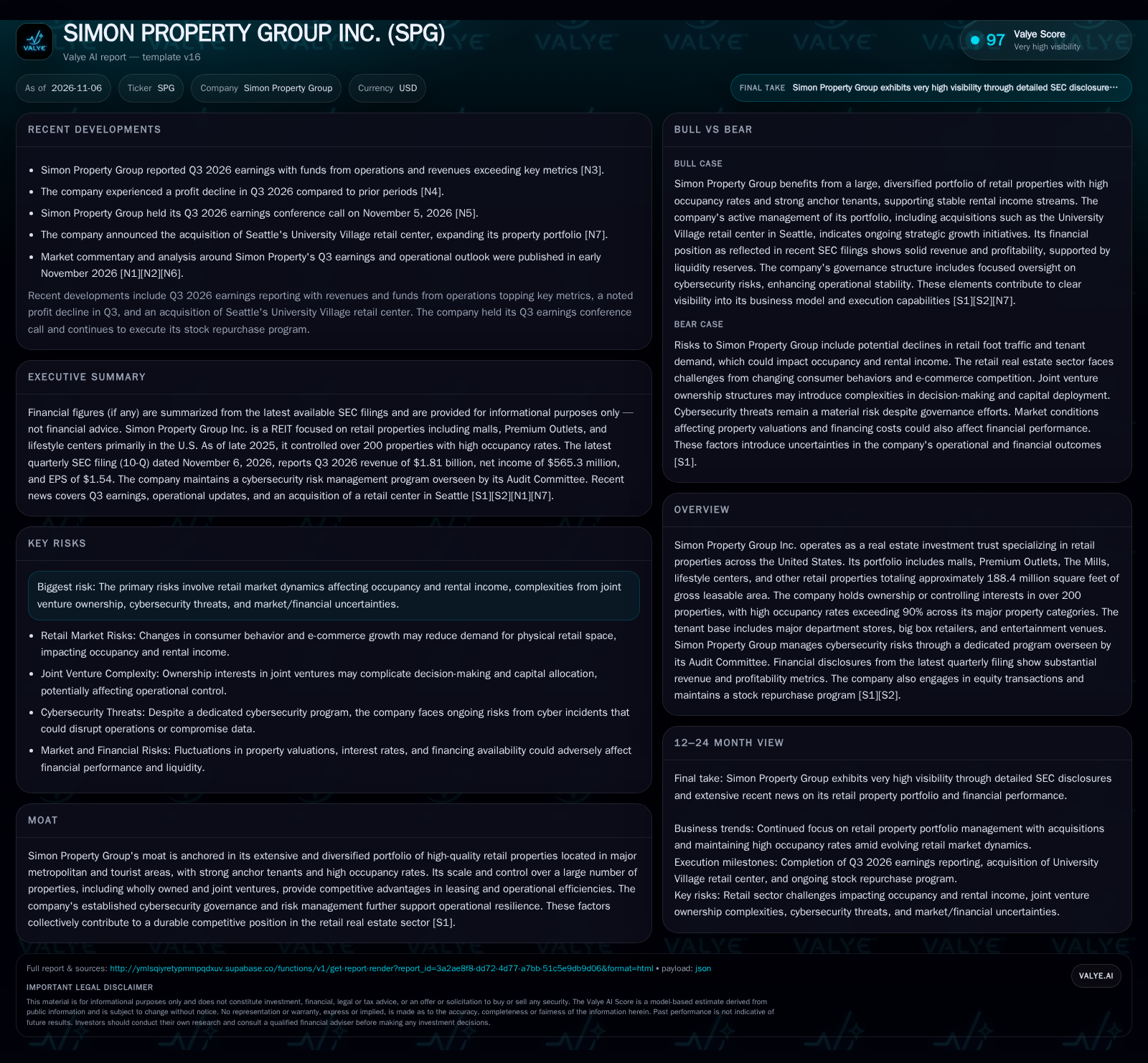
Simon Property Group (SPG) remains one of the largest and most diversified retail REITs in the U.S., with over 200 properties and consistently high occupancy rates. Recent acquisitions, including Seattle's University Village, reinforce a strategy focused on premium assets and operational scale. However, profit declines in Q3 2026 highlight ongoing sector challenges, particularly from e-commerce and structural changes in retail demand. [S1] [S2] [N4] [N7]
Simon Property Group stands as a bellwether for the U.S. retail real estate sector, commanding a vast portfolio of malls, outlets, and lifestyle centers in prime locations. Its high occupancy rates and anchor tenant relationships provide meaningful revenue visibility, while recent acquisitions show a willingness to double down on premium assets. Yet, as Q3 2026 profit softness demonstrates, even the largest players are not immune to the relentless pressures of e-commerce, shifting consumer patterns, and the intricacies of joint venture management. The company's next phase will hinge on its ability to both defend its core economics and evolve its asset base for a retail world in flux.
Recent Financials, Occupancy, and Portfolio Moves Shape the Current Landscape
Simon Property Group reported $1.81 billion in revenue and $565.3 million in net income for Q3 2026, with cash and equivalents at $569.9 million as of September 30, 2026 [S2]. These figures reflect the company's continued scale and operating leverage, though a year-over-year profit decline was noted for the quarter [N4]. Occupancy remains a core strength: as of December 31, 2025, malls and Premium Outlets were 96.4% leased, and The Mills properties reached 99.2% [S1]. The acquisition of Seattle's University Village retail center, announced in late October 2026, highlights ongoing strategic expansion into top-tier, high-traffic assets [N7]. The combination of high occupancy, acquisitive growth, and a strong anchor tenant roster underscores SPG's approach to defending and enhancing portfolio value in a shifting retail environment.
How Simon Property Group Generates and Defends Its Core Earnings Power
SPG’s economics are fundamentally driven by rental income from long-term leases with a diverse mix of retail tenants. Base rent and percentage rent (tied to tenant sales) form the bulk of revenues, while ancillary income streams—such as parking, advertising, and specialty leasing—provide incremental upside. The company’s large GLA base and high occupancy create significant operating leverage: fixed costs are spread across a wide asset base, so incremental lease-up or rent increases can disproportionately impact NOI.
Capital needs are significant: maintaining, repositioning, and acquiring properties requires ongoing investment, though much of SPG’s portfolio consists of stabilized, income-producing assets. The company’s partial ownership of many properties through joint ventures introduces both diversification and complexity—SPG must manage both its wholly owned and JV assets, sharing economics and decision rights with partners. This can dilute direct control but can also reduce capital at risk per property and enable larger aggregate scale.
Operating leverage is a double-edged sword. When occupancy is high and rents rise, margins expand. However, fixed costs and debt service remain substantial, so even modest declines in occupancy or tenant health can compress margins and threaten earnings. The company’s active stock repurchase program and periodic equity issuance reflect a balancing act between returning capital to shareholders and funding growth or maintenance capex [S2].
Scale, Asset Quality, and Anchor Tenants: Competitive Advantages and Sector Headwinds
SPG’s competitive edge lies in its scale, geographic reach, and concentration in high-quality, high-traffic locations. Its properties often feature strong anchor tenants—department stores, big box retailers, and entertainment venues—helping drive foot traffic and attract smaller tenants. This creates a virtuous cycle: strong anchors boost traffic and sales, which supports higher rents and occupancy.
However, the retail landscape is rapidly evolving. E-commerce and omnichannel retail have eroded the value proposition of undifferentiated mall properties, putting pressure on weaker centers and tenants. SPG’s diversified asset mix (malls, outlets, lifestyle centers) helps buffer these risks, but even top-tier properties face secular headwinds from changing consumer behavior. Category peers include other large retail REITs, private real estate funds, and, increasingly, alternative uses for retail real estate (e.g., mixed-use, logistics, or residential conversions).
The company’s joint venture model enables access to larger or more complex assets, but introduces governance and capital allocation challenges. Execution in this context requires both operational discipline and strategic flexibility to adapt to tenant churn, retail bankruptcies, and the changing demands of retailers seeking experiential or omnichannel footprints.
Premium Asset Focus and Adaptive Leasing Could Drive a Rebound in Earnings Quality
If Simon Property Group successfully leans into its premium asset base—acquiring or repositioning properties like University Village to attract experiential, omnichannel, and luxury tenants—it could stabilize and even grow rental income despite sector headwinds. High occupancy and anchor tenant retention would enable continued pricing power, while adaptive leasing (shorter terms, flexible spaces, pop-ups) could fill gaps left by traditional retailers.
A favorable scenario would see foot traffic and tenant sales rebound in the wake of broader retail sector adaptation, with SPG benefiting from its ability to invest in property enhancements and placemaking. This would likely be confirmed by sustained or rising occupancy rates, positive same-property NOI growth, and new leases with digitally native or experiential brands. Additional evidence would include reduced tenant bankruptcies, improved rent collections, and a narrowing of the gap between in-place and market rents.
Defensive Scale and Incremental Portfolio Shifts in a Maturing Retail Real Estate Cycle
The most plausible path for SPG is a gradual evolution of its portfolio: maintaining high occupancy through aggressive tenant management, opportunistic acquisitions, and selective redevelopment of underperforming assets. Revenue growth is likely to be modest, reflecting a balance between rent renewals, new leasing, and ongoing tenant churn. Operating margins may remain stable but show little expansion, as gains from scale are offset by higher costs of tenant incentives, capex, and property upgrades.
This scenario would be confirmed by steady, though not accelerating, NOI and FFO per share, continued high occupancy (above 95%), and a manageable pace of tenant turnover. Evidence of incremental adaptation—such as new lease structures, mixed-use redevelopments, or successful repositioning of challenged assets—would also support this base case. Conversely, a persistent rise in vacancy or a wave of anchor tenant closures would challenge the sustainability of current earnings.
Structural Retail Weakness, Tenant Failures, and Joint Venture Frictions Pressure Results
A more adverse outcome could materialize if retail sector pressures intensify: widespread tenant bankruptcies, anchor store closures, or a step-down in consumer foot traffic could drive higher vacancy, lower renewal rents, and increased capital requirements for repositioning or re-leasing space. Joint venture complexities could further hinder timely decision-making or capital deployment, especially if partners are less willing or able to invest in turnaround efforts.
This scenario would be confirmed by a sustained drop in occupancy below 93-94%, negative same-property NOI growth, and a spike in lease incentives or capital expenditures. Additional warning signs would include rising receivables or tenant delinquencies, asset impairments, and stalled or failed redevelopment projects. If disclosed, an uptick in property-level debt defaults or covenant breaches would further validate a downside trajectory.
Testing the Resilience of Simon’s Retail Real Estate Model: What Will Confirm or Challenge the Thesis?
Occupancy rates across malls, Premium Outlets, and The Mills—sustained levels above 95% would support the bull case; erosion below 93% would signal stress if disclosed.
Same-property net operating income (NOI) growth or decline—positive trends would indicate effective portfolio management and tenant demand.
Tenant sales per square foot, if disclosed, especially at recently acquired or redeveloped centers, would help gauge the health of anchor and specialty tenants.
Lease renewal spreads and new lease rates versus expiring rents—rising spreads would suggest pricing power and asset quality.
Tenant bankruptcy rates and rent collection percentages—an uptick would point to sectoral or company-specific vulnerability.
Capital expenditures and redevelopment returns—rising capex with weak incremental returns would challenge the economics of property repositioning.
Joint venture performance and partner investment appetite—deteriorating JV outcomes or partner disputes could impede portfolio agility.
Property-level debt metrics, if disclosed—rising leverage or covenant headroom would help test financial resilience amid sector volatility.
Disclaimer: This is research-only, informational analysis and not investment advice. It may include AI-generated interpretation and general industry context. Always verify important details using primary sources.

Comments