
Burke & Herbert Financial: Merger Integration, CRE Exposure, and the Community Banking Dilemma
Burke & Herbert Financial Services Corp. is navigating post-merger expansion, notable commercial real estate concentration, and intensifying competition as it leverages its community banking heritage across the Mid-Atlantic. The company's ability to manage credit risk and extract value from its expanded footprint will define its next chapter.
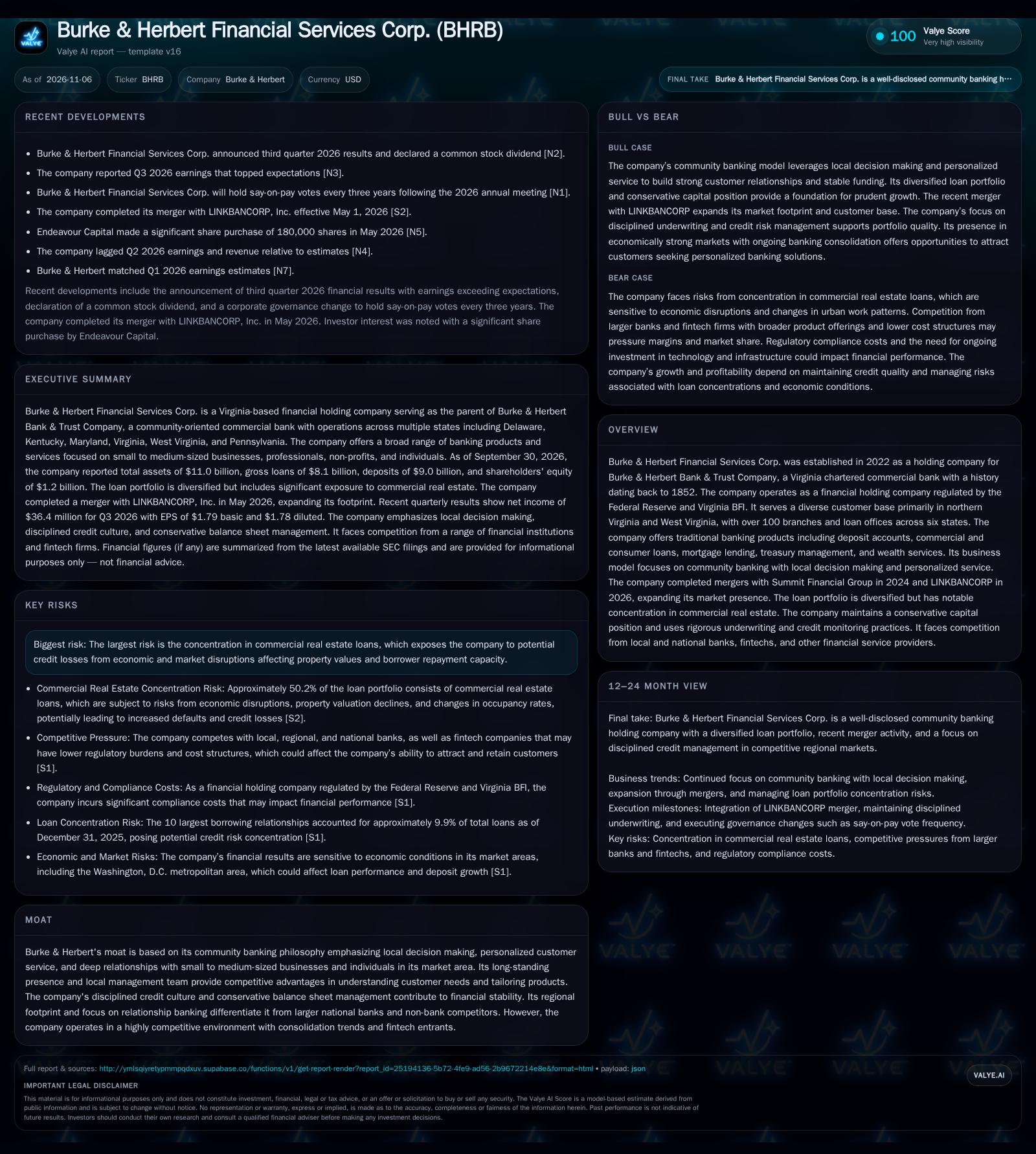
Burke & Herbert Financial Services Corp. has grown to $11.0 billion in assets, completing a merger with LINKBANCORP in 2026 and reporting strong Q3 earnings. The bank faces high commercial real estate (CRE) exposure, a diversified but concentrated loan book, and rising competition from both traditional banks and fintechs. Its future will hinge on credit quality management and successful integration of recent acquisitions as market pressures mount. [S2] [N3]
Burke & Herbert Financial Services Corp., an established community bank holding company, is at a strategic crossroads following rapid asset growth from its recent LINKBANCORP merger. With $11.0 billion in assets, a heavy tilt toward commercial real estate lending, and a strong Q3 2026 earnings beat, the company’s next phase will test its ability to manage credit concentrations and capitalize on its broadened geographic footprint. In an era of banking consolidation and digital disruption, Burke & Herbert’s core strengths in local decision-making and personalized service face new challenges from both macroeconomic pressures and evolving customer expectations. [S2] [N3]
Merger-Driven Expansion and CRE Concentration Shape the 2026 Backdrop
As of September 30, 2026, Burke & Herbert Financial Services Corp. reported $11.0 billion in total assets, $8.1 billion in gross loans, and $9.0 billion in deposits, following its completed merger with LINKBANCORP in May 2026. Shareholders' equity stood at $1.2 billion. The loan book remains heavily weighted toward commercial real estate (CRE), which makes up 50.2% of gross loans, while owner-occupied CRE adds another 14.6%. Net income for Q3 2026 was $36.4 million, with basic EPS of $1.79, both exceeding analyst expectations. This recent performance, coupled with a significant share purchase by Endeavour Capital, signals market confidence but also spotlights the company’s high CRE exposure and the operational demands of integrating a major acquisition. [S2] [N3] [N5]
How Burke & Herbert Earns: Spreads, Scale, and the Cost of Local Service
Burke & Herbert’s revenue engine is built on traditional banking economics: earning net interest income from the spread between loan yields and deposit/funding costs, supplemented by fee income from treasury, wealth, and trust services. The company reported cash and liquidity metrics for the period; these figures do not by themselves establish operating runway, investment capacity, financial flexibility, or financing capacity.
CRE lending, while typically higher-yielding than residential or consumer loans, introduces cyclical risk and can require higher capital reserves. The bank’s local decision-making model and high-touch service can help attract sticky deposits and defend pricing, but they also come with higher fixed costs per customer compared to digital-first peers. Operating leverage may improve as the enlarged footprint spreads overhead across a bigger customer base if integration is managed tightly. However, the risk remains that credit costs could spike if CRE market conditions deteriorate, eroding margin gains.
Capital needs are pronounced in a rising regulatory environment, especially given the concentration in risk-weighted assets like CRE. The company’s stated conservative capital and liquidity positions mitigate near-term solvency risk, but long-term growth depends on balancing prudent lending, cost discipline, and ongoing investment in technology and compliance. [S1] [S2]
Community Banking Strengths Tested by Scale Players and Digital Entrants
Burke & Herbert’s competitive identity is rooted in community banking: local decision-making, relationship-driven service, and deep ties to small businesses and professionals. In markets like the Washington, D.C. metro area—characterized by economic strength and ongoing banking consolidation—this approach can win loyalty and stable funding.
However, the competitive landscape is shifting. Regional and national banks offer broader product suites and technology-enabled convenience, while fintechs compete on speed, user experience, and sometimes lower costs. The company’s recent mergers have increased scale, but integrating diverse systems and cultures can dilute the edge of personalized service if not managed carefully.
The critical question is whether Burke & Herbert can maintain differentiation through customer intimacy and underwriting discipline, or if it will be forced to compete more on rate and digital convenience—areas where larger or nimbler players often set the pace. Its deep CRE expertise and local market knowledge may help defend share in certain segments but may not insulate against broader secular shifts in customer preferences or margin compression. [S1]
If Integration Delivers Synergies and CRE Outperforms, Value Could Compound
In the most favorable scenario, the LINKBANCORP merger yields anticipated cost and revenue synergies, leveraging the expanded branch network and customer base to deepen relationships and cross-sell products. If the CRE market remains stable or improves, credit costs stay contained, and the bank can safely grow its loan book into new and existing markets.
Confirmation would come from sustained above-peer loan growth without deterioration in asset quality, continued outperformance on EPS, and visible improvement in cost efficiency metrics post-merger. Evidence that cross-selling and deposit retention are improving in newly acquired markets would also support the upside thesis. If disclosed, a declining efficiency ratio and steady or improving net interest margin (NIM) would further validate the compounding effect of scale and integration.
Steady Returns Amid Integration, With CRE as a Persistent Wildcard
The most likely outcome is that Burke & Herbert achieves moderate post-merger growth and stable returns, but faces ongoing pressure from CRE concentration and competitive dynamics. Loan growth may track market averages, while deposit costs slowly rise as larger banks and fintechs compete more aggressively for funding. Credit quality remains solid but requires active management, especially in the CRE portfolio.
Confirmation would be continued quarterly earnings in line with expectations, no significant spike in non-performing loans, and stable capital ratios. Signs that integration is progressing—without major disruptions to customer relationships or branch operations—would support the base case. Any disclosed uptick in provisioning or signs of CRE stress would be early warning signals for deviation.
CRE Downturn or Integration Missteps Could Trigger Credit Losses and Margin Compression
A negative turn could be triggered by a downturn in commercial real estate—especially if urban work patterns or valuations shift further—leading to higher defaults and credit losses. Given that CRE makes up over half the loan book, even modest stress could quickly impact earnings and capital. Integration challenges, such as system incompatibility or cultural friction, could further erode efficiency and customer retention, amplifying the pain.
Confirmation would come from rising non-performing assets, increased charge-offs, and a spike in loan loss provisions. If the efficiency ratio worsens or customer attrition in acquired branches accelerates, the downside scenario would be in play. External signals such as local CRE market weakness or negative migration trends in core geographies would also be red flags.
Benchmarks That Will Reveal Whether Burke & Herbert Can Turn Scale into Durable Advantage
Quarterly trends in non-performing assets and charge-offs, especially within the CRE portfolio, as early indicators of credit quality shifts.
Efficiency ratio progression post-merger; a declining ratio would suggest successful integration and cost discipline.
Net interest margin (NIM) trends, particularly in relation to rising funding costs and competitive rate pressure.
Loan growth in new and legacy markets; above-peer growth without asset quality deterioration would support the expansion thesis.
Deposit mix and retention rates in newly acquired branches; customer attrition or increased reliance on high-cost funding would be a concern.
Disclosed provisioning levels and qualitative credit commentary, especially management’s outlook on CRE market segments.
Any disclosed cross-selling or fee income growth attributable to the expanded customer base, as evidence of revenue synergy realization.
External economic signals in core markets, such as CRE vacancy rates or regional employment trends, that could impact credit outcomes.
Disclaimer: This is research-only, informational analysis and not investment advice. It may include AI-generated interpretation and general industry context. Always verify important details using primary sources.

Comments