
Tanger Inc.: Portfolio Expansion, Occupancy Strength, and the Dynamics of Outlet Retail Economics
Tanger Inc.’s high-occupancy outlet and open-air retail centers anchor its REIT model, but the next phase hinges on balancing stable base rents, variable income tied to tenant sales, and disciplined capital deployment as retail competition intensifies and consumer preferences evolve.
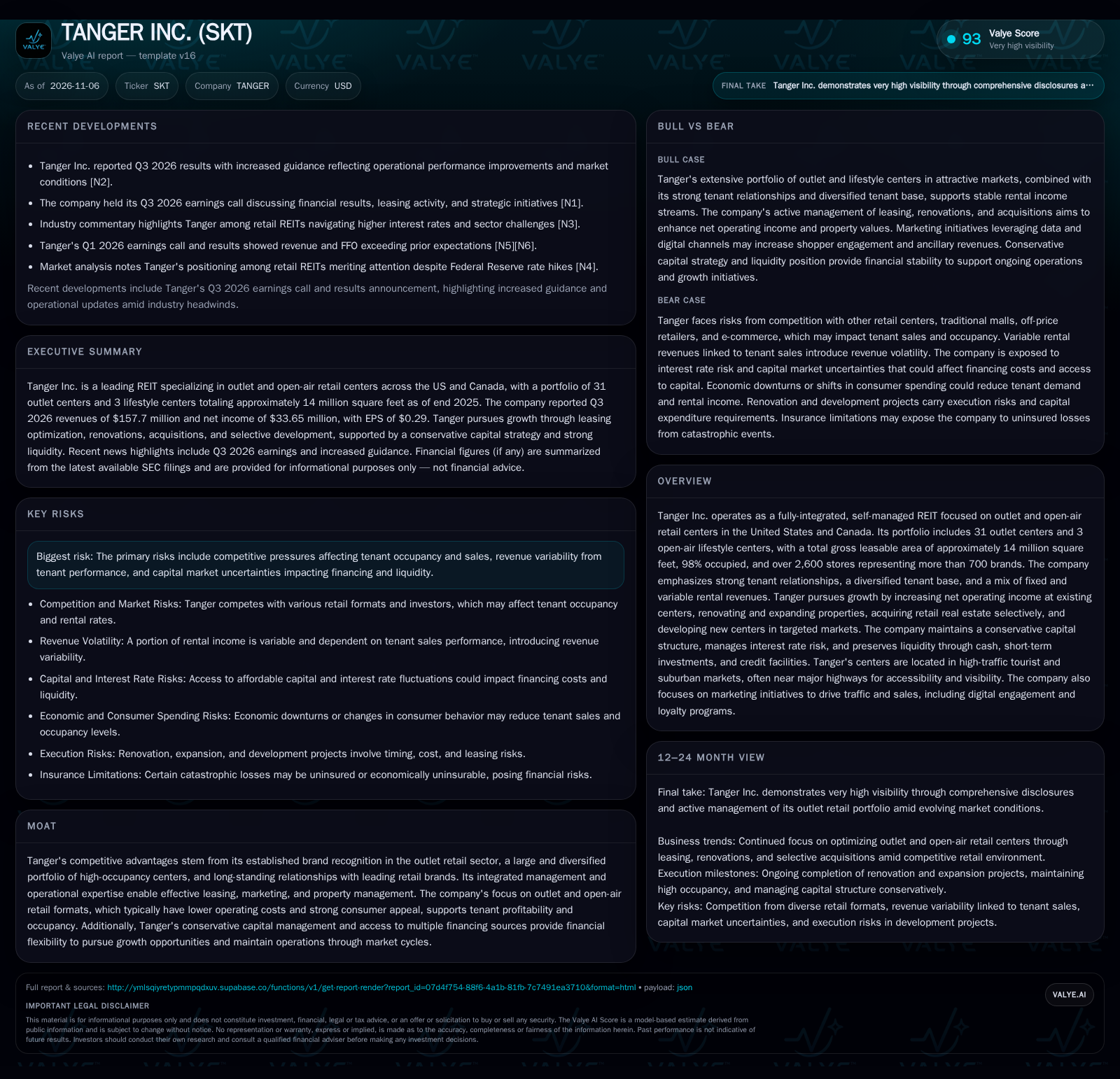
Tanger Inc. reported Q3 2026 revenues of $157.7 million, net income of $33.65 million, and maintains 98% occupancy across its 34 owned centers. Recent acquisitions of open-air lifestyle properties and increased earnings guidance reflect operational momentum, but exposure to variable rents, development risk, and retail-format competition remain central to the investment debate. The company’s ability to optimize its tenant mix, manage capital costs, and sustain high occupancy will determine whether its outlet-focused REIT model can deliver durable growth in a shifting retail landscape. [S2] [N2]
Tanger Inc., a leading REIT in the outlet and open-air retail sector, has maintained high occupancy and steady earnings through a period of retail industry flux. Recent acquisitions in growth markets and an increased earnings outlook underscore operational momentum, but the company’s reliance on both fixed and variable rental income, exposure to retail competition, and disciplined capital allocation remain pivotal. With over 2,600 stores and more than 700 brands across its portfolio, Tanger’s ability to adapt its tenant mix and marketing strategy will be critical as retail formats and consumer expectations evolve. [S2] [N2]
Operational Gains and Strategic Expansion Shape 2026 Snapshot
As of September 30, 2026, Tanger Inc. reported quarterly revenues of $157.7 million and net income of $33.65 million, with basic and diluted EPS of $0.29. The company’s portfolio includes 31 outlet centers and 3 open-air lifestyle centers totaling approximately 14 million square feet, maintaining a 98% occupancy rate across more than 2,600 stores and 700 brands. Recent acquisitions in Huntsville, Little Rock, and Cleveland illustrate Tanger’s commitment to diversifying its asset base and targeting growth markets. The company increased its earnings guidance following these results, citing improved operational performance and ongoing leasing activity. This context highlights Tanger’s momentum in both core operations and selective expansion, setting the stage for future growth but also raising questions about sustainable rent yields, tenant sales performance, and capital allocation discipline in a competitive retail environment. [S2] [N2]
How Tanger’s Revenue Model Blends Stability and Volatility
Tanger’s primary revenue streams are fixed base rents and variable components linked to tenant sales, supplemented by recoveries of property operating expenses. This hybrid structure provides a measure of income stability through long-term leases but also exposes the company to fluctuations in consumer spending and tenant performance. With occupancy at 98%, fixed rents form a relatively predictable foundation; however, as variable rents become more material—especially in strong retail environments or among high-performing tenants—Tanger’s top line becomes increasingly sensitive to macroeconomic and sector-specific trends.
Operating leverage is significant: incremental leasing or rent increases can flow disproportionately to net operating income (NOI) once fixed property costs are covered. Conversely, periods of declining tenant sales or increased vacancy can compress margins quickly. The company’s capital needs include recurring maintenance and renovation, upfront investment for acquisitions or expansions, and debt service. Tanger’s conservative capital strategy, evidenced by modest cash and short-term investments and a disciplined approach to leverage, aims to cushion against cyclical downturns and support ongoing distributions. The challenge is to balance growth investments with the need to maintain a resilient balance sheet, especially as competition for high-traffic centers in growth markets intensifies.
Defining Advantage: Outlet Brand, Tenant Mix, and Retail Format Realities
Tanger’s competitive stance draws on its established brand in the outlet sector, high-occupancy portfolio, and relationships with a broad array of national and international brands. Its centers are typically located in high-traffic tourist destinations and growing suburban areas, often with strong highway access. This geographic and tenant diversification mitigates risk from individual tenant failures, as no single tenant accounts for more than 7% of leased space or 6% of rental revenue.
However, the competitive landscape is evolving. Tanger faces pressure from traditional malls, open-air shopping centers, off-price retailers, and—most disruptively—e-commerce platforms that continue to capture consumer wallet share. Institutional investors are also targeting dominant retail assets, raising acquisition costs and compressing yields. The addition of open-air lifestyle centers to Tanger’s portfolio is a strategic response to changing shopper preferences for experiential, outdoor, and mixed-use environments, but the company must carefully manage tenant mix and foot traffic to defend its value proposition. The ability to integrate experiential and food & beverage tenants could partially offset e-commerce substitution but may also introduce new operational complexities and lease structures.
When Leasing Optimization and Experiential Retail Drive Outperformance
A favorable scenario materializes if Tanger successfully leverages its high-occupancy foundation to drive higher base and variable rents through active leasing, strategic renovations, and targeted tenant mix enhancements. If the company’s data-driven marketing and loyalty programs translate into sustained increases in shopper traffic and sales, variable rent components could outperform, lifting overall revenue above expectations.
Further upside could come from successful integration of recently acquired open-air lifestyle centers, especially if these assets attract best-in-class brands and experiential tenants that boost dwell time and spend. If Tanger can maintain or grow occupancy while incrementally increasing average rent per square foot, operating leverage would amplify NOI growth. Evidence supporting this scenario would include accelerating same-center NOI, rising variable rent as a share of revenue, and robust tenant sales growth outpacing broader retail benchmarks.
Sustaining High Occupancy Amid Retail Evolution
The most plausible path forward sees Tanger sustaining its 98% occupancy and gradually growing rental revenues through steady leasing activity, modest rent escalations, and selective acquisition or development in growth markets. Variable rent components may continue to fluctuate with consumer spending, but the diversified tenant base and high-traffic locations provide a buffer against sharp downturns.
Ongoing renovation and marketing investments maintain tenant appeal and shopper footfall, but margin expansion is incremental rather than dramatic. The company’s conservative capital management tempers risk but also limits aggressive expansion. Confirmation would come from stable or rising occupancy, relatively flat same-center NOI, and continued ability to cover distributions from recurring cash flow. Signs of tenant consolidation, slowdowns in leasing, or stalled rent growth would challenge this scenario.
Retail Disruption, Tenant Strain, and Capital Cost Pressures
Downside risks materialize if retail sector competition intensifies—whether from e-commerce, off-price chains, or alternative retail formats—leading to tenant bankruptcies, store closures, or greater bargaining power for anchor tenants. If consumer spending weakens or shifts further online, variable rent revenue could decline, and occupancy rates could fall below historical levels, reducing operating leverage and compressing margins.
Execution missteps in integrating new acquisitions or cost overruns in renovations and expansions could strain cash flow and force difficult capital allocation tradeoffs. Rising interest rates or tighter credit markets could increase debt service costs and limit access to growth capital. This scenario would be confirmed by declining occupancy, negative same-center NOI growth, increased tenant turnover, or a need to curtail distributions or delay projects to preserve liquidity.
Benchmarks for Testing Tanger’s Outlet Retail Thesis
Occupancy rate trends across both outlet and open-air lifestyle centers, especially following recent acquisitions.
Same-center net operating income (NOI) growth rates—if disclosed—would help assess underlying portfolio performance.
Variable rent revenue as a percentage of total rental income, indicating sensitivity to tenant sales and consumer spending.
Tenant sales per square foot and trends by center or region (if reported), as a proxy for retail health and future rent potential.
Leasing spreads on new and renewal leases versus expiring rents, highlighting pricing power or pressure.
Pace and cost of renovations, expansions, and integration of newly acquired centers, especially their impact on traffic and tenant mix.
Changes in capital costs, debt maturity schedule, and liquidity buffer, particularly in the context of rising rates and refinancing risk.
Major tenant bankruptcies, store closures, or concentration risk increases that could materially impact portfolio stability.
Disclaimer: This is research-only, informational analysis and not investment advice. It may include AI-generated interpretation and general industry context. Always verify important details using primary sources.

Comments