
Strive, Inc.: Bitcoin Treasury Asset Management Meets Structured Capital Innovation
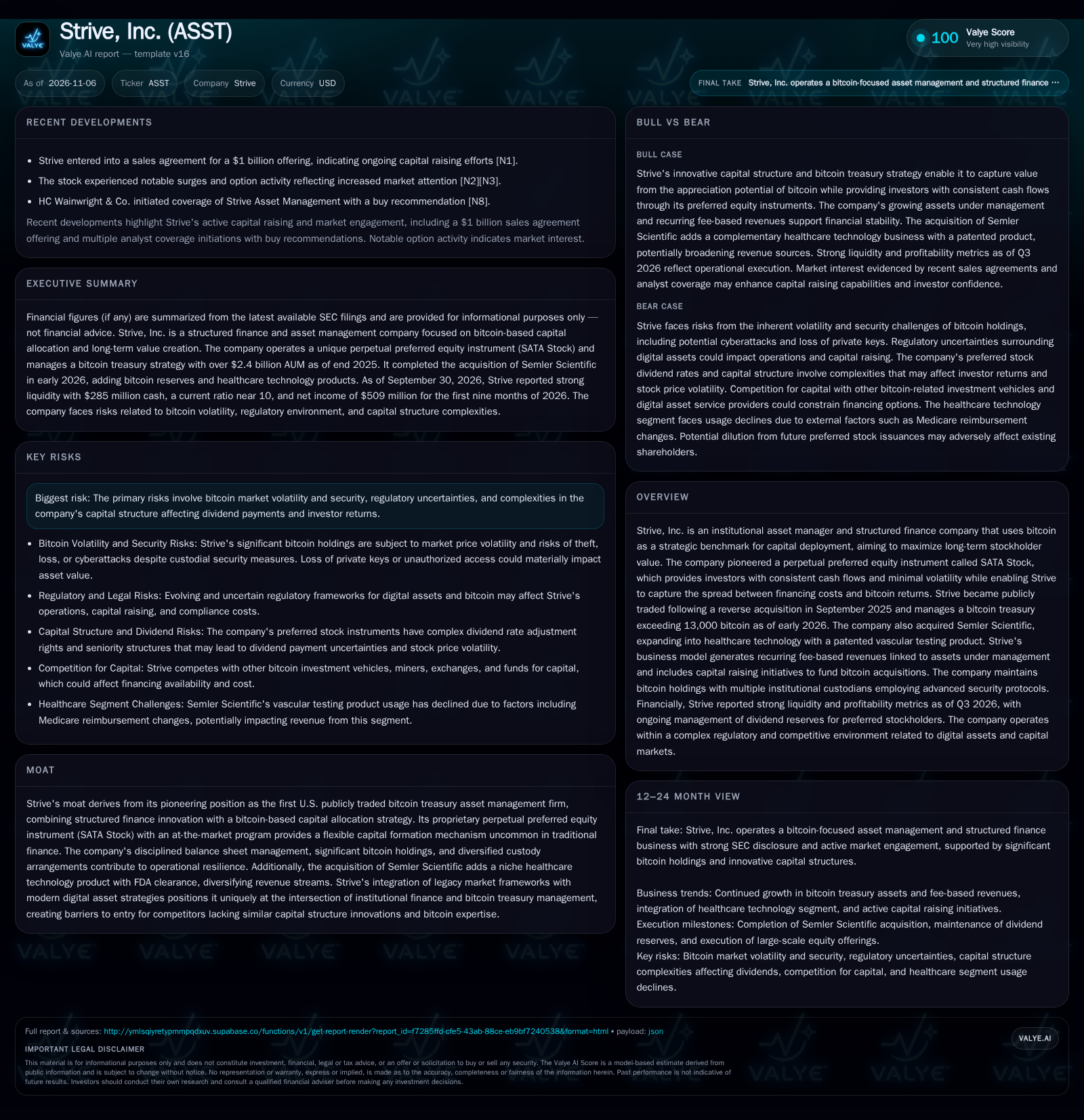
Strive, Inc. is redefining institutional asset management by using bitcoin as a capital allocation benchmark, operating a unique perpetual preferred equity model, and expanding into healthcare technology. The company’s approach to disciplined capital allocation, innovative financing, and diversified revenue streams positions it at an evolving intersection of digital assets and traditional finance. The thesis now hinges on Strive’s ability to scale AUM, manage bitcoin-linked risks, and navigate regulatory and capital structure complexities.
Strive, Inc. is the first U.S. publicly traded bitcoin treasury asset management firm, operating a perpetual preferred equity instrument and managing over $2.4 billion in AUM with a significant bitcoin reserve. The cited source reports dividend-related activity; that disclosure alone does not establish dividend-policy continuity, management confidence, or a material constraint on capital flexibility. [S1] [S2] [N1]
Strive, Inc. is attempting to break new ground as the first U.S. public company explicitly structured around bitcoin treasury asset management and innovative capital formation. By using bitcoin as both a balance sheet reserve and a performance benchmark, Strive seeks to align long-term capital allocation with digital asset appreciation. The company’s perpetual preferred equity model and recent $1 billion sales agreement illustrate a willingness to experiment with institutional finance structures. Yet, this ambition brings significant challenges: bitcoin volatility, regulatory ambiguity, and the need to prove value across both digital assets and its newly acquired healthcare business. The next phase will test whether Strive’s hybrid approach can deliver stable returns, attract capital, and withstand the inherent risks of its chosen markets.
Recent Moves Reshape Strive’s Strategic Footprint
Strive, Inc. now manages over $2.4 billion in assets and holds approximately 13,628 bitcoin, underscoring its commitment to a bitcoin-centric asset management model. The company’s acquisition of Semler Scientific in January 2026 added both bitcoin reserves and a healthcare technology segment, expanding beyond pure digital asset management. Financially, Strive reported $285.4 million in cash, a current ratio of 9.87, and net income of $509 million for the first nine months of 2026, suggesting robust operational performance through Q3. The $1 billion sales agreement signals active capital raising, while new analyst coverage and option activity reflect heightened market interest and liquidity around the shares. These developments matter because they establish Strive’s scale, diversification, and ambition, but also raise questions about risk management, capital allocation discipline, and the ability to integrate disparate business lines. [S1] [S2] [N1] [N8]
How Strive’s Model Could Capture Value: Spread, Leverage, and Recurring Revenue
Strive’s core economics revolve around the spread between its cost of capital (primarily from perpetual preferred equity) and the returns on its bitcoin holdings. By raising funds through SATA Stock and similar instruments, Strive aims to deliver steady preferred dividends while using the proceeds to acquire bitcoin—either on the open market (beta strategies) or at a discount through M&A (alpha strategies). Fee-based revenue, which increases with AUM, provides a recurring income stream and potential operating leverage as the asset base grows. The perpetual nature of SATA Stock gives Strive flexibility in capital deployment and dividend management, but also introduces complexity in dividend rate adjustments and seniority rights. The recently acquired Semler Scientific business adds a healthcare technology product (QuantaFlo) marketed under a license model; however, usage has declined due to Medicare rate changes, potentially limiting its contribution to overall margins. Capital needs remain significant, with ongoing capital raises (such as the $1 billion agreement) funding both bitcoin purchases and business expansion. If Strive can maintain a positive spread between its financing costs and bitcoin returns, operating leverage could be substantial—but this is highly sensitive to bitcoin price movements and financial market conditions. [S1] [S2] [N1]
Institutional Bitcoin Playbook Faces Both Entrenched Finance and Crypto Natives
Strive’s competitive position is anchored in its dual identity: a structured finance innovator and a bitcoin treasury specialist. The perpetual preferred equity model is uncommon among both traditional asset managers and crypto investment vehicles, potentially appealing to institutional investors seeking exposure to bitcoin-linked returns with reduced volatility. However, Strive faces competition from a spectrum of players: bitcoin ETFs, public miners, digital asset funds, and alternative asset managers are all vying for institutional capital. The company’s value proposition may hinge on its ability to deliver yield, transparency, and risk management superior to passive vehicles. Yet, regulatory uncertainty and the evolving landscape of digital asset custody and fund structures could erode any first-mover advantage. The healthcare segment, meanwhile, pits Semler’s vascular testing product against a crowded medtech field, where reimbursement changes and clinical adoption cycles can rapidly alter competitive dynamics. While Strive’s integration of digital asset strategies and traditional finance frameworks creates some barriers to entry, these advantages are not insurmountable if capital markets or regulatory rules shift unfavorably.
If Bitcoin Appreciation and Capital Discipline Align, Substantial Value Could Be Unlocked
The most favorable outcome for Strive would see bitcoin appreciating faster than the company’s cost of capital, enabling the preferred equity model to deliver both stable dividends and underlying capital gains. Successful execution of its capital formation strategy—raising funds at attractive terms and deploying them into bitcoin at opportune times—could result in outsized operating leverage and recurring fee income. If the Semler Scientific segment stabilizes or grows, it could provide a non-correlated revenue stream that supports cash flow and reduces reliance on bitcoin volatility. Confirmation of this scenario would include persistent AUM growth, consistent or rising preferred dividends, successful secondary offerings at minimal dilution, and clear evidence that the spread between financing costs and bitcoin returns remains positive. Falsification would occur if bitcoin underperforms, if preferred dividends come under pressure, or if the healthcare segment fails to stem revenue declines.
Strive’s Hybrid Model Likely Faces Cycles of Volatility and Capital Market Tests
The company may succeed in raising capital and acquiring bitcoin, but the spread between bitcoin returns and financing costs could narrow in adverse markets, compressing margins. The healthcare segment may provide modest diversification but is unlikely to offset core bitcoin-related risks or drive substantial growth without a turnaround in product usage. This scenario would be challenged if Strive is forced to adjust dividend rates downward, struggles to raise capital, or faces regulatory or market disruptions that impact its ability to operate or grow.
Adverse Bitcoin Moves and Capital Structure Complexity Could Trigger Investor Pain
In a negative scenario, sharp declines in bitcoin prices or a regulatory crackdown on digital asset management would erode Strive’s asset base and threaten its ability to deliver on preferred dividend commitments. If the spread between financing costs and bitcoin returns turns negative, the perpetual preferred model could become unsustainable, leading to dividend cuts or forced asset sales. Complexity in the capital structure—including the discretionary use of dividend reserves and possible future preferred issuances—could exacerbate dilution or spark investor uncertainty. The healthcare segment could compound downside risk if Medicare reimbursement cuts persist or clinical adoption wanes further. Confirmation of this scenario would be seen in declining AUM, dividend suspensions or reductions, distressed capital raises, or material deterioration in healthcare segment revenues. Falsification would require evidence of resilience through a major bitcoin downturn, stable or growing dividends, and successful navigation of capital market and regulatory headwinds.
Testing the Strive Thesis: What Could Validate or Challenge the Model Next
Quarterly AUM changes, particularly the pace and source of growth—organic inflows versus market appreciation—would help assess Strive’s ability to attract and deploy capital efficiently.
Preferred dividend payout levels and any adjustments to dividend rates or reserve usage would signal the health and sustainability of the perpetual equity model.
Disclosures on the spread between financing costs (e.g., SATA Stock dividend rates) and realized bitcoin returns would directly test the economic engine of the business.
Capital raising terms—size, pricing, and dilution impact of new offerings—will reveal whether investor demand remains strong and if Strive can fund expansion on attractive terms.
Updates on the Semler Scientific segment’s revenue and usage trends, especially in light of Medicare reimbursement changes, would clarify the diversification thesis.
Regulatory developments affecting digital asset management, preferred equity structures, or bitcoin custody rules could materially alter Strive’s operating environment.
Security incident disclosures—breaches, losses, or custody-related events—would be critical, given bitcoin’s unique vulnerability profile.
A useful metric would be retention and churn rates for institutional investors in Strive’s products, to gauge stickiness and sensitivity to market cycles, if disclosed.
Disclaimer: This is research-only, informational analysis and not investment advice. It may include AI-generated interpretation and general industry context. Always verify important details using primary sources.

Comments