
MSG Rangers Corp.: Post-Spin-Off Realities, Franchise Economics, and the Challenge of Standalone Sports Operations
MSG Rangers Corp. emerges from its 2026 spin-off as the owner of the iconic New York Rangers and related assets, but faces immediate tests of liquidity, profitability, and operational independence in the high-stakes world of professional sports.
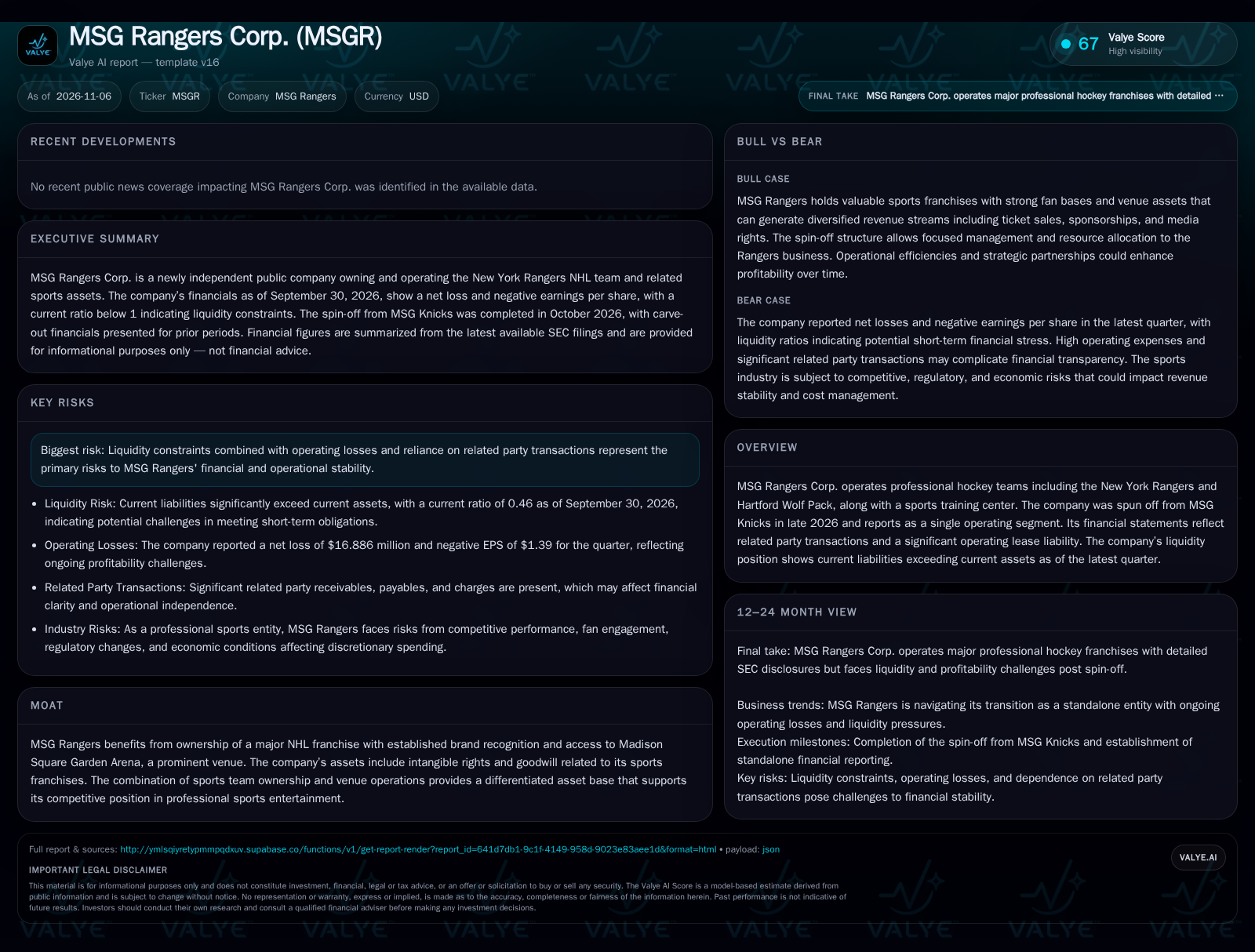
MSG Rangers Corp.—newly independent as of October 2026—operates the New York Rangers and Hartford Wolf Pack hockey franchises, reporting a net loss and a current ratio well below 1 in its first standalone quarter. The ability to convert brand strength and venue access into sustainable cash flow will determine whether MSG Rangers can thrive as a distinct public entity or struggle under the weight of its financial constraints. [S1]
MSG Rangers Corp., the newly independent owner of the New York Rangers NHL team and the Hartford Wolf Pack AHL team, faces an inflection point as it transitions from a division within a larger sports conglomerate to a standalone public company. The company’s first reported quarter after its October 2026 spin-off reveals a mix of classic sports franchise strengths—brand equity, loyal fan base, and prime venue access—alongside immediate financial headwinds. [S1]
Liquidity Crunch and Operating Losses Define MSG Rangers’ Standalone Debut
The company reported a current ratio of 0.46 for the period. Current liabilities ($255.8 million) more than double current assets ($118.3 million), underlining liquidity stress in the short term. The company’s financials are complicated by significant related party transactions and material operating lease liabilities, which may obscure the true picture of recurring expenses and cash needs. The October 2026 spin-off from MSG Knicks included a $19.1 million cash contribution, but this appears insufficient to offset the immediate imbalance between obligations and liquid resources. [S1]
How Franchise Ownership and Venue Access Could Drive—or Drain—Cash Flow
Professional sports teams like the New York Rangers typically monetize their assets through a combination of ticket sales, sponsorships, broadcasting/media rights, merchandise, and ancillary event revenue. The economics are characterized by high fixed costs (player salaries, venue operations, staff, and league fees) and substantial operating leverage—meaning incremental revenue growth can disproportionately improve margins, but downturns can quickly stress liquidity.
MSG Rangers’ reported quarter shows $14.1 million in revenue against $8.8 million in direct operating expenses and $28.1 million in SG&A, the latter including related party charges. This cost structure suggests significant overhead, likely reflecting both personnel costs and ongoing lease obligations tied to venue access. The company’s ability to improve operating leverage will depend on its capacity to grow top-line revenue through attendance, premium experiences, and media deals, while extracting efficiencies post-spin-off.
The presence of material operating lease liabilities hints at long-term commitments for training or arena facilities. Without explicit disclosure on revenue mix (season tickets vs. single-game, recurring sponsorships vs. one-off events), it is difficult to assess revenue visibility. However, most NHL franchises rely on a mix of recurring season ticket holders and multi-year sponsorships to anchor their economics, with variability in playoff years and event-driven spikes.
Brand Power, Venue Assets, and the Realities of Sports Industry Competition
MSG Rangers’ core asset is the New York Rangers franchise—an Original Six NHL team with deep-rooted brand equity and one of the league’s most loyal fan bases. This confers advantages in ticket pricing power, merchandise sales, and sponsorship appeal, especially in the New York market. The affiliated Hartford Wolf Pack AHL team and the Madison Square Garden Training Center add depth and development value, but are unlikely to materially shift the company’s overall economic profile.
However, pro sports is a highly competitive industry, with performance on the ice directly impacting fan engagement, attendance, and secondary revenues. Substitutes are not just other sports teams, but a wide range of entertainment options competing for discretionary spending. Media rights and sponsorships remain fiercely contested, and local market saturation can pressure growth. Venue access—while a differentiator—also brings fixed cost exposure and potential bargaining friction if lease terms are unfavorable.
The spin-off structure could enable more focused management and targeted partnerships, but also removes the financial buffer and cross-subsidization that a larger sports conglomerate can provide. The company’s reliance on related party transactions may create ongoing operational dependencies and complicate cost discipline.
Unlocking Franchise Value Through Revenue Diversification and Cost Discipline
A favorable scenario would see MSG Rangers leverage its brand strength and venue assets to expand high-margin revenue streams, such as premium ticketing, corporate partnerships, and direct-to-consumer digital content. If management can secure new sponsorship deals, optimize ticket pricing, and grow non-game event utilization of its facilities, operating leverage could turn incremental revenue into outsized EBITDA improvement.
Cost discipline—particularly in controlling SG&A overhead and renegotiating related party charges—would be essential.
Confirmation would come from sequential improvement in operating margins, stabilization or growth in cash balances, and clear disclosure of recurring revenue components (e.g., multi-year sponsorships, season ticket renewals). Conversely, if revenue growth remains flat and SG&A costs do not decline, the upside case would be challenged.
Stabilization Efforts Amid Financial Pressure and Limited Flexibility
The most plausible near-term outcome is that MSG Rangers works to stabilize its financial position by tightening cost controls and seeking incremental revenue growth from its existing fan base and sponsorship roster. Liquidity constraints and the need to service operating lease and related party obligations may limit investment in new initiatives or player acquisitions, potentially capping both upside and downside in the short run.
Under this scenario, the company’s financial performance would track closely with team performance, attendance trends, and the ability to renew or modestly expand sponsorship deals. Sequential reductions in net losses, even if not yet profitable, would indicate progress.
Evidence supporting this scenario would include flat to slightly improving revenue, steady or modestly reduced SG&A, and gradual improvement in liquidity ratios. If losses worsen or cash balances fall further, the base case would tilt negative.
Liquidity Strain, Performance Shocks, and the Risk of Forced Restructuring
A negative trajectory could unfold if MSG Rangers is unable to address its liquidity shortfall and operating losses persist or deepen. Should attendance or sponsorship revenue decline—potentially triggered by poor on-ice performance or broader economic weakness—the company may face acute cash shortfalls.
In this scenario, inability to renegotiate related party obligations or lease terms would exacerbate financial stress, potentially forcing asset sales, emergency financing at unfavorable terms, or restructuring efforts. The company’s relatively thin equity cushion and high liabilities leave little room for error.
Confirmation would come from further declines in cash balances, worsening current ratios, growing net losses, or public disclosure of covenant breaches, vendor tensions, or going-concern warnings. Conversely, any successful cost renegotiations or capital raises would mitigate the most severe downside.
Milestones That Will Shape MSG Rangers’ Standalone Future
Quarterly sequential changes in operating cash flow and net loss, which will reveal whether cost controls and revenue initiatives are gaining traction.
Disclosure and growth in recurring revenue streams—such as multi-year sponsorship agreements, season ticket retention rates, and media rights renewals (if disclosed)—to assess revenue stability.
Updates on related party receivables, payables, and charges, as reductions or renegotiations would signal improved operational independence.
Changes in cash and cash equivalents quarter-over-quarter, especially in relation to current liabilities, to monitor liquidity stress.
Attendance and fan engagement metrics—including average gate, premium ticket sales, and secondary market activity—would help test pricing power and brand strength (if disclosed).
Material changes in operating lease liabilities or renegotiation of facility terms, which could impact fixed cost exposure.
Announcements of new or expanded corporate partnerships and sponsorships, as these typically carry higher margins and multi-year commitments.
Any public disclosure of new financing arrangements, equity raises, or covenant issues that would affect short-term solvency or long-term capital structure.
Disclaimer: This is research-only, informational analysis and not investment advice. It may include AI-generated interpretation and general industry context. Always verify important details using primary sources.

Comments