
TDS: Fiber Ambitions and Spectrum Monetization Shape the Next Chapter for a Capital-Intensive Telecom
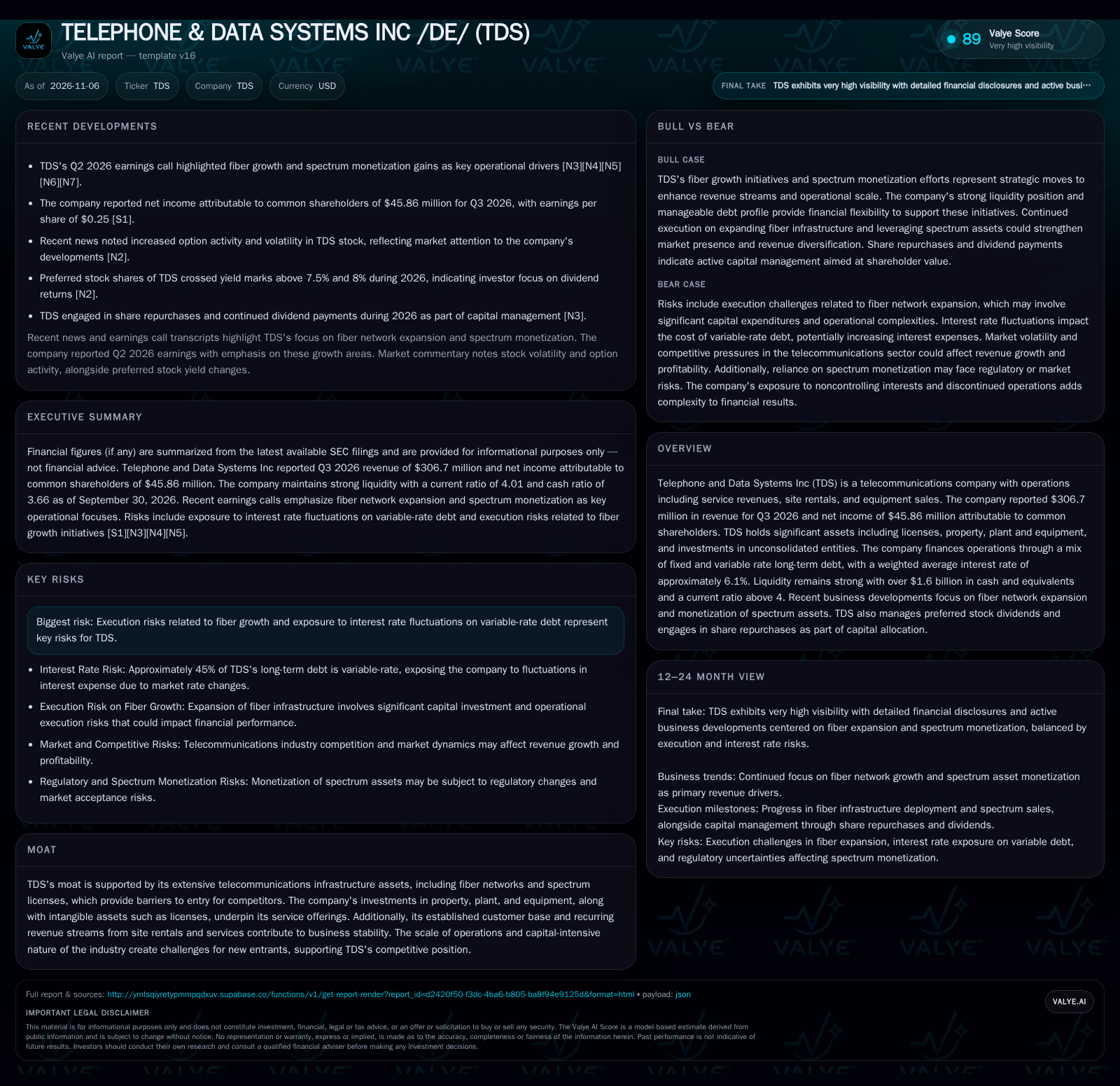
Telephone and Data Systems Inc. (TDS) reported solid Q3 2026 financials, with reported liquidity position and a focus on fiber network expansion and spectrum monetization. The company faces significant execution and interest rate risks as it seeks to navigate the capital demands and competitive realities of the U.S. telecommunications sector.
TDS’s Q3 2026 results show reported liquidity position and a positive net income, with management prioritizing fiber buildout and spectrum asset sales. While these strategies could enhance revenue diversity and market positioning, the company must manage substantial execution risks and interest rate exposure as it invests heavily in capital-intensive infrastructure.
Telephone and Data Systems Inc. (TDS) is at a pivotal juncture, leveraging its reported liquidity position and extensive infrastructure assets to pursue fiber network expansion and spectrum monetization. Q3 2026 results demonstrate positive earnings and a reported balance sheet position, but the company’s future hinges on successfully navigating the capital requirements and operational risks inherent in scaling fiber and extracting value from spectrum holdings. As the telecom landscape evolves, TDS’s ability to execute on its strategic priorities—while managing debt costs and market competition—will determine whether it can translate its asset base into durable, diversified cash flows.
Recent Results Highlight Financial Strength and Strategic Shifts
As of Q3 2026, TDS reported $306.7 million in revenue and net income of $45.86 million attributable to common shareholders, with basic and diluted EPS of $0.25 [S1]. The company’s balance sheet remains robust, showing $1.635 billion in cash and equivalents, a current ratio of 4.01, and a cash ratio of 3.66 [S1]. Operating revenues are diversified across services ($248.5 million), site rentals ($52.5 million), and equipment/product sales ($5.7 million) [S1]. Long-term debt stands at $669 million (net of issuance costs), about 45% of which is variable-rate, with a weighted average interest rate of 6.1% [S1].
Recent earnings calls and news coverage consistently emphasize fiber network expansion and spectrum monetization as key business activities [N3] [N4] [N5]. This signals a strategic pivot aimed at strengthening future revenue streams and leveraging TDS’s substantial infrastructure investment.
How Capital Allocation and Revenue Mix Shape TDS’s Earnings Power
TDS’s business model relies on a mix of recurring service revenues, site rental income, and comparatively minor equipment sales. The service and site rental streams are typically characterized by longer-term contracts and relatively stable cash flows, while equipment sales are more transactional and lower-margin. The capital structure is asset-heavy, with significant investments in spectrum licenses, property, and network infrastructure supporting both fiber and wireless operations.
The company reported cash and liquidity metrics for the period; these figures do not by themselves establish operating runway, investment capacity, financial flexibility, or financing capacity. While the potential for operating leverage exists if TDS can grow its customer base and utilization over largely fixed infrastructure, execution risk remains high: returns depend on the pace of deployment, subscriber uptake, and the ability to price services attractively relative to competitors.
However, these events are lumpy and subject to regulatory, market, and timing uncertainties. The company’s weighted average cost of debt (6.1%) and exposure to variable rates introduce sensitivity to interest expense, which could erode margins if rates rise.
Barriers, Substitutes, and the Challenge of Differentiation in U.S. Telecom
TDS’s competitive position is anchored by its ownership of valuable telecom infrastructure, including fiber networks and spectrum holdings. These assets create meaningful barriers to entry, as replicating them requires vast capital, regulatory approval, and time. Additionally, TDS’s established recurring revenue base from site rentals and services provides a degree of business stability.
However, the U.S. telecommunications market is highly competitive, with incumbent national players, regional providers, and emerging fixed wireless alternatives all vying for market share. Large-scale competitors often have greater scale, marketing muscle, and lower cost of capital, which can pressure margins and limit pricing power. As fiber becomes table stakes for many markets, service differentiation may rely on speed, reliability, and bundled offerings rather than on infrastructure alone.
Substitution risk is present from wireless broadband, cable, and satellite, depending on geography and customer segment. The question is whether TDS’s investments in fiber and spectrum can deliver superior customer value and sustainable returns, or if they merely preserve market share in the face of commoditization.
Fiber Expansion and Spectrum Sales Unlock Higher Growth and Margin Potential
In a favorable scenario, TDS executes efficiently on its fiber buildout, rapidly expanding its high-speed internet footprint and capturing a growing share of customers willing to pay a premium for reliable, high-capacity connectivity. Accelerated adoption could drive operating leverage as incremental subscribers utilize existing network capacity. Meanwhile, successful spectrum monetization—either through sales to other carriers or leasing arrangements—could generate significant, non-dilutive capital to fund further expansion or reduce debt.
Confirmation of this scenario would come from sustained growth in service and site rental revenues, rising ARPU (average revenue per user) if disclosed, and visible milestones in fiber deployment and customer acquisition. A material reduction in net debt or special dividends from spectrum sales would further validate the thesis. Evidence would also include improved margins as scale benefits kick in, and a stable or declining interest expense ratio despite ongoing investment.
Executing Amid Industry Pressures: Gradual Progress with Persistent Risks
The most plausible outlook is that TDS continues to make incremental progress on its fiber agenda, but faces ongoing challenges from capital intensity, execution risk, and stiff competition. Revenue growth may be muted as legacy service declines offset new fiber wins, and spectrum monetization provides only intermittent financial upside. Margins remain under pressure from rising costs (including interest expense on variable-rate debt) and competitive pricing dynamics.
This scenario would be confirmed by moderate, but not accelerating, growth in core revenues, steady but not dramatic increases in fiber penetration (if disclosed), and stable but unspectacular EPS. Debt levels may remain flat or rise slightly if capital spending outpaces cash generation. Investors would look for consistent, though not transformative, progress on disclosed fiber rollout targets and prudent capital allocation.
Capital Strain and Competitive Headwinds Undermine Returns
An adverse scenario could unfold if execution snags—such as construction delays, cost overruns, or slower-than-expected fiber adoption—result in underutilized assets and poor returns on capital. Simultaneously, if interest rates rise or credit markets tighten, TDS’s variable-rate debt could become more burdensome, compressing margins and limiting flexibility for further investment.
Competitive dynamics could intensify, with larger players or disruptive technologies eroding market share and forcing price concessions. Regulatory obstacles to spectrum monetization or changes in spectrum valuation could also derail expected capital inflows. Confirmation of this scenario would include rising net debt, declining or stagnating service revenues, margin erosion, or a need to curtail dividends and share repurchases to preserve liquidity.
Milestones That Will Determine Whether TDS’s Fiber and Spectrum Bets Pay Off
Progress on fiber network deployment—measured by new homes passed, market launches, or total fiber subscribers, if disclosed—would help test the scalability of the current growth strategy.
Trends in service and site rental revenues versus legacy revenue declines will reveal whether new investments are offsetting churn.
Actual proceeds and timing of spectrum monetization events, including whether sales or leases are realized at attractive valuations.
Changes in net debt levels, particularly in the context of ongoing capital expenditures and any step-up in interest expense.
Any shifts in ARPU or customer churn rates, if disclosed, which would indicate competitive dynamics and pricing power.
Market response to new product bundles or service enhancements, which could signal differentiation beyond basic connectivity.
Disclaimer: This is research-only, informational analysis and not investment advice. It may include AI-generated interpretation and general industry context. Always verify important details using primary sources.

Comments