
AirSculpt Technologies: Proprietary Body Contouring Model at a Strategic Crossroads
AirSculpt’s unique, private-pay model and rapid center ramp have historically supported attractive economics, but a 15.8% revenue decline and net loss in 2025 highlight core demand and profitability challenges.
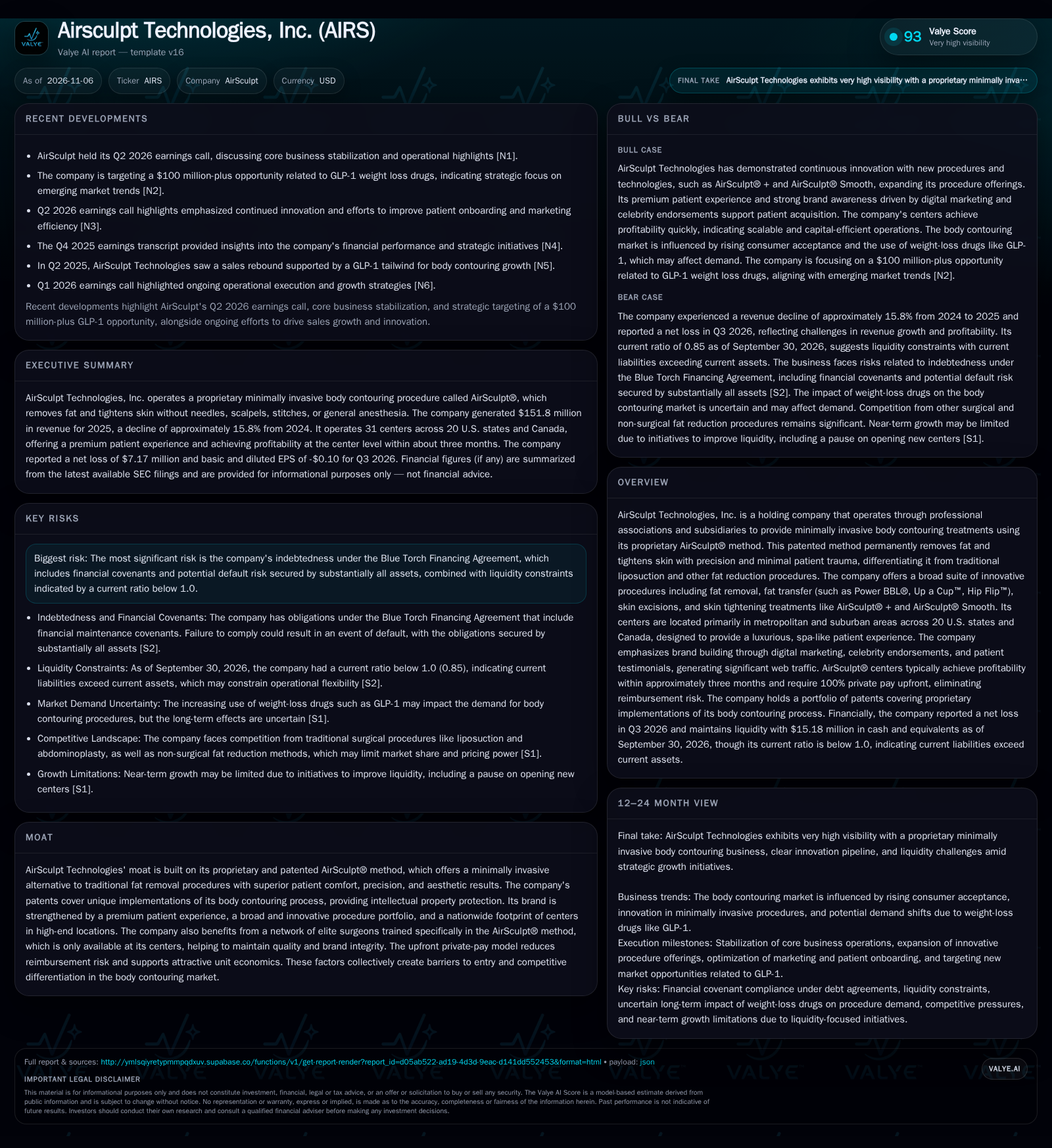
AirSculpt’s unique, private-pay model and rapid center ramp have historically supported attractive economics, but a 15.8% revenue decline and net loss in 2025 highlight core demand and profitability challenges. Financial covenants under the Blue Torch Financing Agreement, a current ratio below 1.0, and paused new center openings underscore the company’s need to stabilize its core business while exploring growth opportunities related to GLP-1 tailwinds in body contouring [S1] [S2] [N2].
With revenue down 15.8% in 2025 and a net loss in Q3 2026, the company faces heightened pressure to stabilize its core business and navigate a shifting competitive landscape—especially as GLP-1 weight-loss drugs reshape patient demand. The next phase will test whether AirSculpt’s proprietary method, premium positioning, and capital-light model can overcome financial constraints and tap into new market segments, or if operational and competitive pressures will limit its growth ambitions.
Recent Financial Performance and Strategic Pivots Define the Landscape
AirSculpt Technologies reported a 15.8% year-over-year revenue decline in 2025, with $151.8 million in sales and 11,852 procedures performed, following a period of prior growth [S1]. This reversal signals a meaningful shift in demand for elective body contouring services and raises questions about the sustainability of recent expansion. The company’s net loss of $7.17 million in Q3 2026, combined with a current ratio of 0.85 and cash of $15.18 million as of September 30, 2026, highlights rising liquidity pressure [S2]. Management has paused new center openings to focus on operational stabilization and liquidity improvement, while targeting a $100 million-plus opportunity linked to GLP-1 weight-loss drug users—reflecting both a tactical response to market headwinds and a bet on emerging demand channels [N2].
How AirSculpt’s Unit Economics and Capital Model Shape Its Resilience
AirSculpt’s business model is built around high-margin, minimally invasive procedures performed in company-operated centers, with 100% private-pay, upfront payment eliminating reimbursement risk and supporting working capital efficiency [S1]. Each center typically achieves profitability within three months, suggesting strong unit economics and a capital-light expansion framework. Fixed costs center on facility leases, core staff, and marketing, while variable costs scale with procedure volume, enabling operating leverage as utilization rises. However, with declining revenue and procedure counts, fixed costs may become less absorbable, pressuring margins. The company reported cash and liquidity metrics for the period; these figures do not by themselves establish operating runway, investment capacity, financial flexibility, or financing capacity. [S2] Center-level profitability does not guarantee consolidated profitability if systemwide demand softens or if expansion is constrained by balance sheet limitations.
The capital-light nature of AirSculpt’s expansion strategy is a double-edged sword. While rapid center ramp-up with breakeven in roughly three months suggests scalability, this model depends heavily on consistent demand and efficient patient acquisition. If demand softens, the fixed costs associated with leases and trained staff become more burdensome, reducing the margin buffer. Furthermore, the upfront payment model, while eliminating reimbursement delays and uncertainties, places pressure on marketing effectiveness and patient conversion rates to maintain cash flow.
Proprietary Process, Brand, and Patient Experience as Differentiators—But Barriers Remain Permeable
The company’s competitive edge rests on its patented AirSculpt® method, which claims to offer a less invasive, more comfortable alternative to traditional liposuction and other fat reduction procedures [S1]. Intellectual property, combined with a premium patient experience and high-end locations, supports brand differentiation and pricing power. The requirement for surgeons to be trained in the proprietary method further protects quality and consistency. However, the body contouring market is crowded: traditional surgery, non-surgical fat reduction, and emerging device-based modalities all compete for the same elective spend. While proprietary technology and a premium brand can create initial barriers, switching costs for consumers remain moderate, and innovations in alternative procedures could erode AirSculpt’s relative advantage. The company’s upfront private-pay model shields it from reimbursement risk, but also means it is exposed to discretionary consumer spending and economic cycles.
The proprietary AirSculpt® method offers differentiation, but competitive dynamics in elective body contouring are evolving rapidly. The market’s fragmentation—with surgical, minimally invasive, and device-based options—means that consumer preferences can shift with technological innovation, pricing changes, and evolving perceptions of safety and efficacy. AirSculpt’s premium positioning may limit its addressable market to higher-income segments, which could be more resilient but also smaller and more sensitive to economic cycles. Additionally, the moderate switching costs for patients imply that competitors with aggressive pricing or novel technologies could erode market share. Sustained investment in brand loyalty, patient education, and clinical outcomes data will be essential to maintain differentiation and justify premium pricing over time.
If GLP-1 Adoption Drives Incremental Demand and Marketing Efficiency Improves
The most favorable scenario is that the rising use of GLP-1 weight-loss drugs creates a new, substantial pool of patients seeking body contouring to address residual fat or skin laxity after significant weight loss. If AirSculpt effectively captures this segment—through tailored procedures, targeted marketing, and rapid onboarding—the company could reignite procedure growth and improve utilization across existing centers. Enhanced digital marketing, influencer partnerships, and patient testimonials could further reduce patient acquisition costs and increase conversion rates. Confirmation for this scenario would include a reversal of the revenue decline, accelerating procedure counts, and a measurable uptick in bookings attributable to GLP-1 users, as well as stabilized or expanding center margins. Falsification would come from stagnant or further declining procedure volumes despite GLP-1 market penetration, or from evidence that GLP-1 patients opt for non-surgical or less expensive alternatives.
Stabilization with Selective Growth: Consolidation Over Expansion
The most probable trajectory is that AirSculpt stabilizes its core business by focusing on operational efficiency, patient conversion, and incremental innovation rather than rapid expansion. This would mean holding the current center count steady, improving marketing ROI, and selectively introducing new procedures to broaden appeal. Financially, this scenario assumes flat or modestly declining revenues in the near term, with gradual improvement as cost controls and margin initiatives take hold. The company manages its debt covenants, avoids default, and either maintains or slightly improves its liquidity position without significant new capital raises. Evidence for this scenario would include stable quarterly procedure counts, a plateau in revenue declines, and narrowing quarterly net losses. Falsification would be a sharp further drop in revenues, covenant breaches, or the need for dilutive financings.
Demand Headwinds and Liquidity Constraints Trigger Further Retrenchment
In the adverse scenario, core demand for elective body contouring continues to weaken—due either to competition, macroeconomic softness, or a negative impact from GLP-1 drugs reducing the perceived need for procedures. Falling procedure volumes and revenues push center-level and consolidated margins negative, while fixed costs become increasingly burdensome. With a current ratio below 1.0 and outstanding debt subject to financial covenants, the company could breach covenants or face liquidity shortfalls, potentially triggering asset sales, center closures, or distressed financings. Confirmation would include further year-over-year revenue declines, negative operating cash flow, missed or renegotiated debt covenants, and announcements of retrenchment or restructuring. Falsification would require stabilization or improvement in procedure counts and evidence of covenant compliance without extraordinary measures.
Milestones That Will Reveal AirSculpt’s Ability to Adapt and Capture New Demand
Procedure volume trends by quarter—particularly the mix of patients citing GLP-1 use as their motivation—would help test the thesis that new demand sources can offset legacy decline.
Revenue per center and center-level profitability, if disclosed, would reveal whether unit economics remain robust as the business matures and as marketing dynamics shift.
Patient acquisition cost and digital marketing ROI would clarify whether AirSculpt’s brand and digital investments are translating into more efficient patient conversion.
Compliance with financial covenants under the Blue Torch Financing Agreement is critical to avoiding liquidity crises or forced restructuring.
Cash flow from operations and changes in cash and equivalents will indicate whether the company can self-fund stabilization or requires external capital.
Any change in the number of operational centers or announced expansion/closure plans would signal management’s confidence in demand and liquidity.
Updates on new procedure launches or enhancements tailored to the GLP-1 segment would indicate strategic agility and innovation responsiveness.
Disclaimer: This is research-only, informational analysis and not investment advice. It may include AI-generated interpretation and general industry context. Always verify important details using primary sources.

Comments