
Bowman Consulting: Engineering Scale, Technological Investment, and Merger Uncertainty Shape the Next Chapter
Success hinges on extracting value from acquisitions, realizing operational gains from technology, and managing the financial and strategic complexities of the transaction.
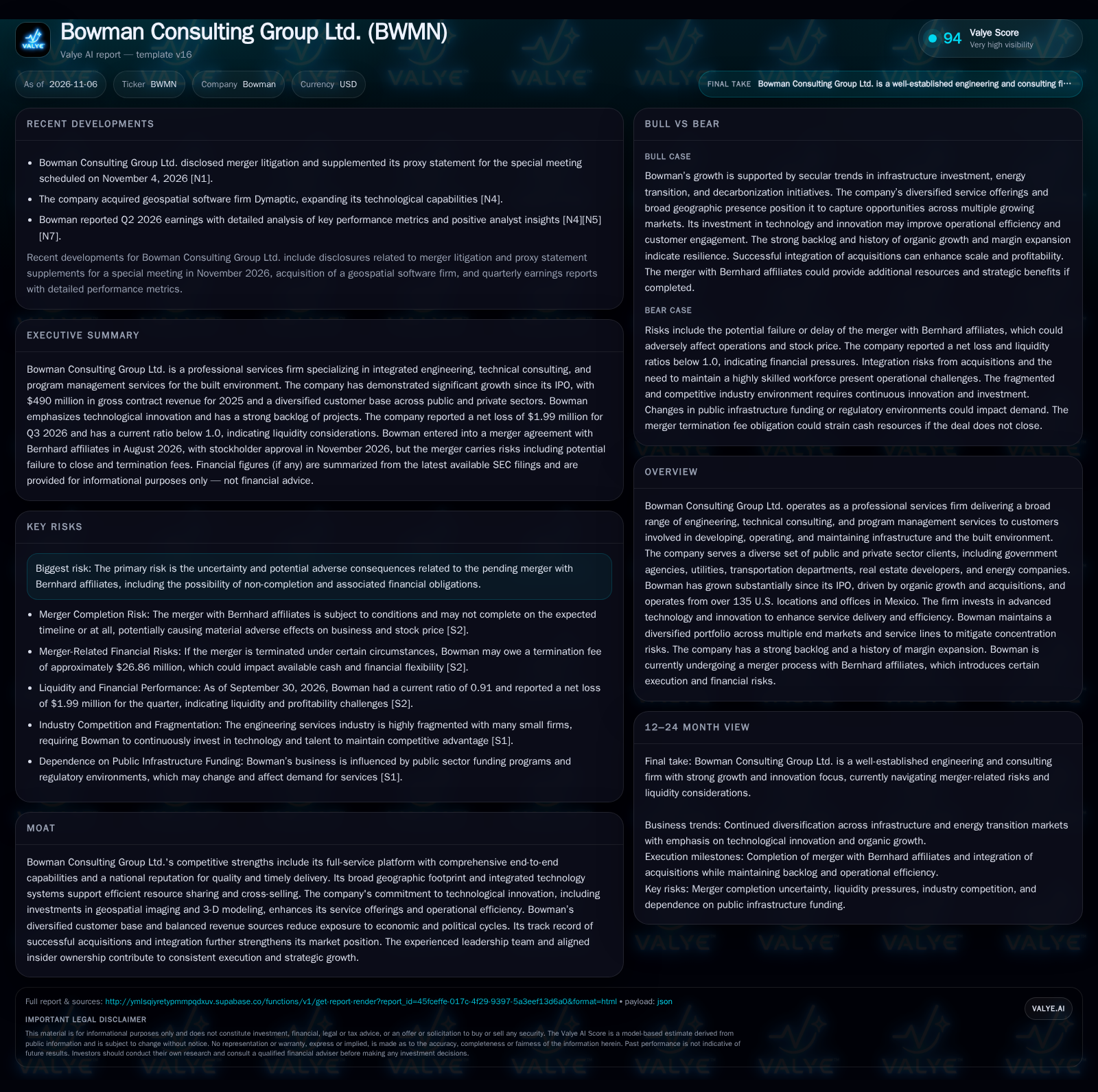
Bowman Consulting has quadrupled revenue since its IPO and built a diversified national platform, with approximately 10,000 projects in backlog and a strong public-private client mix. The company’s future will be shaped by its ability to integrate acquisitions, leverage technological investments for efficiency, and navigate both industry competition and the complex merger process. [S1] [S2]
Bowman Consulting Group’s evolution from a regional engineering firm to a national platform has been marked by aggressive acquisition, technological investment, and expansion into high-growth infrastructure and energy markets. The outcome of this deal—and the ability to translate scale and innovation into sustainable margin expansion—will determine whether Bowman remains a consolidator and innovator or confronts the operational and financial drag of rapid expansion.
Merging Scale with Financial Strain: Recent Developments at Bowman
Bowman Consulting reported $148.7 million in gross contract revenue for Q3 2026, up 18% year-over-year, but posted a net loss of $2.0 million for the quarter. The firm’s liquidity snapshot as of September 30, 2026, showed cash and equivalents of $5.25 million, current assets of $251.76 million, current liabilities of $277.11 million, and a current ratio of 0.91—below the commonly cited 1.0 threshold for short-term coverage. [S2]
The company’s merger with Bernhard affiliates was approved by shareholders on November 4, 2026, but closing remains subject to customary conditions. If the merger is terminated under certain circumstances, Bowman faces a termination fee of approximately $26.86 million, which would significantly impact its already reported cash balance. [S2]
Bowman’s backlog remains strong at approximately $479 million as of year-end 2025, and over 73% of 2025 revenue came from repeat customers. The company continues to emphasize technology investment, including a $25 million internal innovation fund targeting automation and AI-driven productivity improvements. [S1]
How Bowman’s Business Model Converts Scale and Innovation into Returns
Bowman’s core economics are anchored in professional services—engineering, consulting, and program management—where revenue is typically tied to billable hours, project milestones, or fixed-fee contracts. While gross contract revenue has grown rapidly, the business remains people-intensive, with approximately 88% of revenue derived from its workforce. This suggests that Bowman’s cost structure is dominated by labor, with limited fixed-cost leverage outside of its technology investments and regional office infrastructure. [S1] [S2]
Operating leverage in this model is achievable primarily through productivity gains—either by deploying technology to reduce time per deliverable, or by integrating acquisitions to optimize overhead and cross-sell services. The $25 million innovation fund aims to drive such gains via AI-enabled automation, but the realized impact on margins and project delivery remains to be seen. If successful, automation could enable higher throughput per employee and compress project cycles, improving gross margin and freeing up capacity.
Bowman’s aggressive acquisition strategy (41 deals in five years) suggests a capital requirement both for dealmaking and for integration. Acquisitions can boost scale and fill geographic or technical gaps, but they also introduce integration costs and risks. The company reported cash and liquidity metrics for the period; these figures do not by themselves establish operating runway, investment capacity, financial flexibility, or financing capacity. [S2]
Pricing power in this sector is typically constrained by competitive bidding, especially for public sector contracts. However, differentiated capabilities (e.g., advanced geospatial imaging, 3-D modeling, or rapid regulatory response via AI) could command premium rates or enable Bowman to win higher-value, complex projects.
Bowman’s Place in a Fragmented Engineering Landscape
The U.S. engineering services market is large but highly fragmented, with thousands of small and mid-sized firms. Barriers to entry include technical expertise, regulatory compliance, bonding capacity, and the ability to manage risk across diverse project types. Bowman’s national footprint, broad service portfolio, and track record of integrating acquisitions position it as a consolidator with potential scale advantages. [S1]
Diversification across end markets—public infrastructure, energy, utilities, data centers, and real estate—reduces reliance on any single sector and may buffer against cyclical downturns. Bowman’s 73% repeat-customer rate suggests strong client relationships, a key intangible asset in services. However, the flip side of fragmentation is price competition, with margins under pressure unless the firm can consistently differentiate via technical expertise or proprietary technology.
Adoption of advanced technology (geospatial mapping, AI-driven modeling) could create switching frictions for customers if these tools are integrated into project workflows and data environments. Yet, in a services-heavy business, true lock-in is often limited unless tied to proprietary data or long-term program management arrangements.
Bowman’s competition includes regional engineering firms, national consultancies, and specialist technical boutiques. Larger, diversified peers may have more balance-sheet flexibility, while smaller firms may compete aggressively on price or niche expertise.
Unlocking Value: If Integration, Innovation, and the Merger All Deliver
The most favorable outcome for Bowman involves a successful closing of the Bernhard merger, rapid integration of recent acquisitions, and measurable productivity gains from technology investments. If the combined entity can leverage its expanded scale to win larger, multi-year infrastructure and energy transition contracts, the business could see accelerated revenue growth and margin expansion.
Evidence supporting this scenario would include sustained double-digit organic revenue growth, expanding Adjusted EBITDA margins (driven by automation and workflow efficiencies), and a reduction in net working capital days as integration streamlines processes. Confirmation would also come from new contract wins in high-growth sectors (e.g., renewables, power grid modernization) that leverage Bowman’s advanced technical capabilities.
If the merger provides access to additional capital or strategic resources, Bowman could further accelerate its acquisition program or invest in higher-value service lines, deepening its competitive moat.
Stability Amid Uncertainty: Navigating Margin Pressures and Integration Demands
The most plausible near-term scenario is that Bowman continues to grow revenue in line with the mid-single-digit industry average, supported by a robust backlog and diversified client base, but faces ongoing margin and liquidity pressures. Integration of recent acquisitions and realization of technology-driven efficiencies may proceed incrementally rather than in rapid leaps.
If the merger with Bernhard affiliates closes as planned, Bowman gains stability and potential access to additional capital, but also faces the complexities of merging cultures, systems, and client relationships. Margins may remain under pressure as the company absorbs integration costs and works through post-merger restructuring. Should the deal not close, the termination fee could further strain liquidity, forcing near-term cost discipline and possibly limiting further acquisitive growth.
Confirmation of this scenario would come from continued project backlog growth, moderate improvement in operating margins, and stable or narrowing net losses. Falsification would be signaled by a sharp deterioration in cash flow, material client or staff attrition, or significant project delays.
When Growth Outpaces Discipline: Risks of Merger Failure and Financial Stress
In this scenario, liquidity stress could force the company to curtail growth initiatives, delay integration of acquisitions, or seek expensive external financing.
Other downside risks include failure to achieve expected productivity gains from technology investments, resulting in persistent margin compression, or missteps in acquisition integration that lead to client or key staff losses. A downturn in public infrastructure funding, or increased competition leading to price undercutting, could further erode project pipelines and profitability.
Early warning signs would include rising days sales outstanding, declines in backlog or repeat business rates, unplanned asset sales, or executive turnover.
What Will Determine Bowman’s Post-Merger Trajectory?
Completion status and terms of the Bernhard merger, including any delays, amendments, or termination-triggered cash outflows.
Quarterly changes in net working capital and cash conversion cycle; a useful metric would be the trend in days sales outstanding and days payable outstanding if disclosed.
Adjusted EBITDA margin progression, especially as technology investments and acquisition integrations mature.
Backlog growth and composition by end market; a shift toward higher-margin or longer-tenure contracts would help test the margin thesis.
Revenue contribution and profitability from recently acquired entities; integration success would show up in cross-selling rates and margin uplift.
Retention rates for key technical staff and leadership, especially post-merger, to gauge cultural integration and continuity.
Win rates for new contracts in targeted high-growth sectors such as energy transition, renewables, and public infrastructure upgrades.
Evidence of measurable productivity gains from AI and automation investments—such as reduced project cycle times or higher gross margin per employee.
Disclaimer: This is research-only, informational analysis and not investment advice. It may include AI-generated interpretation and general industry context. Always verify important details using primary sources.

Comments